
On January 12, 1971, a few weeks shy of my 18th birthday, I started my first day of work in the Texas Capitol where the 62nd session was gaveled to order. The hubbub of the lawmaking process and the proximity to power was heady stuff, and I was thrilled to be working for a state representative, chairman of the Revenue and Tax Committee (now Ways and Means), a man on the Speaker’s team. As my first workday began, I little realized that I’d be a witness to an explosive moment in Texas history. Nor did I realize how that moment would affect my own family.
Six days later, the bombshell hit. Texas Democrats were readying to celebrate their 1970 election victories and inaugurate their top officials in a big Austin gathering when attorneys for the Securities and Exchange Commission (SEC) fired the starting gun on the scandal that would be called “Sharpstown.” That very afternoon they announced the filing of a lawsuit in Dallas federal court alleging stock fraud against former Democratic state attorney general Waggoner Carr, and former state insurance commissioner John Osorio. They were partners in a law firm that included my father, Eugene “Gene” Palmer. Houston business man Frank Sharp was another defendant, along with about thirty others. Supporting documents to the SEC filing named Governor Preston Smith, House Speaker Gus Mutscher, other state representatives, and the chairman of the State Democratic Executive Committee in an insider trading scheme.
The trades at issue were made in National Bankers Life Insurance Company stock through Dallas broker Ling & Company. I was probably one of the few people at the time who had heard of the insurance company — my dad’s partner, Osorio, was President of the company, which had been bought by Frank Sharp from former governor Alan Shivers.
Sharp’s Sharpstown Bank had provided no-interest loans to the various politicians so they could buy stock in National Bankers Life, and when the price of the stock invariably rose, they paid off the bank and pocketed the profits. But instead of these dealings being the actions of a man ingratiating himself with a few lawmakers, the Governor, and others, the SEC wanted Sharp to say they were more than that. Therefore, he crafted the story that the stock trades were part of an attempt to bribe Texas Democratic officeholders for some legislation he supposedly wanted — this story landed him a favorable plea agreement. This testimony presented the Travis County district attorney with an official corruption and bribery case to pursue against those Texas officeholders.
Accordingly, my first session was consumed with conflict as Speaker Mutscher — fending off legal action and a hungry press — would find his speakership assailed by a group of progressive Democrats, who would come to be known as “the Dirty Thirty.” Mutscher, his team or “Mutscher Men,” and the majority of the Legislature, in contrast, were conservative Democrats. For some time, the Dirty Thirty members had sought to move the Democratic party in a more liberal direction and change the “good ole boy” system of lawmaking. Dethroning Mutscher would give them the opportunity, at last, to pass bills on government reforms relating to the legislative process, governmental records, and financial disclosure for lobbyists, among other “government-in-the-sunshine” laws — if not this session, surely during the next. The soundtrack of the session, therefore, was a constant drumbeat of disruption and distraction as Mutscher and his team tried to maintain business as usual, and ignore the brewing legal actions and demands of the Dirty Thirty. My boss was a Mutscher Man, and I reflexively sided with the Speaker — the dark side, I came to understand.
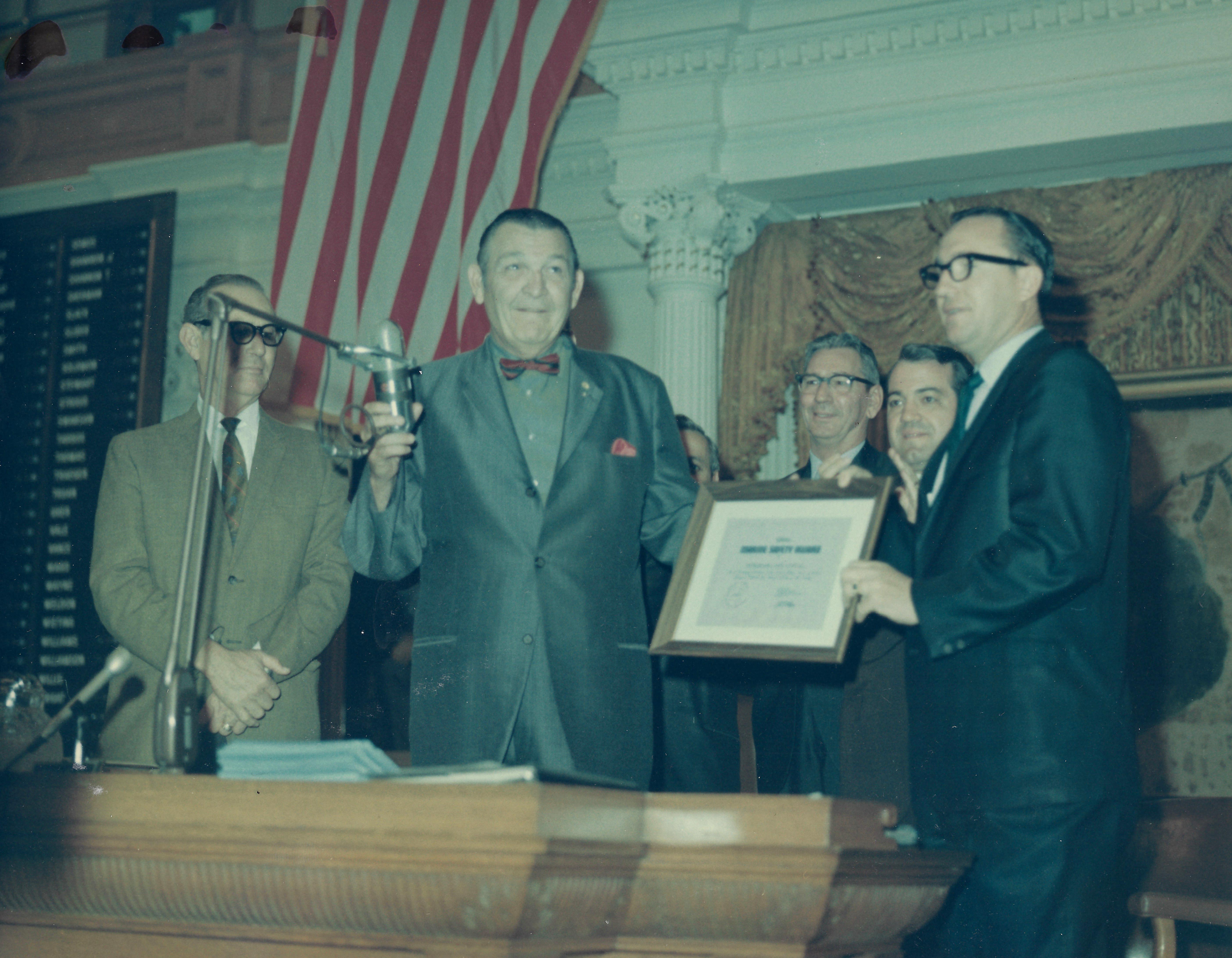
The Travis County DA brought a case against Mutscher and two of his lieutenants based on Sharp’s testimony that the stock trades were a bribe to obtain passage of two bills during a special session of the previous legislature. The stock trades, or so-called bribes, also happened around this time. The bills passed both houses of the Legislature, but paradoxically, the Governor, one of the inside traders, seemed unaware of his bribe. Despite including the bills in the call of the special session, he vetoed them after they passed, although they were largely unchanged from the bills as introduced.
I learned of these bills a few weeks before my dad’s face appeared on the front page of the Dallas Morning News. My father had drafted them as requested by Osorio who was acting as an advisor to Sharp and president of National Bankers Life. Thus, he was deposed by the SEC in regard to facts associated with the activities of Osorio, Carr, and other defendants in its case.

As my father testified, the two bills as Sharp originally understood them and that my father drafted were designed to help all small state banks, including, but not limited to the Sharpstown Bank. At the time, the Federal Deposit Insurance Corporation (FDIC) only insured deposits up to $15,000 — therefore, small state-chartered banks in Texas had a hard time competing with the large national banks that provided the additional security of a large operation. Thus, one of the bills created a State Deposit Insurance Corporation patterned after the FDIC, providing deposit insurance to state bank depositors beyond the FDIC limit of $15,000. The second bill, HB 73, set out the parameters of insuring deposits from $15,000 to $100,000. In essence, the state deposit insurance would be an “excess” policy, insuring amounts up to $100,000 only after the FDIC had paid that first $15,000 to a depositor, thereby leveling the playing field between national and state banks.
Two years after their passage, Sharp falsely claimed that the bills were part of his bribery scheme to supplant the FDIC and its oversight over his banking practices. But while these bills never proposed to supplant the FDIC, Sharp was notorious for his conflicts with banking regulators — so even while the plain language of the bills did not support his story, it had an air of believability about it. With the addition of the insider stock trades and bank loans, enough impropriety was alleged so that the Travis County DA would indict Speaker Mutscher, Rep. Tommy Shannon, the House sponsor of the legislation, and Rush McGinty, an aide to the Speaker. The Governor’s veto presumably spared him from indictment in the case.
While never charged with anything, my dad would long be suspected of some wrongdoing himself by many in the legal/political community who didn’t understand his role as the drafter of perfectly legitimate legislation or even Sharpstown, itself. He was guilty of something by association. Years later, he told me that colleagues and friends would cross the street downtown to avoid having to talk to him.

The 62nd Regular Session would close with Mutscher’s resignation and the choosing of an interim Speaker. The 63rd Legislature would see the election of a new Speaker, the removal of long-time legislators and former Mutscher Men from their chairmanships, and the passage of new ethics, financial disclosure, and open-records laws. They would also update and strengthen open-meetings, and lobbying laws
The court case and legal wrangling of the SEC, through its Department of Justice attorneys, and the multiplicity of defendants in the Dallas case would go on for a while. The intricacies of securities law and actions of stock brokers, banks, and insurance companies were not that interesting or even comprehensible to most people. It might have been a more compelling, if more people had understood the active role the Nixon Administration played in Sharpstown.
Once a tip was received about unusual trades being handled by Ling & Company, and the SEC audit of the company’s books revealed transactions by top Texas Democrats, the Republican Administration had its long-awaited opportunity to undermine the Democratic establishment in Texas. Disappointingly for the Republicans, the name of Lieutenant Governor Ben Barnes was not among the stock traders. As a popular Democrat with presidential potential, he was the only Texas elected official on Nixon’s infamous “enemies list.”
Barnes was an up-and-coming political star, known as a protégé of former Governor John Connally and blessed by former President Lyndon Johnson. From DeLeon, Texas, he had been the youngest Speaker of the House, and in short order, the youngest Lieutenant Governor. He was active in national Democratic politics and heavy odds predicted the career of this talented and charismatic politician would continue its upward trajectory.
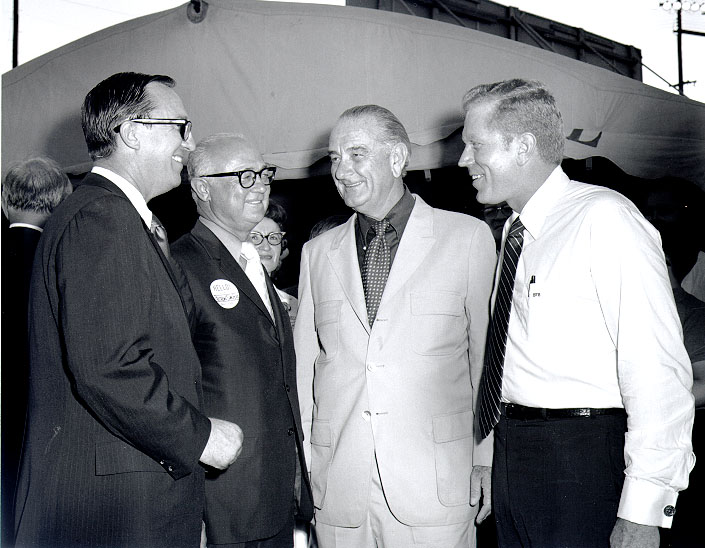
It would have been a real coup for the SEC and John Mitchell’s Department of Justice to find wrongdoing to weigh down Barnes. In fact, finding something on him was likely at the root of the SEC investigation of Ling & Company stock trades in the first place. As Barnes reports in his book, Barn Burning Barn Building, he would eventually learn that the Nixon Administration spent over 5 million dollars trying to dig up dirt on him, and in later years he received personal apologies from former attorney general John Mitchell and Nixon chief of staff, Bob Haldeman, for their roles in the attempt to bring him down.
In fact, the desire to implicate Barnes may also explain why Sharp crafted his story about bribing officials to pass the banking bills. Like its presiding officer, no senator had been the recipient of Sharp’s loans and stock trades. I’m no bribery expert, but I do know that you could bribe all 150 House members, and that wouldn’t be enough to get a bill to the governor’s desk. You need some senators in the bag, and especially, the lieutenant governor to get it on the calendar for passage.
So, as part of his agreement with the SEC, either explicitly or implicitly, Sharp’s testimony was molded to not only change the purpose of the bills, but to also accuse Barnes of accepting a bribe. Specifically, Sharp would say that Barnes was too smart to leave a trail of stock trades and would only accept cash — cash that was given to Barnes directly by Osorio. Osorio, however, would always deny that he had given any money to the Lieutenant Governor.
In fact, before Osorio was convicted of misapplication of pension funds in the Dallas case, the Justice Department offered to drop all charges if he would implicate Barnes for taking a bribe. After receiving the offer, Osorio discussed it with his friend and mentor, former governor Alan Shivers. Could he lie and ruin an innocent man to avoid his own imprisonment? They both agreed that he could not. Osorio was, therefore, convicted and imprisoned.
But Barnes could not escape becoming a casualty of the Sharpstown steamroller that the Nixon Administration set in motion. In 1972, Barnes would run for governor in the Democratic primary against Dolph Briscoe, an uncharismatic Uvalde rancher, and Frances “Sissy” Farenthold, one of the progressive “Dirty Thirty” House Democrats. During the primary, Barnes endured all kinds of smears amid the Sharpstown fervor, although he was never charged with any crime or wrongdoing. Again, guilt by association. Once considered invincible, Barnes could no longer summon the voters. He didn’t even make the runoff, and Briscoe, the uncharismatic rancher, beat Farenthold (tagged with the “liberal” label) and won the governor’s race. Unfortunately, he was not a party builder, and the governor who succeeded him would be a Republican.
There was a lot I didn’t perceive or appreciate as I began my work at the Capitol that January, 1971. That year there were only ten Republicans in the House and two in the Senate, and I would have bet money that Republicans would never gain a foothold in the state. (By 1981, there would be 35 House Republicans and seven Republican Senators.)
Our former Democratic governor, John Connally had become a Republican, largely it seemed, so he could work in the Nixon administration. In 1971, it was doubtful whether others would follow his footsteps, especially in the near future. If predictions had held and Barnes had ascended to the Governor’s office, surely he would have rebuilt and shored up the Democratic Party as he sought to climb the ladder of national prominence.
But the Sharpstown scandal rocked the Texas political world and ousted much of the Democratic establishment. A little more than seven years after that January, 1971, Democrat John Hill lost the governor’s race to Republican Bill Clements. I was at the Capitol the day after the election and vividly remember the sense of shocked silence that engulfed the entire building. Unbelievably, we had gone through a portal — the goal of the Nixon Administration had been consummated and Texas had elected its first Republican governor since Reconstruction.


 Now and Thenadays
jeffee–my dear friend
when i quit it all (in 2016, after fifty years) , I did put it all down in a book–it took me 3years to write but back in 1972 ,I made myself a promise to someday try to leave a record—you may not have known this, but as Ben’s chief of staff I was also a target of the FBI and Criminal IRS investigations—-I couldn’t find any interest from a publisher-covid hit–and I had horribly unsuccesful back surgery. So I am now homebound and my grandbabies will have the story for my family anyway. If you want to read the book I can send it by email–mine is robert@robertdspellings.com—-I might add that in 3 years of research, I have never found an accurate reporting of the whole story. In Texas history books (in both public and private schools) the few accounts that I did find told some fantasy story about Mutcher and friends going to jail–which is totally false. Osorio is the only person in the story that went to jail. But your account is right (as far as it goes) and there is just no telling what Ben’s political story might have been if he hadn’t popped up on Nixon’s radar
LikeLike
My dear Robert, I am so sorry to hear about your back surgery. I imagined you still sitting up in the Men’s Card Room at the Austin Club shuffling and dealing. I would love to read your book. You are right about finding an accurate report of the whole story, I believe. Nowhere I’ve looked has had one. I’ve decided to write pieces of the story and publish them in my blog, since I, too, have never found an agent or anyone interested in publishing on this subject. I didn’t know you were also a target. They were seriously attempting to get Barnes! I’ll email you.
LikeLike
This was so interesting
I remember parts but certainly I was not aware of the machinations
You were so close to memorable Texas history
LikeLike
Thanks for your read and comments, Carolyn. Yes, I was very close, albeit very young and not very astute politically. It’s been an experience I put together over time. I plan to write more about it in installments, since there are other interesting facets of the scandal. Hope to see you soon!
LikeLike
Superlative, Jeffee. Kudos. I am very happy that you wrote this.
Love ya. C
LikeLike
Thank you so much, Christine! It’s a complicated story to tell and there’s more to come. I’m so glad you liked it.
LikeLike
Jeffee, I remember those days pretty well, and I was one of those liberals who was glad to see Mutscher and the Mutschermen driven out. But, I never understood the whole thing until I read this piece. You laid to rest a few myths and illuminated some dark corners in this saga. Great writing, too!
LikeLike
Thanks for your comments! And thank you for affirming my belief — that even those of us who lived through that time never understood it very well. I didn’t have the easy narrative of Watergate or a good sex scandal.
LikeLike
You were very close to it. That probably sharpened your curiosity!
LikeLike
So true. I also spent a lot of time with my dad with a tape recorder trying to get as much of the story as possible. Thank you, Robin, for your editorial input and helping me sort through the facts to find the best way to present all this information. Your distance from them helped very much.
LikeLike
Wow, this takes me back! In 1971, I’d heard about the Sharpstown scandal, but didn’t understand the intricacies underlying it. (Thank you for explaining that, Jeffee.) That year, I was a junior at Austin College, where I did a photo essay of Sissy Farenthold’s campaign stops in Sherman. She seemed like (and I guess she was) such an anomaly – a woman, a lawyer(!), and a liberal Democrat – running for governor! And she was my inspiration to go to law school, in 1976.
LikeLike
You aren’t alone, Polly. Few people understood Sharpstown then, and fewer still today. I think Sissy could have won — even with liberal credentials — if she weren’t a woman. Ann Richards was able to win in this misogynous state, I think, because she knew how to swagger.
LikeLike
Great piece, Jeffee. So, is this the start of the Sharpstown Scandal book, or is this all we get?
LikeLike
Thanks so much, my friend. There will be other installments. Instead of toying with putting together a whole book, as I’ve been doing for years, I was encouraged by several people to just start putting it out in pieces, and eventually maybe, compile and publish them. There are just so many facets and people involved and I’d like to explore those. This installment is the general outline.
LikeLike