A Crying Shame — Sharpstown II

Few scandals in Texas history have caused as much political damage to so many as the one we call Sharpstown.  Although it ignited fifty-three years ago, in January 1971, Sharpstown has had a lasting impact on this state.  It ruined the careers of many individual politicians along with those non-politicians, like my dad, a lawyer who merely drafted some legislation.  Most importantly, it weakened and, ultimately, shattered the Democratic party in Texas.  Such was the intent of Republicans in the Nixon administration.  

The seeds of the scandal were planted when the U.S. Securities and Exchange Commission (SEC) received a tip that there were some stock trades involving the Governor of Texas, the Speaker of the House, and other officials at a brokerage firm in Dallas, Ling & Co.  These were stocks in a company called National Banker’s Life Insurance (NBLI), which was owned by Houston banker Frank Sharp.  Trading records showed that these purchased stocks were soon repurchased by the company at a higher price, producing profits for these politicians and associated individuals.  It was soon discovered that Sharp had also lent money from his bank to these investors specifically for the purpose of making these stock purchases and manipulating the stock’s price.  Some say that this was typical Frank Sharp, playing fast and loose with his bank’s money and currying favor with people he figured he could use to his advantage one day.

Even before Sharpstown, the Nixon administration had a couple of goals in Texas.  As part of his Southern strategy, Nixon wanted to break the Democratic party’s political stranglehold in the state. Equally important, he wanted to kneecap any further rise to power by then Lieutenant Governor Ben Barnes, whose political aspirations had been blessed by LBJ and who was becoming known in Democratic political circles nationwide. (Note 1)  Having been the youngest Speaker of the House and Lieutenant Governor in Texas, he was well on his way to fulfilling the promise that the former president had recognized in him.  Republican officials sought to keep that from happening.  As mentioned in my last Sharpstown post, Nixon Attorney General John Mitchell and Chief of Staff H. R. “Bob” Haldeman would later apologize personally to Barnes for their roles in ending his political career.

So, with the SEC investigating the NBLI stock trades, Frank Sharp turned from being the owner of a bank, an insurance company, and various real estate developments, to a man facing numerous indictments for fraud and securities violations and possible prison time.   He became putty in the hands of the Department of Justice, doing and saying whatever he could to stay out of jail, truth be damned.   He entered into a plea agreement and fed the Feds lies.  There were three main ones.

First, Sharp claimed that the purpose of the 1969 bank deposit legislation he championed and that was passed by the Legislature was for the purpose of allowing state banks to replace the FDIC with the state deposit insurance.  If the FDIC were eliminated, banks like Sharp’s, for instance, would be allowed to escape FDIC regulations and federal oversight that Sharp considered  bothersome and onerous.

Second, he claimed that he bribed state officials with NBLI stock, helping them purchase with his bank’s money to get the bank deposit legislation passed.

Finally, he swore that John Osorio — the lobbyist who was working for him —  told him that he had bribed Ben Barnes with cash to help pass the legislation.

None of this was true, but it gave this weaponized Justice Department something to use for discrediting Democratic politicians, especially Barnes. 

The Lie About Evading the FDIC  

Regarding the first lie, the bill, as written, was clearly meant as insurance that would cover a customer’s deposits from $15,001 to $100,000 of deposits in state banks.  As H.B. 73’s emergency clause, embodying the purpose of the bill, reads:

The fact that the depositors in banks in this state are limited in protection of insured deposits to the sum of $15,000 under federal law and the fact that such sum is totally inadequate in view of the inflationary pressure on the economy and the fact the citizens of this state should be provided with a mechanism for protection of deposits in excess of $15,000 create an emergency and an imperative public necessity …..”

Former attorney general Waggoner Carr testified before the General House Investigating Committee that “[a]ll this gobbledygook about it being for the purpose of supplanting, or rather substituting, for FDIC was not in the picture at that time, nor so far as I’m concerned was intended.” (Note 2) 

Even Sharp knew the true intent, writing to Speaker Mutscher in a letter dated February 19, 1969.  In the letter, he explained that the bill is “predicated on the idea that the FDIC will have the first $15K and the State the 100K after that.” (Note 3)  

Also, when the senate sponsor of the bills, Senator Charlie Wilson, testified before the House Investigating Committee he said that he understood the legislation as giving depositors added protection which wouldn’t cost them anything.  “The idea that it was in lieu of FDIC insurance was never raised.”  (Note 4) 

The Lie About Quid Pro Quo Bribes

As to the second lie about bribery, here is the reality: These bills didn’t need bribes to pass.  State deposit insurance wasn’t controversial and, in fact, it was mostly considered a good thing for state banks and small town banking in 1969.  

Context helps.  In the 1960’s state-chartered banks in Texas operated at a serious disadvantage compared to national banks located in the state.  Think of Wells Fargo (national) versus First State Bank of Uvalde (state-chartered).   The amount  of deposits told the story.  Customers in the 546 national banks in Texas deposited a total of $13,864,716, averaging $25,393.25 per bank.  Customers of the 593 state-chartered banks deposited only $4,864,298 (averaging $8,202.86 per bank). (Note 5)

Home-grown state-chartered banks found it difficult to compete with national banks for several reasons.  National banks centered their operations in metropolitan areas where customers were plentiful and more affluent than those in rural areas.  That distinction gave national banks the perceived advantage of greater solvency, thus engendering trust, particularly from large depositors.  Since the FDIC only insured deposits up to $15,000 for both state and national banks, trust in a bank’s size and overall solvency loomed large. 

Another consideration justifying the state deposit insurance was that big depositors, such as pension funds and retirement funds, were hindered by the FDIC insurance maximum because they were limited to making deposits only to the extent they were insured.  So, a $1.5 million investment in certificates of deposit, for example, would have to be distributed in 100 banks to obtain the $15,000 FDIC coverage.  

With a state deposit insurance in place covering deposits up to $100,000, big investors could place $100,000 in each of 15 state banks, and the sponsors hoped that that amount of coverage would draw substantial out-of-state deposits to Texas banks.  Thus, these banks would have additional funds they could loan for business establishment and expansion, especially helping banks and businesses in smaller towns. (Note 6) 

“Hell, there didn’t need to be any bribery for those two bills to pass,” wrote Robert Spellings, recounting a conversation at the time of Sharpstown with District Attorney Bob Smith.  He was Chief of Staff to Lieutenant Governor Barnes at the time. (Note 7) 

And consider the individuals who took monies from Sharp to invest in NBLI stock: Governor Preston Smith, Speaker Gus Mutscher, Gus Mutscher, Sr. (the Speaker’s father), Dr. Elmer Baum (chairman of the State Democratic Executive Committee), State Representative Bill Heatly (Chairman of the Appropriations committee), State Rep. Tommy Shannon (state representative), Rush McGinty (aide to Speaker Mutscher), and F.D. Schulte, administrative aide to Speaker Mutscher.  Of these eight individuals, four of them were not even officials who could vote on the passage of the bills or secure its passage in any way.

So what was going on?  Two sources possibly explain it.

First, Spellings surprisingly admits that he and other legislative staffers often received what they thought were hot tips from brokers or businessmen attempting to curry favor with a particular politician. He recalled the following:

My old friend Rush McGinty would frequently tout a stock to me that he’d heard about, as I sometimes did for him… . If one of us got a tip that sounded good and one or both of us had or could acquire money to invest, we would buy as many shares as it seemed prudent to buy or that we could afford, not only for ourselves but often for our respective bosses, Barnes and Mutscher . . .  (Note 8)

Second, in “The Texas Banker who Bought Politicians,” by James Reichley in Fortune magazine, Sharp was described as a poor farm boy from Crockett, Texas, who made it big in Houston, but was never quite accepted by the city  establishment.  Thus, he was always striving for acceptance and clout in Houston, and ultimately, in Austin.  

A good example is how Sharp sought favor with the NASA astronauts, wanting to be associated with them and the burgeoning space program.  Sharp tried to implement various programs to benefit the astronauts,  like free housing and life insurance policies both of which NASA officials rejected.  He successfully cozied up to James Lovell a friend of one of his sons-in-law.  Sharp gave him 25,000 shares of NBLI stock, worth about $360,000.  Lowell would say it was understood that at the proper time he would sell it and repay Sharp’s cost of the stock.  Lovell later joined the NBLI board at a fee of $5,000 a month, which after a few months was reduced to $100, the monthly fee received by other board members. (Note 9) 

When it came to the Sharpstown scandal and bribery, Reichley speculated that Sharp’s investment in the state officials was not a quid pro quo specifically for help with the banking bills:  

What Sharp really must have had in mind, beyond passage of a single bill, was building up an indebtedness among the state’s politicians upon which he could again call at some future time.  This was very much his style….He had, at least in his own mind, established a claim for future favor on the governor, the speaker of the  house, the most powerful committee chairman in the house, the state chairman of the dominant party…. (Note 10)

I would also discount the quid pro quo bribery angle in regard to the banking legislation simply because common sense would dictate that anyone wanting to pass a bill through the legislature by bribing lawmakers wouldn’t just bribe one house of the legislature.  They would certainly consider a senator or two.  And yet none from that body received any of Sharp’s largesse.  This leads us to the third lie.

The Lie About Barnes Taking a Cash Pay-Off

Frank Sharp’s third lie was telling the Feds that John Osorio paid the Lieutenant Governor, Ben Barnes a cash bribe to help get the bills passed in the Senate.  Anyone who knew or knew of John Osorio would have picked out this particular lie.  Osorio didn’t get his reputation as an effective lobbyist or maintain his law license by bribing people to pass bills. Plus, as Barnes’s chief of staff said, no one needed a bribe to pass this legislation.  

The Justice Department would later try to bribe Osorio with a dismissal of the case against him if he would admit to Sharp’s claim that Osorio told him he had “taken care” of Barnes, and that “Ben is smarter than most of these other politicians, he only accepts cash.” After Sharp’s deposition, a reporter found Osorio the next day and showed him the page with those statements.  Osorio read it and in the margin next to the statement writes, “Cheap trick…part of the SEC’s scrip[t].  Nothing like this ever took place with Ben,” and signs his name.  Note 11. 

Regarding the possibility that Barnes would accept a bribe, his ambition for higher political office makes him an unlikely candidate to risk his career for nothing more than a wad of cash.  Barnes was a man with big plans for his future — ones that didn’t include going to prison for accepting bribes to secure the passage of a couple of bills involving bank deposits.  Barnes paid little attention to these bill, as he was consumed with getting an expansion of the sales tax passed during that special session.  

Barnes as a Target

Barnes knew that he had a target on his back and went out of his way to pay taxes and handle funds with great care.  Every use of anyone’s airplane by Barnes for a personal trip, as well as a percentage of all the office phone bills were treated as income on which Barnes paid taxes.  When the Nixon administration IRS audited Barnes, they could find no wrongdoing.  Instead of finding criminality, they discovered that he was entitled to a refund of $3,800. 

Lieutenant Governor Ben Barnes

Before it was all said and done, the Justice Department spent five million dollars trying to find dirt on Barnes to no avail.  Anthony Farriss, former U.S. Attorney who extended the immunity deal to Sharp told a friend of Barnes years later, “Barnes was too clean, so extraordinary measures became necessary.” One such measure included granting Sharp immunity to say that “Barnes only takes cash.”  (Note 12) 

Although the House lost quite a few members in the “throw the rascals out” frenzy of the 1972 elections, no senator was particularly touched by the passage of the bank deposit bills.  Charlie Wilson, for example, the Senate sponsor of the bills went on to serve in Congress in 1972.  Even Babe Schwartz, senator from Galveston, served another 10 years, and he was a big fan of the legislation. In fact,  he threatened to filibuster the bills unless the Senate approved an amendment that would allow private banks to participate in the deposit insurance program for state-chartered banks.  His constituents never held it against him — certainly not his constituents at Galveston’s Moody Bank.

The only Sharpstown victim from the senate side of the Capitol was the Lieutenant Governor.  This was partly because the name “Ben Barnes” was like “click-bait” on the internet today and the press was quick to throw his name into any story, or at least in the headlines, to pull in readership.  

The Governor’s Veto

In regard to the Governor’s veto, some have suggested that had he signed the bills into law, he would have been indicted with Mutscher as another recipient of Sharp’s money and the NBLI stock deal.  One has to ask whether he failed to understand that he had been bribed by Sharp, or whether there was simply never any quid pro quo associated with the investment scheme. Nevertheless, in his Veto proclamation, the Governor expressed great concern about the effects of state-chartered banks and saving and loan associations withdrawing from federal supervision (the FDIC).  

Why was withdrawal a concern if this legislation was excess insurance that only kicked in once the FDIC had covered the first $15,000?  The most probable answer is that Governor Smith was being lobbied by representatives of national banks that were feeding him fear tactics because they didn’t want the competition from state banks.  

Another possible contributing factor is the Schwartz amendment allowing for the participation of private banks, such as Galveston’s Moody Bank.  Private banks did not participate in the FDIC system.  Once these banks were included, the intent of the legislation to provide coverage in excess of the FDIC was eviscerated.  Would state banks then feel free to leave the FDIC system?  A court might clear up any confusion by invalidating the amendment, but that would be an open question upon passage, contributing to the governor’s point about state banks leaving the system and and concern regarding the loss of federal oversight.

The 1972 Democratic Primary

But while the veto might have kept him from being indicted, Governor Smith would nevertheless be another politician to pay the price that Sharpstown exacted on Democratic office holders.  Running for reelection n the 1972 Democratic primary, he won only 8% of the vote.  

Additionally, Ben Barnes who had had nothing to do with Frank Sharp or his money was an unfortunate casualty in that primary.  A third-place showing by a man who had been Texas’s top vote-getter at the age of 32 just a few years earlier demonstrated how effectively the feds and the press had smeared him with innuendo and mere suggestions of wrongdoing,

Additionally, another effort to smear him with Sharpstown was activated by  Barnes’s primary opponent, House member Frances Farenthold.  She published an ad with a picture of one of the bank deposit bills displaying his signature as Lt. Governor along with that of Speaker Mutscher.  By using that signature, she meant to exploit the public impression that Barnes was one of the politicians who had been bribed by Frank Sharp.

What Farenthold purposely didn’t convey was that the lieutenant governor signs all bills that pass the Senate chamber before they are sent to the Governor’s Office for his approval or veto.  That signature is required by the Texas Constitution, and, as a lawyer and a legislator, she knew that very well.  (Note 13) 

Barnes wanted to respond to the ad and explain the signature.  He told me in a conversation last year that his campaign managers, George Christian and Julian Read, advised against it, telling him it would just confuse voters and further link him to the Sharpstown scandal.  He reluctantly followed their advice.  But there are many mornings, he said, when he still wakes up wondering whether an explanation of his signature would have made a difference.  Could he possibly have won over doubting voters?  

Would explaining that he had a constitutional duty to sign all Senate-passed bills have been enough?  Would he have needed to further explain that there was nothing untoward about the bank deposit legislation?  And the more he tried to explain, might it have had the effect his campaign managers feared?  

Nixon’s administration wanted to eliminate Barnes from political contention and yet, they never found any thing unlawful or fraudulent to accuse him of — until they found Frank Sharp, a man willing to lie to save his own skin.  The man Sharp fingered for paying off Barnes, John Osorio, could have avoided conviction and a prison term if he had agreed to corroborate Sharp’s lie.  He refused to implicate an innocent man and became the only man to serve prison time in the Sharpstown scandal — for actions he took at Frank Sharp’s direction involving the NBLI pension fund, which I will explain in a future post.

I’m not sure a complete accounting can be done of the lives that Frank Sharp’s lies ravaged, and the collateral damage that ensued.  But Nixon’s weaponized federal agencies used lies and innuendos to debilitate the Texas Democratic party, making Texas the state it is today — shamefully, a crimson red state with one of the most draconian abortion laws in the country, every gun toting provision possible, an indicted attorney general running amok, questioning election results, trying to dismantle environmental safety laws among many others.  , . . shamefully a state that just helped elect another president who will weaponize federal agencies to pursue his political enemies and all those he considers threats.

Soon, I will tell you more about John Osorio, the man at the center of the Sharpstown scandal, whose name few in the public had heard of and even less remember. Stay tuned.

_______

Note 1.  Barnes Ben. Barn Building, Barn Burning, Bright Sky Press, 2006, p. 186.  

Note 2.  General Investigating Committee Report to the House of Representatives, Deposit Insurance Investigation, January 1973, (GICR) p. 220.

Note 3.  Carr, Waggoner. Not Guilty, Shoal Creek Publishers, 1977, p. 21.

Note 4.  GICR, p. 89.

Note 5.  Texas Almanac, 1968-1969.

Note 6.  Senator Jack Strong, GICR, pp.  308-309. 

Note 7.  Beyond Politics, Aikers, Monte and Robert D. Spellings, 2024, p. 182.

Note 8.  Aikers and Spellings, p. 52-53.

Note 9.  “The Texas Banker who Bought Politicians,” by James Reichley in Fortune,  December 1971, p. 99.

Note 10.  Fortune, p. 143.

Note 11.  Aikers and Spellings, p. 171; Barnes, p. 205.

Note 12.  Aikers and Spellings, p. 198.

Note 13. Texas Constitution, Article 3, §38.

Posted in History, Politics | Tagged , , , , , , , , , , , , , , , , , | 4 Comments

The Wisdom of Marian the Librarian

I know everyone is eagerly waiting to hear more about the Sharpstown scandal, which I began explaining in my last post.  But don’t worry, it’s in the pipeline. As I close down 2023, however, I’ll share something I’ve been thinking about since running across a blast-from-the-past letter. 

Back in October 2006, I wrote to my friend, Susie Huber, tongue firmly planted in cheek (if that can happen on the written page).   Susie and I met in 1982 when we were both working at the Comptroller’s office and we remained good friends for almost 40 years until she succumbed to pancreatic cancer in 2020. She was one of the funniest people I’ve ever known.

Jeffee and Susie at Bob Bullock memorial birthday party.

This letter brought back a lot of good memories.

Dear Susie,

As you’ll recall, back in our Bullockian days of demanding, but damn effective government service, those of us in the Research Division would find creative ways to add some levity to our work days.  

Remember “Dan Casey Day?” We all showed up for work that day in khakis, blue button-down shirts, and yellow ties to mock, I mean, honor, our friend Dan by donning his “uniform” en masse.  That was a hoot!  What about that time when someone in the division (who must remain nameless) wrote a fake Comptroller press release that was momentarily confused for the real thing? It was very funny for a short while.

And it was during those days, while you were the Research Division’s librarian, that our boss and consummate wit, Tony Proffitt, started calling you “Marian.”  Strangely enough, the Marian sobriquet stuck and, even today, some people think it’s your REAL name!  

Then, there was some, no doubt, hysterically funny joke we were going to play that involved superimposing Bob Farley’s head on a picture of a tuxedo-clad guy escorting a gal in a formal ballgown.  For this, you brought your high school yearbook that had a picture we would use with our “high tech” Xerox machine.  (Photoshop was a way off.)It was this yearbook that prompted your telling me about your Peaking Principle.

As anyone who has seen it will agree, the New Braunfels High School yearbook of that year should have been subtitled, “Susie Does High School.”   There you were on virtually EVERY page.  You were like Barbie!   As Homecoming Queen, you were Royal Barbie.  You were Sporty Barbie, appearing as head cheerleader.  As football team sweetheart, you were Sugar-and-Spice Barbie.  And to top it all off, there was Beauty Queen Barbie, wearing a ribbon that proclaimed you “Miss Flame 1967?!”  (This was a special honor bestowed during the town’s Fire Prevention Week.)  I was so impressed!  I just wish color photographs had been invented back then. . . I bet your dress was a stunning red!

Marveling over all this, I shared with you how my high school career was rather pedestrian in comparison.  I was just a nice-enough gal, while you were obviously the most sought-after girl within a 100-mile radius. 

Then you told me that all this pageantry and popularity before the age of 19 was good stuff, but it had one big downside.  As you divulged, “I peaked too soon, and the problem with peaking so early is that everything that comes afterward in life is somewhat anti-climatic.It’s all downhill after all that.”   

“But,” as you so helpfully told me, “since you haven’t peaked yet, you have a lot to look forward to in life.”

I was thankful for that encouragement.Ever since, Susie, I wake up wondering if this is the day when I’ll begin to peak.

After something particularly great occurs, I’ll often stop and ask:   “Am I peaking yet?”  Invariably, I say, “Nahhh, not yet. . .”  In fact, I  thought it might have happened last weekend at my 35th high school reunion, attending in good health and wearing Banana Republic SIZE 8 jeans!!!I didn’t even wear size 8 in high school!  But the next day, as I nursed my hangover, I decided I wouldn’t feel that bad if I were at a pinnacle period.

So, I just want you to know that I’m still wondering when it might happen

*    *    * 

I had forgotten about this attempt at friendly jocularity until I ran across it in the first days of this month. I was already in a reflective mood as most of us are this time of year.  So, after I reread the letter with a few chuckles and fond memories, I began to take stock of the past few years from a new perspective, a peaking perspective.

Things have been pretty good during the last few years. For a septuagenarian, I have relatively good health.  I still get around. After 40 years of work with the State of Texas, I retired, having worked in several agencies where I maintained a positive reputation and acquired a good bunch of friends along the way.  I have two sons  and two grandsons that I get to see often, and a paid-for house in Austin, the city where I grew up and in which I still enjoy living, despite the traffic and burgeoning population.

All of that would tally up to a pretty good 70 years, but, wait, there’s more!  I have a handsome man in my life whose love and companionship are beyond anything I could have ever imagined.  A fellow lawyer and professional poet, Robin Cravey respects, admires, romances, and tells me on a regular basis how great I am.  Very regularly.

I wish I could tell Susie how he makes me laugh, writes beautiful poems about me and listens to my poems about him without wincing.  Together, we enjoy travel, nature hikes and bike rides on our e-bikes. We spend many blissful evenings cooking together, talking and drinking wine with Frank Sinatra, Willie, or Elvis singing in the background.  He listens to me attentively, which is wonderful, and remembers what I tell him, which is even more wonderful. 

Robin and Jeffee at Venda’s Ristorante in Providence, RI.

Could I possibly be peaking?  

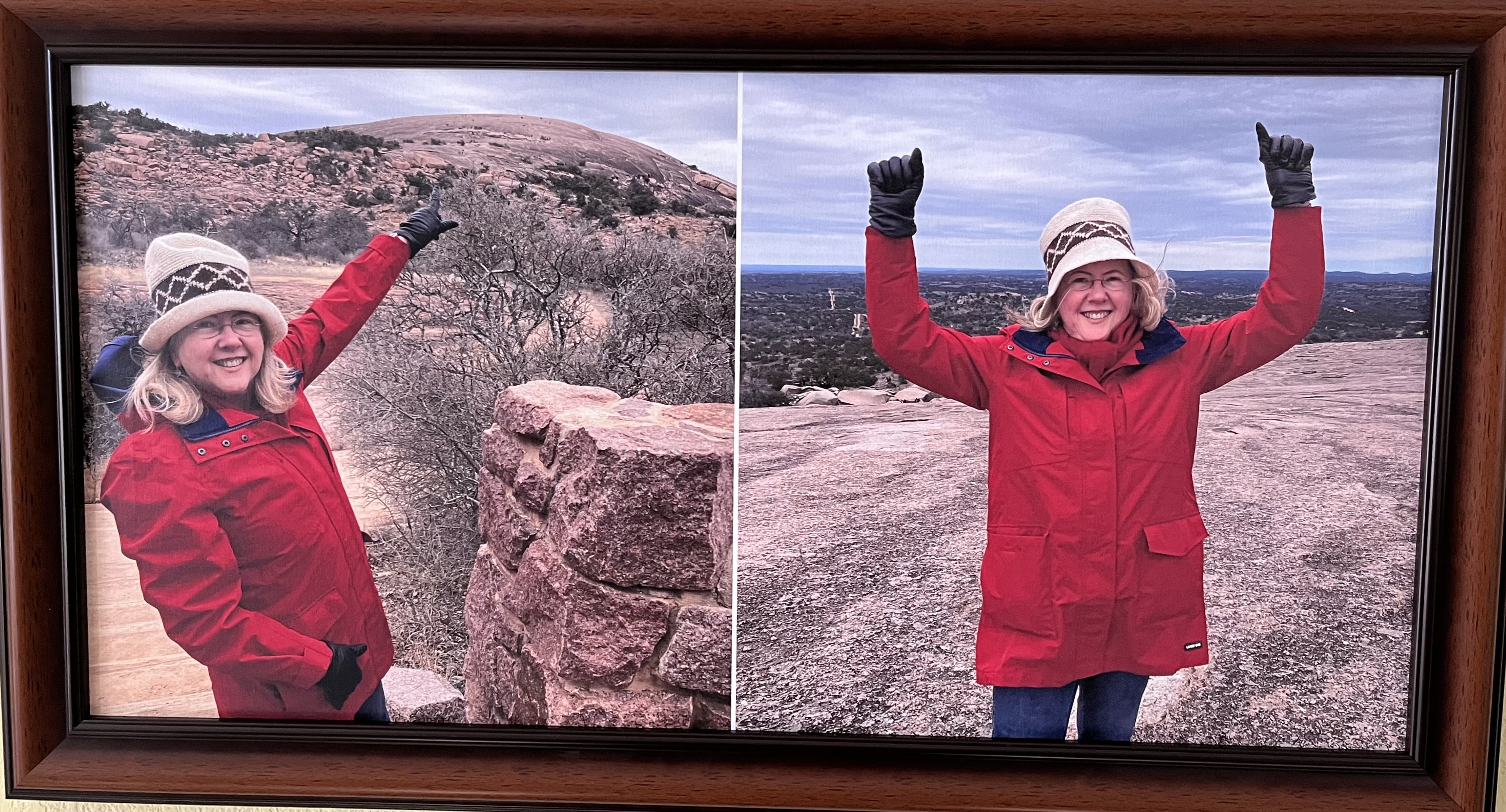
Ironically, Robin and I have had a literal peak experience — climbing to the top of Enchanted Rock, which Robin had done many times, but I’d never thought I could do, despite its appearance on my bucket list. In truth, it was more on my regrets list, i.e., things I wish I had done. Robin, however, thought I could still do it and that we should try (after he helped me train on some hilly terrain).  

With my confidence bolstered, we made reservations for a day that ended up being cold and very windy, and to my surprise, I made it!!  I was delighted that my legs were strong enough, with help and tugs from Robin at some tricky parts, to make it to the top.  I was equally pleased that I managed not to break an ankle on the way down (we septuagenarians think like this). 

I was so excited about the experience, I couldn’t stop talking about it, even after the second celebratory martini in a Fredericksburg bar!  Robin had taken pictures during the climb and later ordered a big canvas to hang on my wall, depicting my moment at the top — just so I would remember what victory felt like. 

I made it all the way up there!!

Now, as I look at that picture and think of Susie’s (semi-serious) peaking principle, I realize that my standing up there in my “Rocky” pose is more than a picture of a successful rock climber — it is a metaphor for my life.  It is also a signal to Susie proclaiming,

I AM PEAKING, SUSIE, DAMMIT, I AM PEAKING!!

As I begin this new year, I toast Susie/Marian and all the good friends I’ve been lucky enough to have in my life and the loving man who wants to help me continue peaking, one dream and desire at a time.  As we continue along life’s journey, I will be smelling whatever roses I find, living in the moments I have left, and savoring each and every one.  I am a lucky woman.

Happy New Year, everyone, and hail to librarians everywhere!! 

Posted in Uncategorized | Tagged , , , , , , , | 14 Comments

When Texas Took a Sharp Turn

On January 12, 1971, a few weeks shy of my 18th birthday, I started my first day of work in the Texas Capitol where the 62nd session was gaveled to order.  The hubbub of the lawmaking process and the proximity to power was heady stuff, and I was thrilled to be working for a state representative, chairman of the Revenue and Tax Committee (now Ways and Means), a man on the Speaker’s team.  As my first workday began, I little realized that I’d be a witness to an explosive moment in Texas history.  Nor did I realize how that moment would affect my own family. 

Six days later, the bombshell hit.  Texas Democrats were readying to celebrate their 1970 election victories and inaugurate their top officials in a big Austin gathering when attorneys for the Securities and Exchange Commission (SEC) fired the starting gun on the scandal that would be called “Sharpstown.”  That very afternoon they announced the filing of a lawsuit in Dallas federal court alleging stock fraud against former Democratic state attorney general Waggoner Carr, and former state insurance commissioner John Osorio. They were partners in a law firm that included my father, Eugene “Gene” Palmer. Houston business man Frank Sharp was another defendant, along with about thirty others.  Supporting documents to the SEC filing named Governor Preston Smith, House Speaker Gus Mutscher, other state representatives, and the chairman of the State Democratic Executive Committee in an insider trading scheme. 

The trades at issue were made in National Bankers Life Insurance Company stock through Dallas broker Ling & Company.  I was probably one of the few people at the time who had heard of the insurance company — my dad’s partner, Osorio, was President of the company, which had been bought by Frank Sharp from former governor Alan Shivers.  

Sharp’s Sharpstown Bank had provided no-interest loans to the various politicians so they could buy stock in National Bankers Life, and when the price of the stock invariably rose, they paid off the bank and pocketed the profits. But instead of these dealings being the actions of a man ingratiating himself with a few lawmakers, the Governor, and others, the SEC wanted Sharp to say they were more than that. Therefore, he crafted the story that the stock trades were part of an attempt to bribe Texas Democratic officeholders for some legislation he supposedly wanted — this story landed him a favorable plea agreement.  This testimony presented the Travis County district attorney with an official corruption and bribery case to pursue against those Texas officeholders. 

Accordingly, my first session was consumed with conflict as Speaker Mutscher — fending off legal action and a hungry press — would find his speakership assailed by a group of progressive Democrats, who would come to be known as “the Dirty Thirty.”  Mutscher, his team or “Mutscher Men,” and the majority of the Legislature, in contrast, were conservative Democrats.  For some time, the Dirty Thirty members had sought to move the Democratic party in a more liberal direction and change the “good ole boy” system of lawmaking.  Dethroning Mutscher would give them the opportunity, at last, to pass bills on government reforms relating to the legislative process, governmental records, and financial disclosure for lobbyists, among other “government-in-the-sunshine” laws — if not this session, surely during the next.  The soundtrack of the session, therefore, was a constant drumbeat of disruption and distraction as Mutscher and his team tried to maintain business as usual, and ignore the brewing legal actions and demands of the Dirty Thirty.  My boss was a Mutscher Man, and I reflexively sided with the Speaker — the dark side, I came to understand.

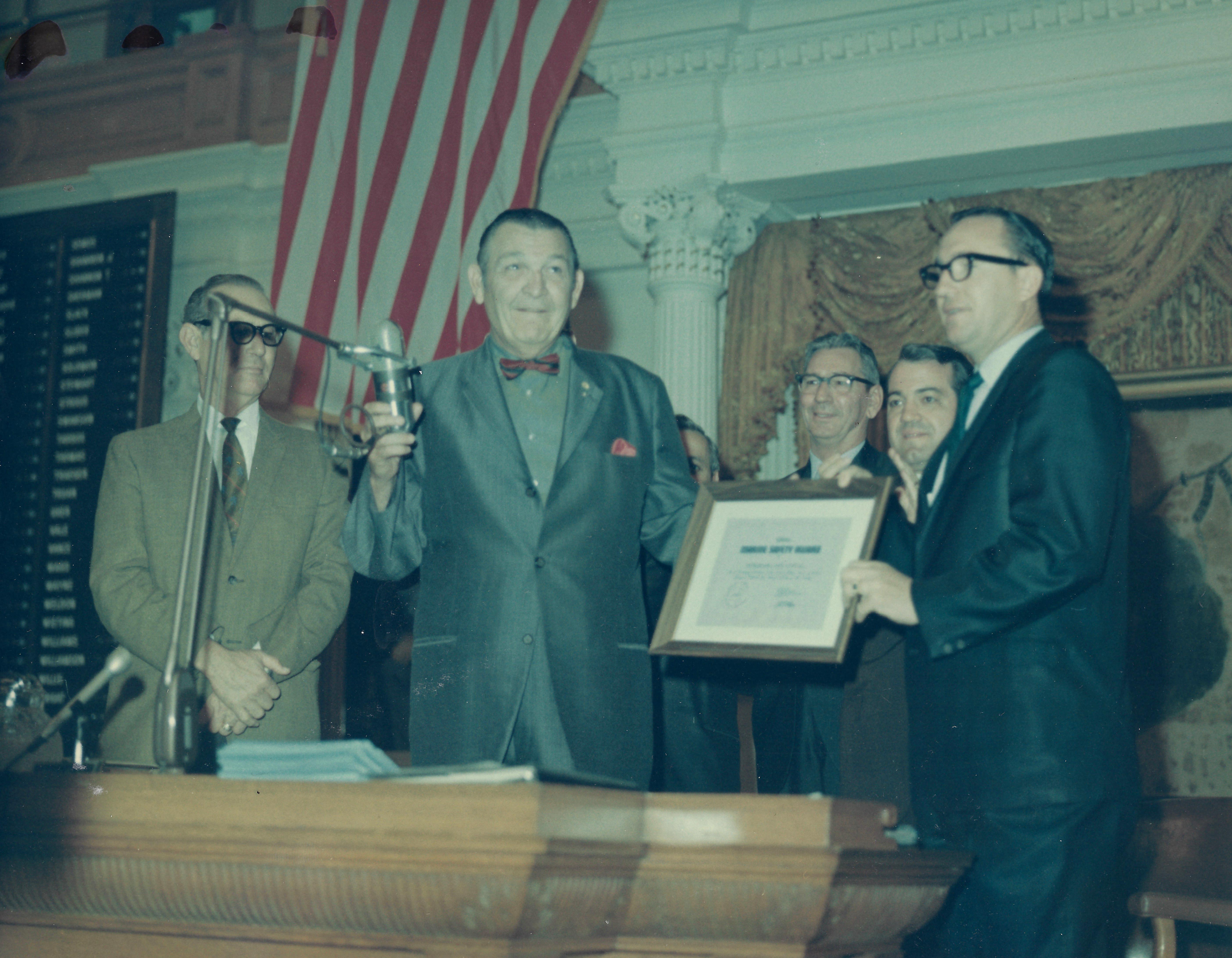
My boss, Ben “Jumbo” Atwell receiving a certificate from Speaker Gus Mutscher

The Travis County DA brought a case against Mutscher and two of his lieutenants based on Sharp’s testimony that the stock trades were a bribe to obtain passage of two bills during a special session of the previous legislature.  The stock trades, or so-called bribes, also happened around this time.  The bills passed both houses of the Legislature, but paradoxically, the Governor, one of the inside traders, seemed unaware of his bribe.  Despite including the bills in the call of the special session, he vetoed them after they passed,  although they were largely unchanged from the bills as introduced.  

I learned of these bills a few weeks before my dad’s face appeared on the front page of the Dallas Morning News.  My father had drafted them as requested by Osorio who was acting as an advisor to Sharp and president of National Bankers Life.  Thus, he was deposed by the SEC in regard to facts associated with the activities of Osorio, Carr, and other defendants in its case. 

My father, to the left, Frank Sharp on the right.

As my father testified, the two bills as Sharp originally understood them and that my father drafted were designed to help all small state banks, including, but not limited to the Sharpstown Bank.  At the time, the Federal Deposit Insurance Corporation (FDIC) only insured deposits up to $15,000 — therefore, small state-chartered banks in Texas had a hard time competing with the large national banks that provided the additional security of a large operation.  Thus, one of the bills created a State Deposit Insurance Corporation patterned after the FDIC, providing deposit insurance to state bank depositors beyond the FDIC limit of $15,000.  The second bill, HB 73, set out the parameters of insuring deposits from $15,000 to $100,000.  In essence, the state deposit insurance would be an “excess” policy, insuring amounts up to $100,000 only after the FDIC had paid that first $15,000 to a depositor, thereby leveling the playing field between national and state banks.

Two years after their passage, Sharp falsely claimed that the bills were part of his bribery scheme to supplant the FDIC and its oversight over his banking practices.  But while these bills never proposed to supplant the FDIC, Sharp was notorious for his conflicts with banking regulators — so even while the plain language of the bills did not support his story, it had an air of believability about it.  With the addition of the insider stock trades and bank loans, enough impropriety was alleged so that the Travis County DA would indict Speaker Mutscher, Rep. Tommy Shannon, the House sponsor of the legislation, and Rush McGinty, an aide to the Speaker.  The Governor’s veto presumably spared him from indictment in the case. 

While never charged with anything, my dad would long be suspected of some wrongdoing himself by many in the legal/political community who didn’t understand his role as the drafter of perfectly legitimate legislation or even Sharpstown, itself.  He was guilty of something by association. Years later, he told me that colleagues and friends would cross the street downtown to avoid having to talk to him. 

Gene Palmer, Waggoner Carr, and John Osorio (woman in rear unidentified)

The 62nd Regular Session would close with Mutscher’s resignation and the choosing of an interim Speaker.  The 63rd Legislature would see the election of a new Speaker, the removal of long-time legislators and former Mutscher Men from their chairmanships, and the passage of new ethics, financial disclosure, and open-records laws. They would also update and strengthen open-meetings, and lobbying laws

The court case and legal wrangling of the SEC, through its Department of Justice attorneys, and the multiplicity of defendants in the Dallas case would go on for a while.  The intricacies of securities law and actions of stock brokers, banks, and insurance companies were not that interesting or even comprehensible to most people.  It might have been a more compelling, if more people had understood the active role the Nixon Administration played in Sharpstown.

Once a tip was received about unusual trades being handled by Ling & Company, and the SEC audit of the company’s books revealed transactions by top Texas Democrats,  the Republican Administration had its long-awaited opportunity to undermine the Democratic establishment in Texas.  Disappointingly for the Republicans, the name of Lieutenant Governor Ben Barnes was not among the stock traders.  As a popular Democrat with presidential potential, he was the only Texas elected official on Nixon’s  infamous “enemies list.” 

Barnes was an up-and-coming political star, known as a protégé of former Governor John Connally and blessed by former President Lyndon Johnson.  From DeLeon, Texas, he had been the youngest Speaker of the House, and in short order, the youngest Lieutenant Governor.  He was active in national Democratic politics and heavy odds predicted the career of this talented and charismatic politician would continue its upward trajectory.

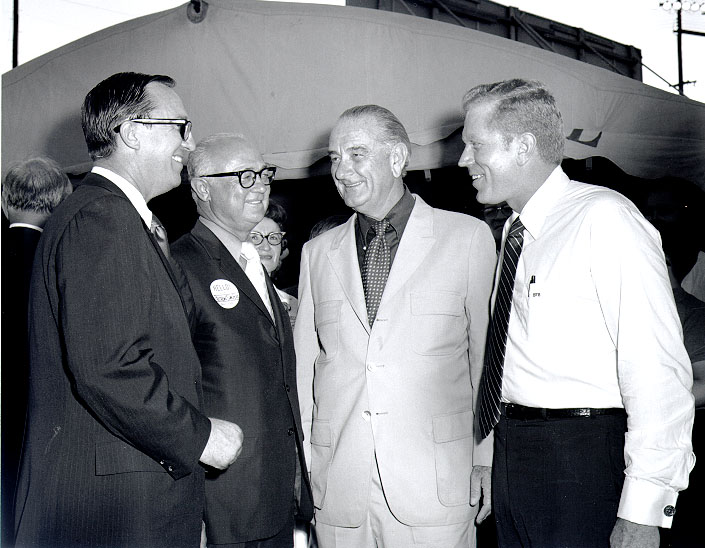
Speaker Gus Mutscher, Governor Preston Smith, former President Lyndon Johnson, Lieutenant Governor Ben Barnes

It would have been a real coup for the SEC and John Mitchell’s Department of Justice to find wrongdoing to weigh down Barnes.  In fact, finding something on him was likely at the root of the SEC investigation of Ling & Company stock trades in the first place.  As Barnes reports in his book, Barn Burning Barn Building, he would eventually learn that the Nixon Administration spent over 5 million dollars trying to dig up dirt on him, and in later years he received personal apologies from former attorney general John Mitchell and Nixon chief of staff, Bob Haldeman, for their roles in the attempt to bring him down.

In fact, the desire to implicate Barnes may also explain why Sharp crafted his story about bribing officials to pass the banking bills.  Like its presiding officer, no senator had been the recipient of Sharp’s loans and stock trades. I’m no bribery expert, but I do know that you could bribe all 150 House members, and that wouldn’t be enough to get a bill to the governor’s desk.  You need some senators in the bag, and especially, the lieutenant governor to get it on the calendar for passage.

So, as part of his agreement with the SEC, either explicitly or implicitly, Sharp’s testimony was molded to not only change the purpose of the bills, but to also accuse Barnes of accepting a bribe.  Specifically, Sharp would say that Barnes was too smart to leave a trail of stock trades and would only accept cash — cash that was given to Barnes directly by Osorio.  Osorio, however, would always deny that he had given any money to the Lieutenant Governor.

In fact, before Osorio was convicted of misapplication of pension funds in the Dallas case, the Justice Department offered to drop all charges if he would implicate Barnes for taking a bribe.  After receiving the offer, Osorio discussed it with his friend and mentor, former governor Alan Shivers. Could he lie and ruin an innocent man to avoid his own imprisonment?  They both agreed that he could not. Osorio was, therefore, convicted and imprisoned.

But Barnes could not escape becoming a casualty of the Sharpstown steamroller that the Nixon Administration set in motion.  In 1972, Barnes would run for governor in the Democratic primary against Dolph Briscoe, an uncharismatic Uvalde rancher, and Frances “Sissy” Farenthold, one of the progressive “Dirty Thirty” House Democrats. During the primary, Barnes endured all kinds of smears amid the Sharpstown fervor, although he was never charged with any crime or wrongdoing.  Again, guilt by association. Once considered invincible, Barnes could no longer summon the voters.  He didn’t even make the runoff, and Briscoe, the uncharismatic rancher, beat Farenthold (tagged with the “liberal” label) and won the  governor’s race.  Unfortunately, he was not a party builder, and the governor who succeeded him would be a Republican. 

There was a lot I didn’t perceive or appreciate as I began my work at the Capitol that January, 1971.  That year there were only ten Republicans in the House and two in the Senate, and I would have bet money that Republicans would never gain a foothold in the state.    (By 1981, there would be 35 House Republicans and seven Republican Senators.)

Our former Democratic governor, John Connally had become a Republican, largely it seemed, so he could work in the Nixon administration.  In 1971, it was doubtful whether others would follow his footsteps, especially in the near future.  If predictions had held and Barnes had ascended to the Governor’s office, surely he would have rebuilt and shored up the Democratic Party as he sought to climb the ladder of national prominence.

But the Sharpstown scandal rocked the Texas political world and ousted much of the Democratic establishment.  A little more than seven years after that January, 1971, Democrat John Hill  lost the governor’s race to Republican Bill Clements.  I was at the Capitol the day after the election and vividly remember the sense of shocked silence that engulfed the entire building.  Unbelievably, we had gone through a portal — the goal of the Nixon Administration had been consummated and Texas had elected its first Republican governor since Reconstruction. 

Posted in History | Tagged , , , , , , , , , , , , , , , , , , | 14 Comments

High on Life — Jumbo and Willie

During the 60s and 70s, when Bee Caves Road was little more than a drive through the country, there was a beer joint whose back fence hid a small cabin on a back lot known by the cognoscenti as “the Pad.”  The Pad’s proprietor and master of ceremonies was Ben Dodson Atwell, a State Representative, elected from Dallas.  The Pad was his home during his 24 legislative sessions, numerous special sessions, and whenever he tired of Dallas life. 

Most everyone knew him as “Jumbo,” the nickname he acquired as a UT student. Many think it derived from his height (6’4”), but I also heard that it originated from his prodigious consumption of milk shakes made with  Jumbo brand ice cream.

When Jumbo was in residence, a typical day at the Pad started early with music emanating from various speakers, inside and outside of the cabin.  Faron, Willie, Waylon, Marty, Ray, Charlie, and Merle sang from the outdoor speakers to the adjacent woods, its creatures, and a church built in later years behind the trees next door. (Yes, the church folk appealed to city leaders to make the music stop on Sundays, but to no avail.  The music was there first.)

As the day wore on, the Pad attracted drop-in visits from people of all persuasions, e.g., local folks, legislators (former and current), and friends passing through town.  You could distinguish between first- and old-timers by whether they recognized the painting Jumbo called Mrs. Nelson with a greeting or a reverent touch as they walked by her.  Mrs. Nelson was a tasteful depiction of the back of a nude woman’s torso, from the nape of her neck to the beginning of her calves.  

Jumbo welcomed everybody.  What set him apart then (and would more so today) was that he bore no ill will against his opposition in the legislative arena.  Of course, during his days in the Leg, almost everyone was a Democrat — Republicans could be counted on one hand — but the Ds were divided between conservatives and liberals and functioned like two parties.  Yet, Jumbo was known to quip, “I vote with the conservatives, but I party with the liberals.”  Hence, Jumbo gladly hosted liberal champions of union interests even while he supported the conservative business interests of his Dallas district.  

He may have loved a good party, but Jumbo was serious about lawmaking and achieved many things in his 24 years.  He sponsored the Water Safety Act of 1959 and subsequent amendments — which earned him recognition as the “Father of Water Safety.”  Jumbo also sponsored the bill creating the first dental school in Dallas, and was instrumental in guiding the House bill creating the authority to build DFW Airport.  He had a strong conservationist streak with bills protecting whooping cranes and roadrunners.  In 1971, he introduced two bills to protect the cougar, the Texas mountain lion, in danger of extinction.  Those two bills were unsuccessful and the cougar remains unprotected.

Jumbo receiving boating safety award from Speaker Gus Mutscher.

 But he was proudest of his work as chairman of the Revenue and Tax (now Ways and Means) committee for 12 years during which he authored and passed various tax bills, while killing any efforts to tax groceries.  Spearheading the passage of tax bills won’t make you popular, but Jumbo was undaunted. Undoubtedly, his service as a navigator on a WWII minesweeper  stiffened his resolve for accomplishing the uncelebrated, but necessary, tasks, like imposing taxes on your fellow citizens.  

It’s not glamorous work, he’d explain, but we couldn’t have a dependable government without revenues.  And, yet, he noticed, while surveying the headstones in the State Cemetery one day, among those state officials who had served in the government, no one chose passing tax legislation as a lasting legacy. 

So, long before he needed it, Jumbo made sure it would be part of his, ordering his pink granite headstone in the shape of Texas with this inscription:   

Lawyer – Legislator

Author of Tax Bill

For years, the headstone waited patiently for him at the cemetery by his strategically-selected burial plot.  The plot he chose is close to 7th street, he said, allowing his friends leaving Ciscos Bakery to wave at him as they headed to the Capitol.

I was about 15 when Jumbo made his appearance in my life story. My parents had been divorced a year or so and my mother had begun dating.  That’s not easy when you have a smart-ass teen-age daughter who could be, perhaps, a bit intimidating to men who weren’t looking for trouble.  But, it was impossible to intimidate Jumbo.  He was a big guy and not one for debating with teen-agers, appearing very stern a lot of the time — until he let loose with that sunshiny smile.   

Jumbo did fun things that included me and my sister.  He introduced us to Luckenbach, before it was famous.  Lazy afternoons watching the town’s owners, Hondo Crouch and Guich Koock, perform were such a treat.  

Jumbo watching Guich Koock in Luckenbach.

Then, there were chili cook-offs.   As one of the sponsors/founders of the San Marcos Chilympiad and others, Jumbo  would often be a judge or enter as a contestant.  When he was competing, he’d pick a theme and his entourage, which might  include me and some of my friends, would dress up accordingly and help him compete. I ingested a lot of chili back then!  Tip:  you can’t win with beans in your chili.  

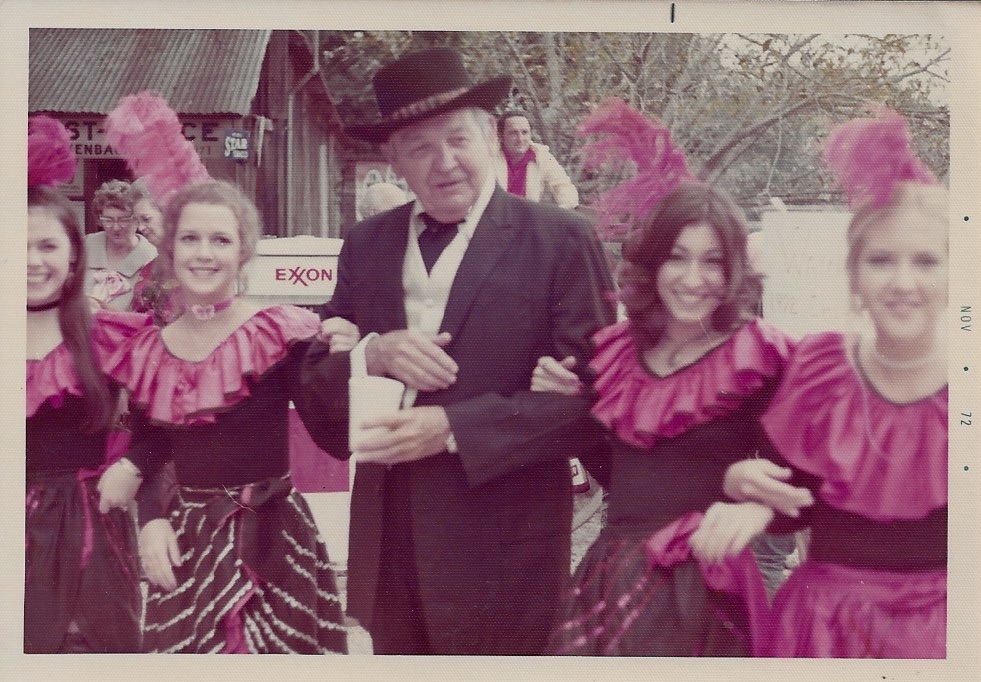
Jumbo (Riverboat Gambler) and the River City Chili Queens at Luckenbach’s Amelia Jenks Bloomer Chili Cookoff

I also liked being an adjunct to Jumbo’s and Mother’s life because I was able to hang out with his friends on occasion.  They could be current or former legislators, lobbyists of various interest groups, Don Russell the president of Aquarena Springs who once wrestled an alligator, local Westlake folks like Emmett and Joyce Shelton, or Austin notables, like Joe “the Barber” (Picciandra).  Jumbo surrounded himself with many interesting “characters,” although few outshone Jumbo. 

Except, maybe, Willie Nelson.  

Willie didn’t drop by the Pad, as I recall.  Instead, Jumbo went to Willie to catch his shows.  Long before Willie moved to Austin, Jumbo had met him playing poker when Willie was passing through Dallas.  Or so I heard.  

I’ll never forget the first time I saw Willie.  Still in high school, I joined Jumbo and Mother at the historic Dessau Hall (Elvis played there twice).  That night’s headliner was Sammi Smith, whose “Help Me Make it Through the Night,” was a current big hit.  But, Willie made more of an impression on me, especially since he came over to the table to say hello.   He wore a loose lantern-sleeved white shirt drawn in by a lace-up vest. His hair was cut in a short page boy, if memory serves.  I don’t remember his pants. I’m sure he wasn’t wearing tights, although they would have completed this Renaissance look.  Needless to say, Willie’s look has changed over the years.

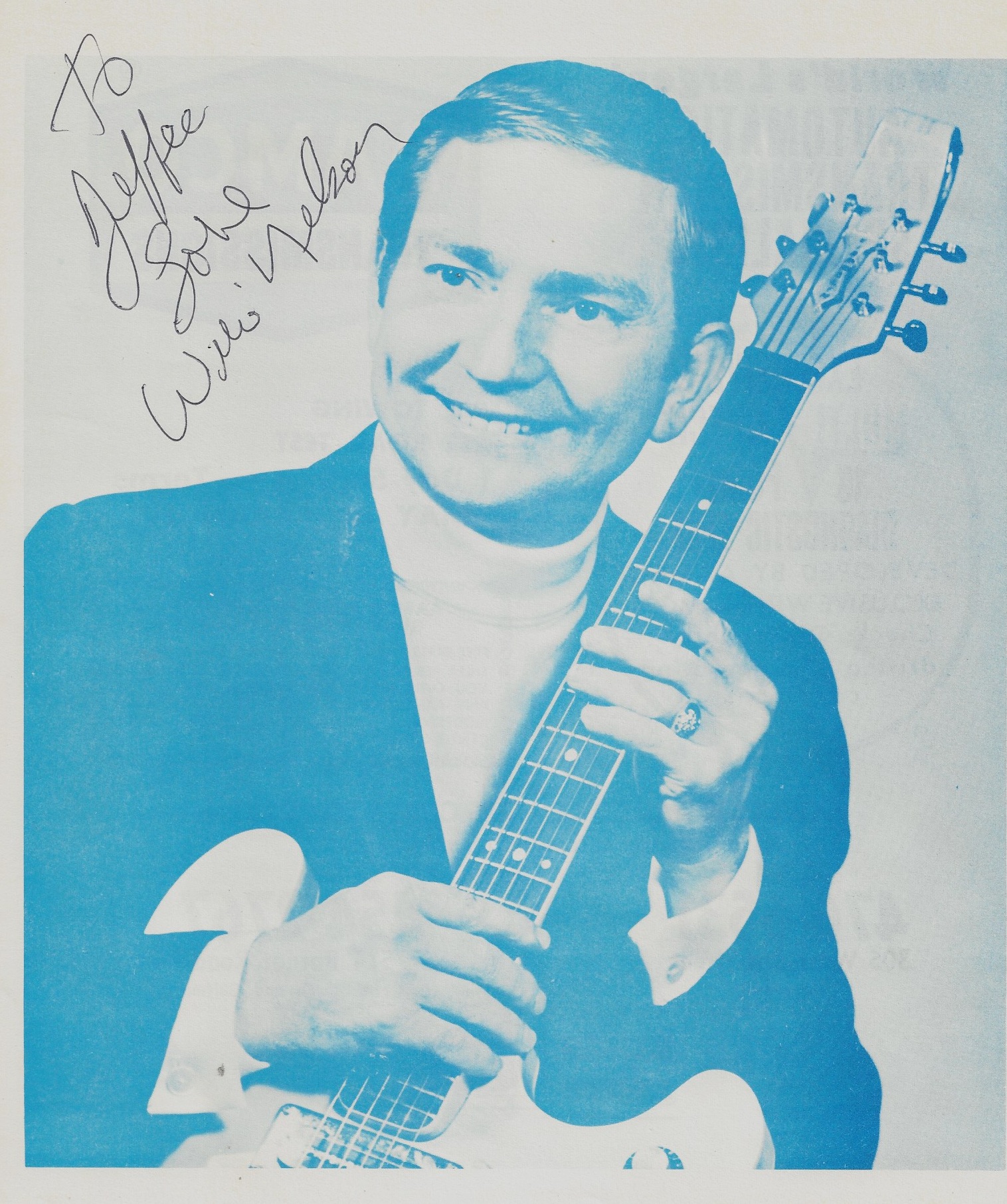
Here’s a very early example of Willie’s look (autographed to my mother — we share first names)

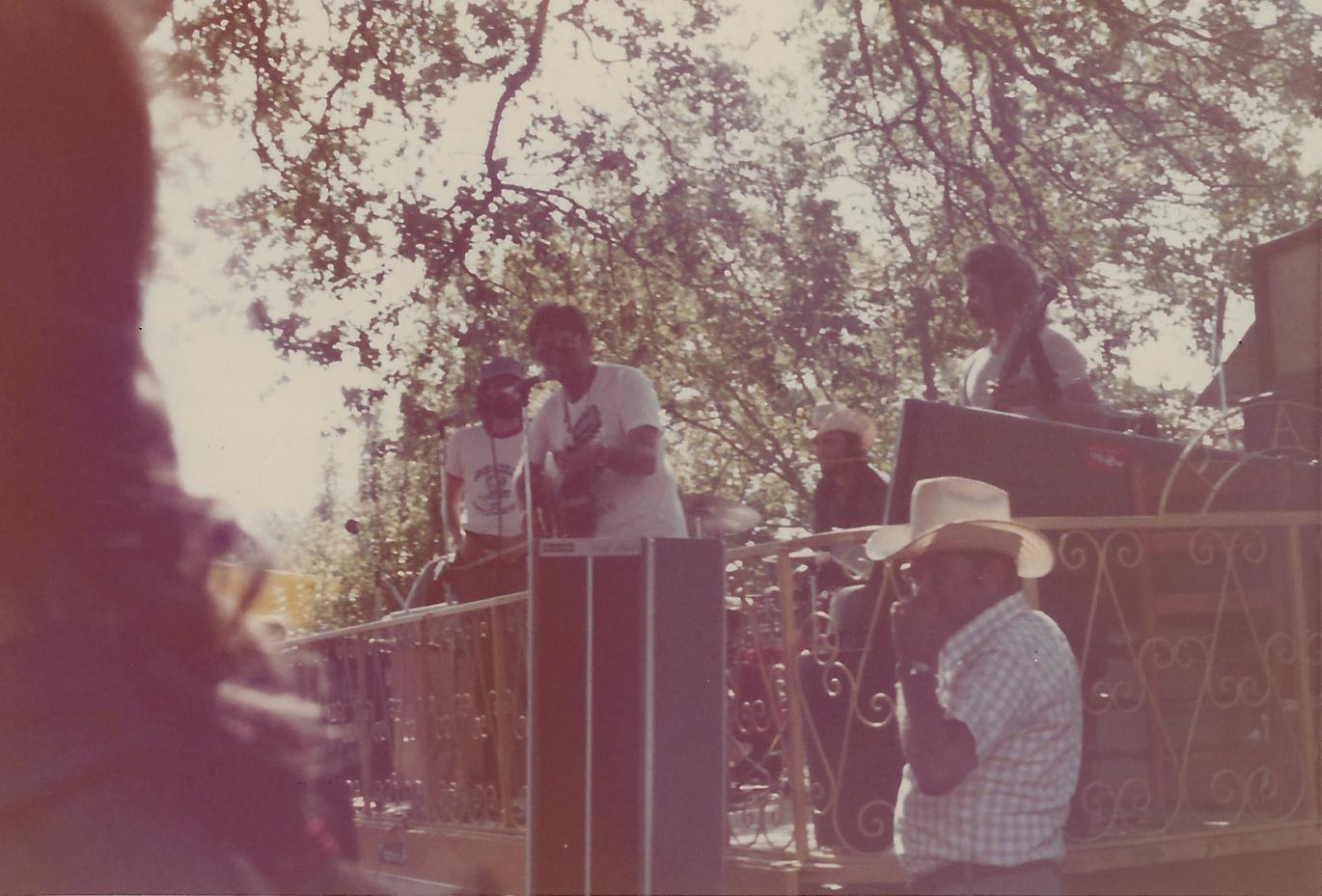
There would be many other Willie outings.  For example, one Saturday, Jumbo got word that Willie was dropping in at Luckenbach for a surprise outdoor concert.  Sure enough, we were there when his bus rolled up on the town’s one road, along with about a hundred other in-the-know fans, ready to watch the concert.

My sister reminded me of the night that Willie was performing at the Broken Spoke and Mother and Jumbo took her and some friends to celebrate her birthday.  At the end of the night, while the adults chatted and drank with Willie, he heard about the occasion and handed my sister the key to his Cadillac, inviting her to take it for a birthday spin with her friends.  She only had a learner’s permit, but she jumped at the opportunity.

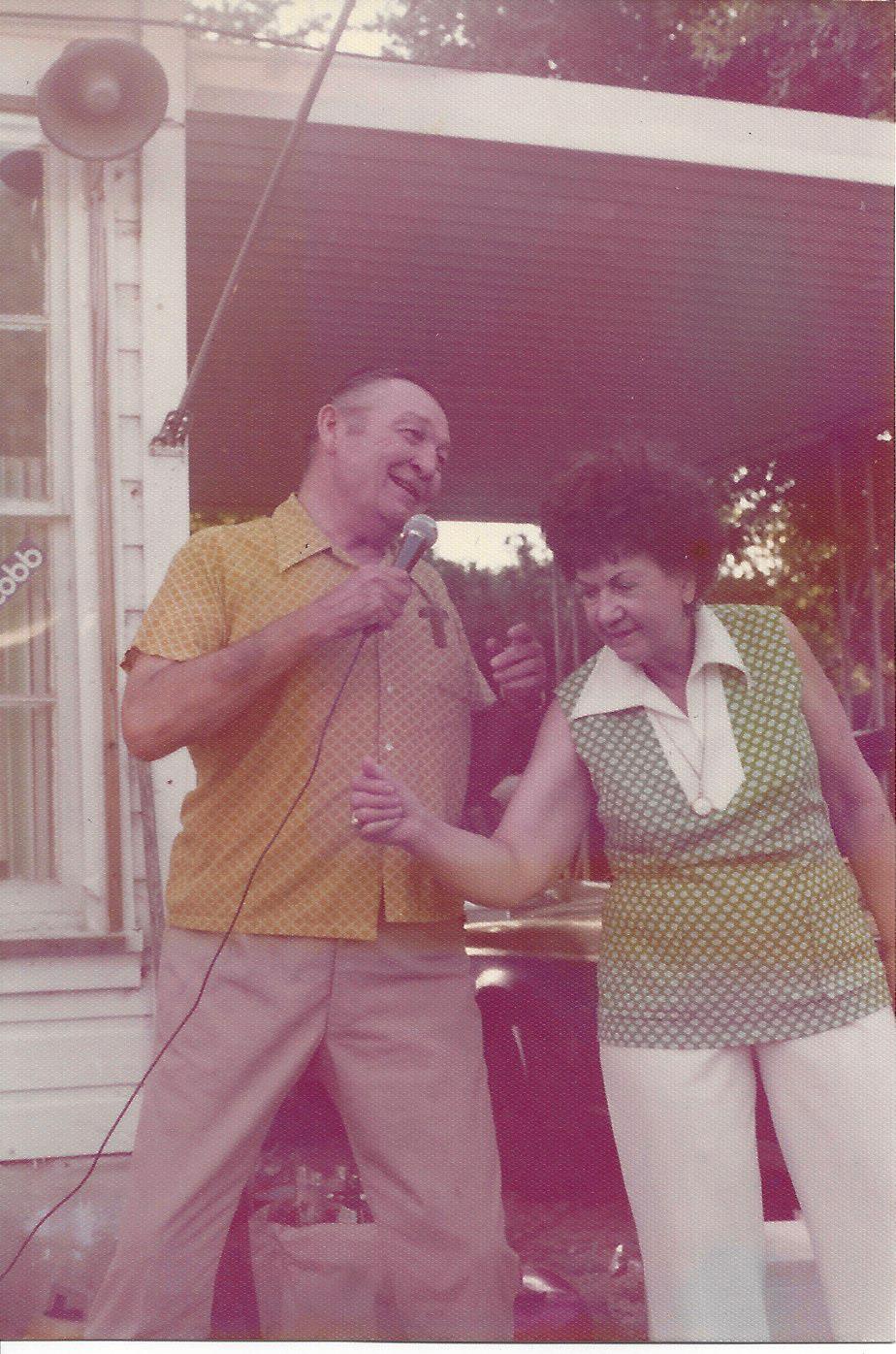
In addition to listening to and going to Willie’s shows, Jumbo also “performed” a couple of Willie songs.  By performing, I mean that he would mug and lip sync to his two favorite Willie recordings of Bring Me Sunshine, and Me and Paul

Jumbo gave these performances in front of guests at the Pad, chili cook-offs, and wherever he found a stage (and had his Willie tape on hand). 

Jumbo performing with help from Madeline Gaddis (my grandmother)

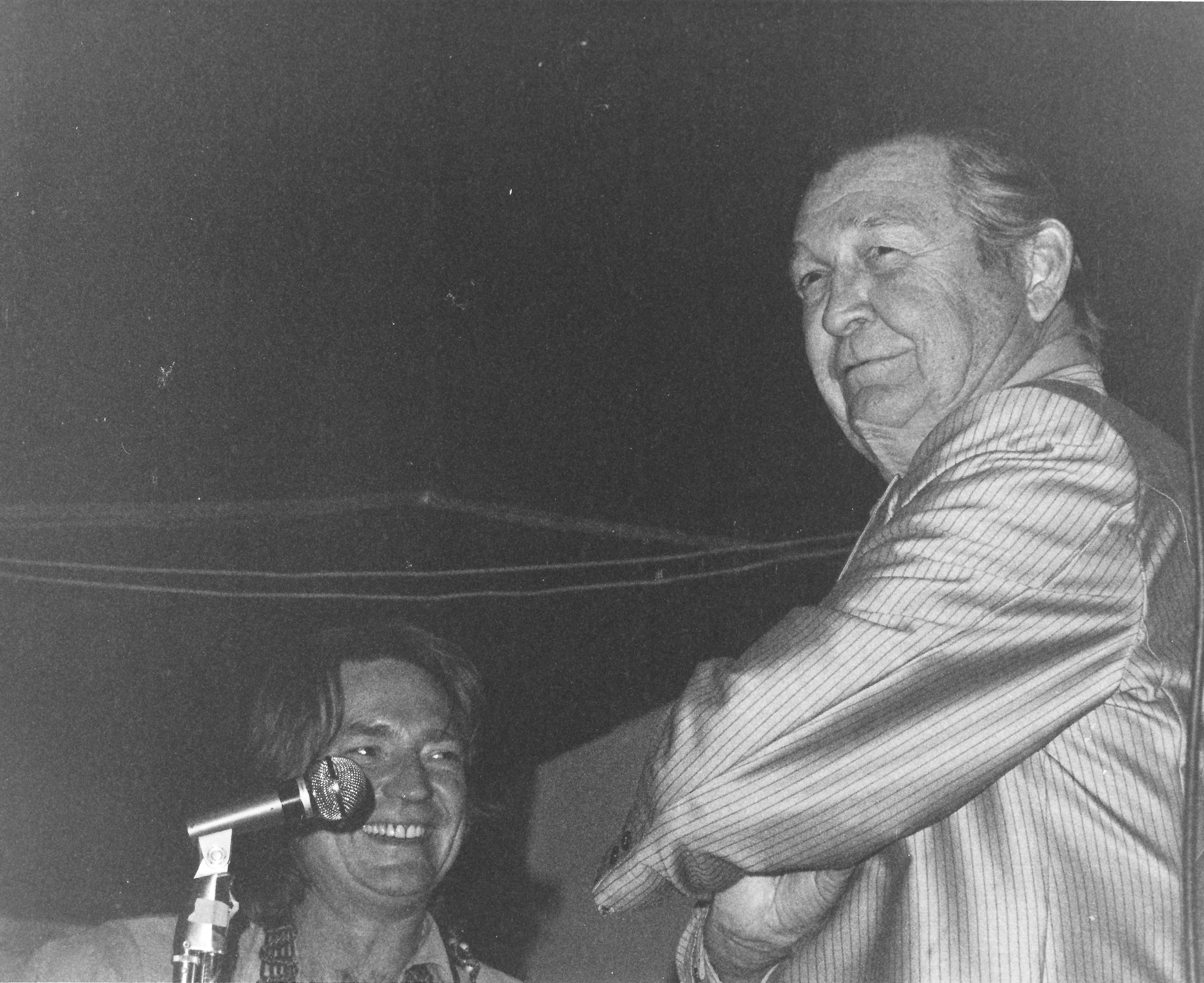
The best Jumbo-Willie performance was in 1974 at Castle Creek, a club located next door to the Chili Parlor where Willie and his band were appearing. As pre-arranged, Willie invited Jumbo to join him on stage and, while Willie and the band performed the two songs, Jumbo performed his lip syncing act as if he were the star of the show!!  It was great to watch the two having fun — just high on life!  We were two blocks from the Capitol and many of the folks suffering through the party-less Constitutional Convention showed up at the club, including the House of Representatives’s photographer who, fortunately, brought his camera and captured the moment.  

Willie and Jumbo at Castle Creek, 1974.

I am pretty sure that Willie Nelson will never know a bigger fan than Jumbo, as I’m also convinced that the Texas Capitol will never see a bigger personality than Jumbo Atwell.

 A true original, I think Jumbo would have been a great performer.  Music was an indispensable part of his life and brought him great happiness.  

And now that I think about it, Willie would’ve made a great politician.  Just imagine the new spin he’d bring to legislators working in smoke-filled rooms!!

Posted in Memories, Old/New Austin | Tagged , , , | 10 Comments

The End of Roe and the End of the Road

The writing is on the wall (and a draft Supreme Court opinion):  Roe v. Wade will soon gasp its last breath at the hands of Supreme Court Justice Samuel Alito and his co-Taliban wannabes.  The last fifty years of women having a constitutionally protected right to make decisions about their own bodies will be history.

According to Alito, Roe must be overturned because it is an ill-conceived and deeply flawed decision that invented the right of privacy, a right not specifically spelled out in the Constitution. He also dismisses Planned Parenthood v. Casey that holds the right to an abortion is found within the general concept of “liberty.”

To overrule these cases Alito tramples over the judicial doctrine of “stare decisis,” whose translation means that what’s been decided should stay decided.  Its rationale is that decided cases, also known as precedents, provide stability in society, allowing citizens to arrange their lives in reliance on the law. 

But, no problem.  Alito informs us that stare decisis is “not an inexorable command,” by which he means we can do whatever we feel like.   Now, they feel like “correcting” Roe and Casey.

The big question now is whether the Supreme Court will revisit and “correct” other intimate personal decisions that previous courts have upheld. Alito’s draft says that “our decision concerns the constitutional right to abortion and no other right,” but that’s not really believable considering his record and the implications of this ruling. The three most at risk include: Griswold v. Connecticut, which protects contraception access; Loving v. Virginia, which held laws against interracial marriage were unconstitutional; and Obergefell v. Hodges, which legalized same-sex marriage nationwide.

I’d be willing to bet that the dominos start toppling in Roe‘s wake.  Anyone who’s been been awake at some point during the last 50 years knows that the Republican Party has made overturning Roe among its prime directives.  But, it’s just not abortions they oppose.  They don’t like gay sex, same sex marriage, interracial marriage, or even contraception. They justify their dislike on the concept of originalism, i.e., if it’s not specifically mentioned in the Constitution, drafted in 1787 (or Bill of Rights 1791), a right doesn’t exist.  They will re-interpret cases to roll back, in effect, the period from 1965, when Griswold was decided, to the present, during which we’ve seen an expansion of personal rights.  Alito’s statement that this won’t effect other rights is simply “not true.”  The Alito wrecking crew will, surely, usher in a period of contraction and elimination of those personal rights we’ve arranged our lives around. 

This means that Roe’s loss is not just a woman’s issue, but a societal issue.  People have been able to love and marry as they want.  No matter your sexual orientation, you can be you and contribute as you see fit.  Society as a whole has benefitted from women and men being able to control their futures, to decide when bringing children in the world is a right for them.  

But the times they are a’changing.  Republicans (and white supremacists, if there’s a difference) have been saying that American women need to have more babies to counteract the high fertility rate and influx of immigrants.  You may have heard this and thought they meant voluntarily, but now it seems that a tyrannical minority that includes the Court intend for women to produce those babies, whether they like it or not.  

I first heard the “more babies” argument in 2013 when Texas Republican, Barry Smitherman, shared with an audience his plan for getting more non-minority babies. Young women, he explained, need to use college as hunting grounds to find husbands and, then, soon after graduation, put any career plans on hold and get started with baby-making. “We have to encourage the production of more children,” Smitherman exhorted, as if he were referring to a widget factory. “Young people: first, get married, and then begin having children.”  He decried the fact that educated white women have a collective fertility rate of only 1.6 when we need 2.1 for mere replacement.  He and his wife, he boasted, did their part with an impressive brood of FOUR children.

But the world has changed since Smitherman girded his loins and got into production with sweet Maryanne. For most women, the whole point of attending college is to have careers and get started with them, or continue on with post-graduate studies in law, medicine, business, or whatever.  They know that starting a family right away will derail them from these goals.  

I wonder whether parents want to pay for a daughter’s college plan that centers on hooking a breeding partner and start churning out babies.  And what student would take out loans when repayments would come due at the same time as bills for diapers and formula?  Smitherman  didn’t utter the words “barefoot and pregnant,” but his plan sounds like one way of diminishing the presence of women in colleges, boardrooms, courtrooms, and operating rooms.

If you are cool with Smitherman’s marriage-and-baby production plan, no need to read on.  But other men must consider the effect on their futures when engaging in sex and possibly fathering a child.  Without marriage, the father will still be responsible for monthly child support payments for the first 18 years of the child’s life.   There’s no escape clause from this obligation, enforced by the Attorney General’s office.  Failure to pay can result in the garnishment of wages, suspension of drivers’ and professional licenses and denial of a passport.  The baby father can also have liens filed on properties, bank accounts, and other assets, and, ultimately, face jail time and criminal fines.  

And don’t think we can preserve the protections of Roe and other rights by federal statute.  Any such bills would be blocked by the Senate filibuster rule, a disappointing feature of our current government that could be easily changed if there weren’t Democratic hold-outs.  (Thanks, Joe Manchin.)

Those who would block any such bills are Republicans who don’t care that 70% of the American public do not want Roe overturned or that approximately the same proportion believe an abortion decision should be made by the woman and her doctor.  The percentages of support are even higher when the woman’s physical health is endangered or when pregnancies are caused by rape or incest. Despite this level of support, these senators could care less about the will of the people. 

Tragically, ours is a country where Republican-dominated state legislatures and a U.S. Senate controlled, in effect, by Republicans are poised to drag us back to the past, to eliminate the ability of women, men, and couples to make their own choices.

Equally tragic, ours is a country whose government, controlled by the aforementioned Republicans, doesn’t believe in any safety net to provide for the needs of children after birth, counting on families and single mothers to raise them whatever their circumstances.

Ours is a country where personal decisions that should be made in bedrooms and doctors’ offices will soon be dictated by politicians and Catholic jurists who do not represent the interests of the majority of Americans.  

What to do? Normally, I’d say the recipe for overcoming this situation would be to vote and remove from office those elected officials who don’t represent the majority’s preferences.  I’d encourage campaign contributions and volunteer work to elect candidates who do care about choice and real, live children. 

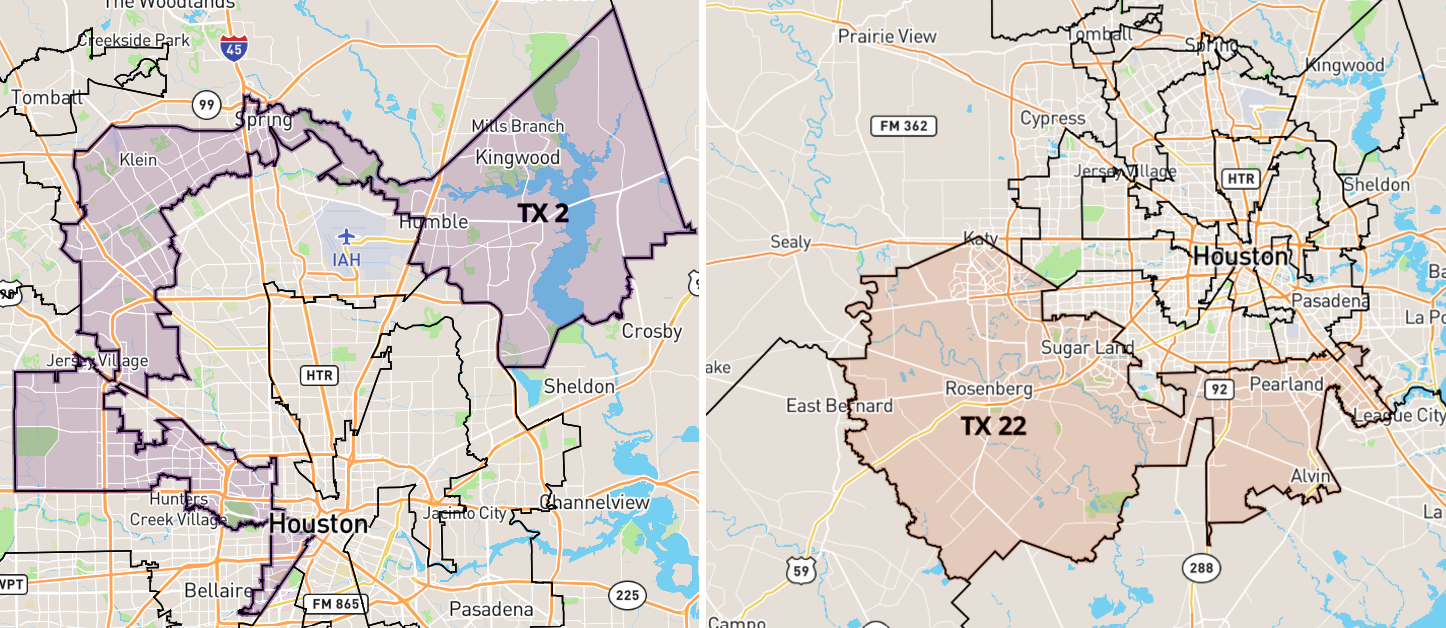
But, our voting districts are gerrymandered.  Our votes don’t make any difference when districts are drawn by those in power with the intent to stay in power.  

And then, there’s the U.S. Senate, hopelessly unrepresentative of the majority of this country.  That is the place where bills supported by the majority of Americans go to die and reactionary judges get approved.  Since every state has two senators, whatever their size, rural interests have a disproportionate clout.   Consider that Wyoming has 262,719 registered voters, while California has over 22 million, thereby institutionalizing a preference for rural interests over the majority urban interests.  The chances of changing that?  My educated guess would be…zero. 

I was beginning to have doubts about our system with Hillary Clinton’s loss to Donald Trump, but now, with the demise of Roe, and all the other rights that will surely be repudiated by Alito and his Tali-band, I’ve lost my hope for this country.   I’ve lost my hope in U.S. democracy.  You can’t have a healthy democracy when its citizens are being stripped of their rights.  The criminalizing of abortions seems to be a leading indicator of democratic decline.

I’d like to find some nugget of optimism, but, sadly, we stand weaponless and surrounded by the forces of misogyny, ignorance, corruption, autocracy, and greed.  

Sorry, Mr. Franklin, it was a good republic, but it was too hard to keep.

Posted in Politics, Women | Tagged , , , , , , , , , , , , , , | 4 Comments

My Quest to Find the Rude in Rhode Island

In case you’ve ever wondered which state is the most polite, YouGov.com asked the following question to 77,000 people across the nation: do people in your state tend to be more rude or more polite than most other Americans. You might be surprised to learn that Rhode Islanders ranked themselves as the most rude, 50th place on the politeness scale.

This is especially significant considering that Rhode Island is really small, boasting a whopping 1.06 million residents and 1,214 square miles of territory. It would easily fit within the boundaries of the Greater Houston area. So, even weighting the results as statisticians do, if Rhode Island got enough responses in the polite rankings to come in dead last, rudeness must be rampant. Or, maybe Rhode Islanders excel in candid self-reflection?

I’ve had a particular interest in Rhode Island since my boyfriend, Robin, took up residence in Providence for a while. I hadn’t heard of this survey before I visited him, so I didn’t expect to be landing in a snake pit of incivility. When it was brought to my attention early on during my stay, I was surprised because all my interactions with the natives had theretofore seemed pretty darn polite. Rhode Islanders complimented me on my Texas accent and, overall, were extremely helpful in the restaurants, bars, and retail establishments we frequented. Many people had visited Austin for one reason or another and were glad to meet us. We cycled on city streets where drivers seemed especially accommodating, not a bit interested in running us off the road. Admittedly, it was a small sampling of the state’s residents.

On the PVD Providence Pedestrian Bridge

But suddenly, my sample size ballooned when I had to meet a bunch of Rhode Islanders all at once. You might question the structure of that last sentence, particularly the “had to” part. You’ll understand when I also explain “suddenly.”

Like, suddenly, I fell off my bicycle. Robin and I were having a wonderful ride along the East Bay Bike Path, when I began to sense my steering wheel was wobbling. Maybe there was a smattering of sand on the concrete. Maybe it was just me. Whichever, I decided to stop. My best reconstruction of the accident is while I applied the hand brakes, I might not have come to a full stop before I tried to dismount. The bike’s remaining momentum threw me down and I broke the arm in an attempt to brace my fall.

By the time Robin had peeled me off the pavement I was hugging, my cell phone rang. I was being called by the Providence Fire Department which had been alerted by the fall detector on my Apple watch (best watch ever!). They couldn’t find us because the path wasn’t visible on their GPS map. Robin gave them directions and a swarm of friendly firefighters was soon upon us. With polite concern, they performed some first aid and gingerly placed my arm in a sling before hauling me down the path to the ambulance. Soon after arrival in the ER, I began meeting Rhode Islanders around every corridor who all wanted to have interactions with me, some painful, some not. But, all polite.

I visited the hospital’s x-ray room frequently that day. Each time I showed up, I was greeted with a “welcome back!” How’s that for friendliness? My second or third photo shoot involved someone pulling my arm to more clearly show the edges of the break. After enduring this tortuous ordeal, which I met with some spectacular grimaces, I was congratulated. Many people, a technician told me, screamed when that was done, so I probably could have gotten away with a sob or two. Was I trying to show my Texas toughness?

But back to Rhode Islanders. Once, while I waited for x-rays in a holding area off the main corridor, a woman on a gurney was wheeled by to get her x-rays. She spots me on my gurney and says, “Oh, there you are! How are you doing?” I thought it was strange that she appeared to know me, but she seemed nice, so I just responded, “I’m hanging in there, thank you.”

Apparently, she soon realized she’d mistaken my identity, and upon leaving the room, she said to me, “I’m sorry, I thought you were my roommate from last night.” I told her that I thought she was just being friendly, adding that Rhode Islanders seemed to be very nice people. Then, a man on a nearby gurney who had appeared to be sleeping, raised his head and said, “We are.” I’m guessing he didn’t respond to the yougov.com survey.

Unfortunately, I would need surgery and a few days later, I met the surgeon who would perform it, Dr. Andrew Evans, co-director of Orthopedic Trauma at Rhode Island Hospital, surgeon with University Orthopedics, and an assistant professor at Brown University’s Alpert Medical School. With so many credentials, I expected an older man. When I asked someone about his apparent youth, I was told he was about 45 — no Doogie Howser. But the more important point is that he, and everyone on his staff couldn’t have been less hostile. Actually, they were great professionals. Not a rude person among them. Dr. Evans’ secretary, Becky, was just a phone call away both before and after my surgery. She was an absolute pleasure to work with. Same with Amanda, her assistant.

A week after my fall, I went back to the hospital to join Dr. Evans as he joined my humerus back together. Since every single person I encountered in pre-op and post-op was so compassionate and caring, I was forced to conclude that rude people didn’t make it into Rhode Island health care.

Nor do they become hairdressers. While incapacitated, I went to a nearby salon and got to know two of the hairdressers, Ray and Jaclyn, who washed and dried my hair at least four or five few times. Both made me feel like an old customer by the time I left town.

You have probably figured out by now that I failed to find rampant rudeness in Rhode Island. I still wonder whether my sample size was too small, even for this small state, but I’d prefer to believe that Rhode Islanders might be too hard on themselves. I’d also like believing that Robin, who doesn’t have a rude bone in his body, is living among a population of equally nice people.

So, that’s what I did during my summer vacation – conducted a survey of rudeness among Rhode Islanders and broke my arm. I wouldn’t recommend breaking an arm, but if it has to happen, Providence, Rhode Island is not a bad place for it. I received excellent care from a great surgeon and very compassionate people. In my case, of course, I had the added benefit of having Robin, the most wonderful and patient caretaker a gal could ask for. He never seemed to tire of caring for the functional equivalent of a five-year-old.

By the way, just in case you wondered about Texans in the YouGov survey, we were ranked No. 19 on the “more polite” scale. Obviously, we have a pretty high opinion of ourselves. In the past, I would have agreed with this opinion, but I run into more rudeness all the time, which I suspect may be the result of migrants from other states. Despite my doubts about their actual rudeness, I might even accept the possibility that we have some former Rhode Islanders in our midst. Maybe it’s no wonder I couldn’t find any rude ones up there!

Posted in Uncategorized | Tagged , , , , , , | 6 Comments

Zelma for President!!!

The woman known as Bicycle Annie has found her way to my pages of Austin memories on several occasions.  During the 50s, 60s, and 70s, she was a frequent sight along the Drag (the part of Guadalupe on the western edge of the UT campus) and other downtown Austin streets.  As her nickname would suggest, she was often on her bicycle or walking along as she pushed it.  Most Austinites and UT students of those decades remember her, some referring to her as the Indian Princess, other referring to her as simply Bicycle Annie.  She seemed to eschew interaction with others (if not outright resent it) and, was, accordingly, left alone  with the mental issues we assumed upon her.

But, as I learned recently, her real name was Zelma O’Riley.  This information arrived at my doorstep from Diane in Wichita Falls, a relative of Bicycle Annie’s who has been researching her life.  Through an exchange of emails precipitated after she discovered my blog entries, Diane shared with me what she has learned about this well-known, yet unknown, woman who once roamed our streets and garnered a place among local legends.

So, thanks to Diane, I have the opportunity to tell you that Zelma was from Durant, Oklahoma, where her father, John O’Riley was a professor.  John and wife, Mary Catherine Harkins, had five other children including, Lester, Arlee, Zula, Lula, Ora, and Lela.  Mary Catherine was a full-blooded Choctaw Indian who actually came to Durant on the “Trail of Tears.”  The family was purportedly very wealthy, and raised their children quite traditionally.  Zelma, who was very intelligent, moved to Fort Worth for a few years, and then finally to Austin to go to college at UT.   Here she started the publication “Up and Down the Drag” in 1941.

In an edition of “Up and Down” from November, 1947, she wrote what I think are the most prescient words I’ve ever heard:  “It will take a woman to save America.”    She saw herself as this potential savior of the country, and explained that her principal campaign plank was:  preparedness.  The advertisement read, “Vote for Zelma O’Riley for First Woman President of the United States –  she is Irish, she is Indian and she will care for you.”   Also, it is known that as the daughter of a strong Indian woman, one of her main causes throughout her life was Native American rights.

To finance her publication, Zelma sold subscriptions and advertising along the Drag.  But even after she stopped publishing”Up and Down,” she would periodically continued to sell advertising once in a while to fund herself.  It’s possible to believe that she actually intended to publish it again.  Whether her intentions were real or part of a delusion fantasy, many businesses bought “ads” to make her leave them alone.

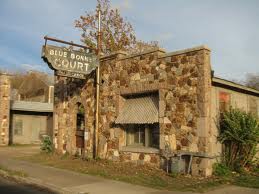
While stories circulated about her being married to the man of her dreams and his death causing her to go into a depression, Diane says these are not true. She was never married and never had any kids. Her having a house in Hyde Park was also a fiction, although the Blue Bonnet Courts where she appeared to have lived is at the northwestern corner of that neighborhood.

Diane reports that throughout her life, Zelma visited Durant, in addition to Dallas where she stayed with her niece (Diane’s grandmother). Strangely enough, Diane’s uncle went to college in Austin and had many encounters with Zelma although he did not know at the time that he was her great-nephew.  He only knew her as “Bicycle Annie” for years.  Additionally, there are rumors that she attended Law School at one point to understand the judicial system to better “fight the power.”   The law school attendance cannot be verified, but in characterizing Zelma as a pioneer activist, Diane finds it credible.

Apparently, the niece (Diane’s grandmother) knew Zelma suffered from some mental problems and tried to keep up with her without much success.  After her grandmother’s death, Diane found Zelma’s obituary and a few copies of “Up and Down the Drag” among her things, which sparked her interest in this unusual relative.

Zelma passed away April 30, 1991, and is buried in Durant in a Choctaw burial ground.

As troubled and  as unconventional as Leslie ( our once-celebrated local transvestite), Zelma is significant to me because she is a piece of the original weirdness of the Austin I knew and loved.   In sharing our memories of her, Zelma links me to other Austinites who cherish yesterday’s city.  While our Indian Princess could be a bit shocking and disagreeable, she made a unique mark in our psyches, tying us to this unique city.

May Zelma remind us — in these times of antipathy toward the homeless — that even the most unappealing person was once child and part of family that cared about them.  And even if we can’t comprehend their world, they are still human beings, deserving of our compassion and understanding.

I hope our Indian Princess is at home resting in a world of peace and love. Austin sends you prayers and remembrance, Zelma.   And on a personal note, I think you were right about a woman president.

Posted in Great Lessons, Old/New Austin, Women | Tagged , , , , , , , , | 15 Comments

Tail-Wagging New Year’s Eves

As the worst year ever finally rolls to an end, I am reminded of another New Year’s Eve two years ago when I ended the year alone for the first time ever, or at least since my marriage. My husband of 44 years had passed away seven months earlier.

I experienced many “firsts” in the year after his passing in May. He had been declining progressively since 2013, but had held it pretty much together while my father endured 18 months in hospitals and nursing centers with me helming the ship of his medical journey.

In what seemed like a seamless transition, my husband took a definitive turn for the worse shortly after my father’s death in 2016. My passing acquaintances with dementia, diabetes, and heart failure evolved into close and personal relationships. Each of his maladies came with its appropriate doctor, who, one by one, joined the circle of my new best friends.

As many care givers can confirm, overseeing someone with these conditions compounded by memory loss requires constant observation and vigilance. Many nights I went to bed, mentally, emotionally, and physically exhausted, experiencing a fitful sleep and wondering whether the man next to me would still be breathing in the morning.

One morning, he wasn’t. In fact, I found him on the floor, his heart having stopped suddenly when he was walking to the bathroom. I didn’t even hear him drop. He left this world as most of us would prefer, quickly and painlessly, leaving me to record the ending in my mind’s eye.

In the aftermath, I had much to do. Preparing a memorial, notifying friends and family, getting financial affairs in order, and probating the will kept me occupied. Within months, most everything was done. Adrift in a sea where no one needed me to do anything, be in any particular place, perform any particular task, I’d lost my moorings. What do I do now?

One doesn’t make plans for their widowhood. First of all, you don’t know when that time will come. Second, it smacks of wishful thinking, which feels a bit unseemly. Then, there’s the difficulty of imagining a single life.  Even more difficult was imagining that I might need help.

That was proven in September that year when I hurt my back and couldn’t leave my bed for several days. No one was around to notice that I had to crawl to the bathroom. Asking for help didn’t occur to me. I was, after all, the one who helped others!

A few weeks after that episode, my son in Los Angeles asked me to temporarily shelter his ex-girlfriend who was moving back to Austin and needed a place to stay until she could get on her feet. I liked her very much and welcomed her to my too-quiet house. I figured she might even bring me food if I landed in bed again! But the real bonus to this arrangement was her ownership of two darling little dogs, Pascal – a Maltese – and Einstein, a mix of Maltese and Chihuahua. Since they didn’t have to go to work during the day like their owner, we became devoted companions.

Of the two, Pascal was the Alpha dog – very bossy. An on-line search of Maltese characteristics revealed that this was a common trait of the breed. In fact, one site said that a Maltese can take over a household if you aren’t careful from the beginning. I learned this too late. He kept me on a tight schedule.

Pascal, alpha dog

Specifically, aside from the periodic calls of nature, there were the morning and evening meal times, not to mention my own meal times when I was expected to set aside a few scraps for him. When it came time to walk, Pascal would position himself close to the door with eyes steadily locked on me, demanding action. In the late evenings, he’d leave his sofa perch and I’d find him laying in the hallway, pointedly waiting for me to announce it was crate time (bedtime). And yet, he’d lose all control and run around in happy circles when he saw me bringing his food or reaching for the leash. I always smiled to see such joy in motion!

Einstein was more easy-going, often just following Pascal’s lead. That said, he had one nasty habit stemming, I think, from his Chihuahua genes. Specifically, he was a bit over-protective, barking at people he saw from street side windows or the delivery people on the other side of the front door. Worse, though, was how that trait manifested when my friends, who were just trying to get on his good side, made the mistake of letting their hands get too close to his teeth.  Yikes!

Einstein

In short, my roost was ruled by my little boarders. But I was okay with that. Having lived under the rule of a relentless and cruel medical regime, I appreciated the lively reign of these shaggy beings and their wagging tails.

So, I wasn’t actually “alone” on New Year’s Eve 2018. The dogs and I spent it together while their owner went out with friends. I decided to watch the movie “Roma,” which was lengthy and required my attention to read the subtitles. I thought I’d simply watch the movie, put the dogs in their crates, and go to bed early. No countdown, no clinking of glasses, no saying “Happy New Year” to another human being. I’d just power through the night.

But then, fireworks rang out in the neighborhood, way before midnight, and the two little dogs clamored to my side, whimpering, shaking, and shivering. Flat-out terrified! With one hand, I caressed Pascal who had firmly planted himself on my lap; with the other arm, I closely embraced Einstein whose little body was just one big shiver.

We stayed like that, glued together, a threesome of beings in reassuring contact, until midnight passed and the fireworks stopped. The movie was good, I think, and whatever I watched afterwards, I’ve long since forgotten. All I wanted was to help these scared little animals cope with the terror of the night.

They didn’t know it, of course, but they were helping me, too. I was finding my own kind of comfort from patting their furry bodies and keeping them close. It was a strange little miracle of caretaking in my household that night.

In the last few months, both of my sweet canine friends passed over that rainbow bridge, succumbing to health problems that weren’t apparent that year. It’s a sadder world without them, but I’ll long remember that night when three disconcerted souls found comfort with each other in that year’s waning hours. May they rest in peace and live on in the hearts of all of us who loved them.

This year couldn’t be more different than 2018. I consider myself a lucky woman to be ringing in the new year with a wonderful human being who will take care of me if I begin to shiver. And, he may even take me for a walk on New Year’s Day! Life can be sweet with the right companion!  Like running-in-circles sweet with tail a-wagging.

Robin & Jeffee


Here’s to a better 2021 as we say good riddance to 2020! We deserve better.  Take care, be safe, and stay healthy, my friends!

Posted in Uncategorized | Tagged , , , , , | 8 Comments

Thanksgiving’s Cornucopia of Remembrances

Like many Americans, I spent the day of Thanksgiving feeling nostalgic for the customary family and food-filled celebration with my extended family and friends. It’s always been my favorite holiday – simple, straight-forward. People cook, people gather, people eat, drink, and enjoy the fellowship. It’s the one time when we organize a “foodathon” to appreciate the company of the loved ones and friends who populate our lives – and remember those who used to be a part of our celebrations. Food, as the sustenance of life that utilizes all of our senses, is a powerful vehicle for steering us down that memory lane.

Long-time readers may remember a previous post in which I explained how my family expects me to make the same chocolate pudding/pecan/whipped cream dessert every year for Thanksgiving.  Knowing how much they look forward to it, I find reason enough to repeat it year after year (although I could blow their socks off with my dump cake). Before me, my maternal grandmother, Madeline, would bring it to our family celebration after she had retired her chief cook apron and applied herself to desserts. She called it “Angel Delight,” and in my recipe book, it is entitled “Madeline’s Angel Delight,” to be forever associated with her. (Can it be a coincidence that I recently found, among my grandmother’s things, a lock of hair in an envelope with my name on it and the additional words, “Angels Hair?”)

I suppose the dessert (not my angelhood) will be associated with me in the long run. Grandmother died in 1984, so our younger family members never knew her or her cooking. But whoever gets the credit, it brings me pleasure to prepare it (even the crust, which is kind of a pain), because it conjures up memories of being in her kitchen where she stood by the stove, always in 1-2 inch heels. She spent her working life in such shoes and she never gave her calf muscles an opportunity to adjust to flats or going barefoot.

Cooking and feeding others was one of her love languages, which I absorbed and learned at her knee where many of my young years were spent. Few places brought me more comfort than her kitchen as I watched her deftly frying chicken, my most favorite food as a kid. In those days, fried chicken was not easily acquired – there were no Kentucky Fried Chicken or Popeyes franchises, and many restaurants did not serve it. Generally, fried chicken was done at home. My mother disliked cooking in general, and chicken, in particular, so I had to wait for Dallas visits with Grandmother, who made it a point to prepare it for me.

My grandmother was not only a willing cook, but a very good cook in the Southern tradition. Her chicken and dumplings made your mouth start watering, even before they made it to the table! Some might say her green beans were too limp, but I learned to love them that way. (Certain people have insinuated that my green beans are over-cooked and limp. . . to which I say, Bah!) I will never understand barely-steamed green beans that crunch when you bite them and taste like chlorophyll! But I’ll always remember the sound as I snapped the long fresh beans into pieces as I helped in Grandmother’s kitchen, getting them ready for real cookin’.

These days, my sister, cousin, and I alternate the hosting of holiday get-togethers between the three of us. We try, in vain, to replicate the 40-year tradition of gathering at my aunt and uncle’s house on Thanksgiving. It was a rollicking affair with all of our family members and my uncle’s family, which outnumbered ours by about three to one. Just as soon as I learned all my uncle’s cousins’ names, they had hordes of offspring and I had to learn more, or, at least, remember to whom they belonged! While my aunt would make the turkey, dressing, gravy, and bread, she would coordinate with the rest of us to bring desserts, salads, and vegetables, usually the same ones year after year depending on their popularity, e.g., Angel Delight.

Now that my aunt has passed on, one of us often tries to make her dressing, which for us is the gold standard of what good cornbread dressing should be. Invariably, the resulting dressing will become a point of discussion. Did we get it right this time? What does it lack? Too much sage? Generally, however, the dressing appraisal boils down to a single factor: whether it’s too dry or not. Sad to say that those of us who really care about dressing are dwindling. Only two or three of us even remember that it was Grandmother’s dressing before my aunt took over from her.

So many associations and memories are part of Thanksgiving. Among the unforgettable ones was the year I showed up and my uncle expressed his unfiltered disappointment with my apparel. He said, “I was hoping you’d wear that sweater again, the one where your nipples showed through.” My aunt overheard and was, naturally, horrified. But I just laughed to cover a sob with the realization that he was beginning to lose contact with his internal editor. Meanwhile, I’m still pondering which sweater he was remembering so fondly.

This year, my son and daughter-in-law invited me to share Thanksgiving at their home with everyone in masks (even the four-year-old!) and wide-opened windows. It was a first for all of us, but it was very nice. And while it didn’t conjure up a lifetime of associations for me, I felt the love and ties that bind us as family. And that’s plenty to be thankful for.

That will be one of the lessons I’ve learned under the tutelage of this pandemic – how things don’t have to be all or nothing. A nice meal can be as good as a feast. Phone calls can be enough to keep the family ties taut. And the many memories of Thanksgivings pasts and hopes for the ones to come, will sustain us. One thing is certain: none of us will ever take for granted our good fortune when we are able to reunite again.

Looking forward to 2021, I want everyone to be on notice that Angel Delight will make a triumphal return to our Thanksgiving table. And, just maybe, a big bowl of limp green beans to feed our ever-lovin’ southern souls.


Posted in Great Lessons, Memories, Uncategorized | 5 Comments

I Want a Senator who Stands with Women

During a recent coronavirus briefing, Donald Trump gave a shout-out to Ghislaine Maxwell, wishing her well, as she sits in jail, charged with procuring young girls for a sex-trafficking ring, grooming them to be raped by influential men. “Why, why,” I hear decent people asking, “is Trump still this country’s president?”

The answer is simple. He’s supported by Republicans, both men, and, sadly, women. Some of these Rs are U.S. Senators, and earlier this year, these senators (with the Romney exception) couldn’t find their way to remove this president after he tried to obtain election dirt on Joe Biden, his most-feared rival, by bribing the Ukranian president. As if this were perfectly acceptable for a U.S. President to do! No doubt, they wouldn’t vote to remove him if he shot someone in the middle of Fifth Avenue.

Sadly, two of Trump’s most devoted enablers are from Texas, a state that in modern times elected men of principles at least twice – Lloyd Bentsen and Ralph Yarborough. And let’s go ahead and count L.B.J. as a third, despite the Ballot Box 13 incident. Now, Texas is represented by a couple of Trumpist toadies, one who is incurably obnoxious, the other, a bit more measured (which is probably more dangerous).

Ralph Yarborough

Lloyd Bentsen

The obnoxious one is Ted Cruz, of course, whose name will appear in the thesaurus as a synonym for that adjective one of these days. But I never expected Ted Cruz to be anything but a slimy, self-promoting weasel. During our coinciding stints of employment at the Texas Attorney General’s office, I can’t recall that a single positive thing was ever said about him, just many negative ones.

John Cornyn was another matter. As Attorney General, he seemed like a decent person, even if I didn’t agree with every policy and legal position. Many of the other assistant attorneys general agreed, finding him to be a Republican who hadn’t swallowed the Kool-Aid of rabid, knee-jerk partisanship. But, as Senator, he proved himself as a chameleon who became as power-hungry as so many other Republicans in Washington. Upon arrival, he didn’t just drink the Kool-Aid, he started chugging it.

As anyone who has been a regular voter understands, buyer’s remorse often sets in after a period of performance that fails to meet expectations. John Cornyn’s lapdog performance, standing next to Mitch McConnell, grinning and nodding while in support of Trump and his heartless policies, should be particularly distasteful for many buyers, especially considering that everyone thought he looked oh-so senatorial.

My opinion as a Democrat may not count, but I’m beyond ashamed by his political representation. Moreover, in the wake of the death of my own father, who never gave me cause to be embarrassed, I’ve often thought about the feelings of daughters with fathers who support this molester-in-chief. If I were one of John Cornyn’s daughters, I would be mortified to see him standing in front of the world voicing support for – or even tacitly supporting – a man who bragged about grabbing a woman’s genitals, as if they were playthings for his personal enjoyment. Few men get a national stage to be their daughter’s hero and tell the world that such behavior is despicable and no man should be “handling” anyone’s daughters. John Cornyn missed that opportunity. Instead, he stands shoulder-to-shoulder with a man who admits that he’d like to date his own daughter.

I also feel sorry for John Cornyn’s wife. Many of the same reasons apply. My husband’s embrace of Donald Trump would make me wonder who I’d been embracing during our long marriage. Every day I’d be wondering how he had surrendered the principles he seemingly lived by as a judge and Attorney General to serve as a yes-man for Donald Trump and Mitch McConnell, two men lacking any empathy or respect for the norms of fair play and decency. Living with a spineless spouse who supports a man who admittedly assaults women would be revolting.

And, I am saddened to think how being his mother would feel. It’s in a mother’s arms and at her knee that a man learns about unconditional love, good and bad, what makes a woman cry, what brings her joy. Often, her pride in him is the sole factor giving him the confidence to go out, take his place in society, and do well while doing good. Most sons seek to justify that pride. I imagine her disappointment as her once-commendable son shredded any patina of decency, supporting the head of a criminal enterprise, molester of women, and friend of sex traffickers (Jeffrey Epstein and Maxwell). I can imagine her sadly thinking, wherever she may be, “That’s not the son I raised.”

During this era of Trumpification, many of us toss and turn in our sleep, but it’s a wonder that John Cornyn can sleep at all, having thrown out his pride and that of his family’s and constituents like ballast from the little boat carrying him on his power-trip. Also tossed overboard are this country’s norms, institutions, and respectability in the world of nations.

If only we could elect Cornyn’s November election challenger, Mary Jennings (“MJ”) Hegar, an Air Force combat veteran and recipient of the Purple Heart, a daughter, a wife, and a mother.

She could help us wake up and recover from this national nightmare. She would have the guts to call out a man who assaults and disparages women, no matter what his position. And let me throw this out: she’d be one of the last people to allow Vladimir Putin to influence our election or put bounties on our soldiers’ heads. In short, instead of simpering in some corner trying to win favor with political masters, MJ has the balls to stand up and say, “No way!”

I will not insult all the good and decent men in this world by making some caustic comment suggesting that only women can right the wrongs of this world. But when our Senator is a man who can’t even lift up his own rifle at those wrongs, we need to give a strong woman our votes. Undoubtedly, MJ Hegar is better equipped to serve as our Senator than either of the men currently serving themselves in Washington.

Posted in Politics, Women | Tagged , , , , , , , | 4 Comments