Will Our Democracy Survive the Tea Party?

Like most Americans, I hate seeing our nation’s capital entangled in the throes of hatred and ignorance that have been plaguing it almost since the beginning of President Obama’s presidency.  At first, Republicans vowed to make sure Obama was a one-term president by refusing to approve anything the President favored.   Of course, that led to the ludicrous spectacle of Republican legislators rejecting legislative initiatives that they themselves had once advocated, e.g., Affordable Care Act, solely because the President supported them.

Not only did the R’s strategy of recalcitrance and obstruction make them look silly, it also didn’t work — President Obama is a second-term president.  And now that they’ve brought the country to the brink of economic collapse, they start complaining that the President, for whom they’ve shown such disdain and overt lack of respect, doesn’t want to negotiate with them.  Except he does . . . if only they propose realistic plans that don’t include the defunding of the Affordable Care Act or funding the government for a mere six weeks so we can have this fun all over again in time for Christmas.  As for the healthcare law, it was an issue at the core of his campaign, and upon winning the election, it’s a safe bet that a majority of Americans want it to go forward.

Of course, the flames of this crisis were mightily flamed by Texas’s junior senator Ted “Cruzoid.”  First, there was his pseudo filibuster in the Senate, then just yesterday he found another stage on the Mall.  He squished up his face and pontificated to a small throng of individuals, presumably veterans, who seemed to have emerged from under rocks in Appalachia, Georgia, Alabama, or who knows where.  As they congregated around a closed war memorial, he expressed high dudgeon that the government had closed down access to federal facilities and monuments. Makes you wonder what he thought “government shutdown” meant. Everything except his chosen stage of the day? Even so, the fact remains that we all know what kind of person Cruz is and what he is doing. He doesn’t believe what he says but he needs to demagogue somewhere about something.  After all, he has to do something more than read Green Eggs and Ham on the Senate floor to impress his tea party followers.

But as obnoxious and destructive as the Cruzoid undoubtedly is, he doesn’t bother me as much as Judicial Watch founder Larry Klayman and the crowds who seem to thrive on the hate and intolerance spewed by Klayman and his ilk. After Cruz spoke yesterday, Klayman — cheered on by crowds waving Confederate and Marine Corps flags — demanded President Obama quit reading his Quran and come out with his hands up!  And after that, then what, Ku Klux Klayman?  Were you going to lynch him?  You have no jail cell to throw him in, so what did you plan to do with him, pray tell, once he submitted to you, hands up?  Set the dogs on him?  What a sick spectacle!

I can live with this guy having his private thoughts or voicing his doubts among his comrades in Crazytown about the president’s birthplace and his religion, because it only illustrates his peculiar brand of stupid given all that we know about the Obama family. This is a free country, after all, and you can be as stupid or as uneducated as you like, for all I care, although I’d prefer your staying under the rocks you crawled out from under.

BUT, to call for the President to leave his office (and presumably the presidency) to submit to you and your mob, hands up, in front of the Confederate flag?? The flag of those who chose to secede from the union rather than admit that black men and women should live as free citizens?  To think that an American president should surrender to some maniac who has as much authority, actual or moral, as a worthless yard slug may be the height of insanity.

However measured on the insanity scale, this man’s demand of our President could not be more offensive to me and every person who believes in democracy . . . every citizen who believes that the individual who garners the majority of the votes in this country’s electoral college gets to be President for four years, barring death or impeachment. And more particularly, KKKlayman offends every one of us who voted for President Obama and believes that he has more goodness, more intelligence, and more dignity in his little finger than any human being this man and his motley crew have ever had the privilege to know.  They could learn a lot from President Barack Obama.

Which, of course, is what enrages them the most. How dare this uppity black man (I will not use the “n” word, although I’m sure they think it), be better, smarter, and more respected in the world than any white man at this point in history!!!  Was I the only one watching Klayman on television last night and thinking that this could have been a meeting of the Ku Klux Klan, sans hoods and torches? Isn’t their anger about a black man who doesn’t know his place and stay there?  It certainly isn’t about Allah because everyone with a lick of sense knows the President and his family worship a Christian faith.  That’s just pure pretext for “he’s not our type . . . he’s black!”

If only there were a way to yell them down, drown them out, drive them out of town with sounds of our screams of outrage and collective fury against their attempts to destroy our democracy, to kill this beautiful experiment in self-government called American democracy, which we, the people, have cherished and nurtured every tortured step of the way.  We even send our young men and women in harm’s way to make the world safe for a democracy such as ours.  Many die for this cause and are proud to do so.

I would also yell out that I’m proud to have voted for Barack Obama, a black man who was born in America of a Kenyan father and American mother, and frankly, I don’t care what god he worships, if any, because his values are on public display every day of his life. He cares about his fellow man and woman, about their jobs, their children’s education, their access to health care, and spends every waking moment trying to figure out what he can do to help. He has worked hard on our behalf for four years, and last year, I gave him my vote again, for another four years. I just wish you, Ted Cruzoid, KKKlayman, and all the rock dwellers, would shut up and let him do the job I elected him to do, because when you try to take him hostage, you take me and my sacred vote hostage.

And that, Sam-I-am, I do not like.

Posted in Politics | Tagged , , , , , , | 14 Comments

Austin May be Weird, But Portland is Cool!

I’m not generally known as a travel blogger (assuming I’m known for anything at all), but a recent trip to Portland was motivation for me to write about that city for its sheer audacity, if keep portlandnothing else.  Portland, you see, has unabashedly adopted Austin’s unofficial motto:  Keep Austin Weird.  Actually, they didn’t steal it word-for-word since they deleted Austin and substituted Portland.  But imagine the gall it must take, considering, after all, that Austinites are going to discover that their credo was purloined.  We get around.  So, as the Austinite on the scene, I looked around Portland and have done a quick weirdness comparison between the two cities so that you, dear readers, can decide which city’s weirdness claim has more merit.

First of all, as a matter of logic, in order to keep something weird, seems like there must be a legacy of weirdness to maintain.  Austin wasn’t weird at all until the late 60s when the Armadillo World Headquarters stepped in to save us from mediocrity: turning cowboys and college kids into wannabe hippies, who subsequently morphed into slackers, i.e., Wholeformer hippies, college kids, “tree huggers,” and others who adopted the laid-back lifestyle of the formerly far-out.  These were the years of low rent and cost of living, i.e., before Whole Foods became Whole Paycheck.  Apparently, Keep Austin Weird these days means holding on to our hippie and slacker past – despite the fact that reasonable property values, low rents and cheap food are distant memories.  Surely, this mass delusion deserves big points on the weirdness scale.

But that’s not the only reason Austin is perpetually weird.  Sometime in the 70s, after the completion of most of Mopac (Loop 1), Austin decided it wasn’t going to grow anymore so it didn’t need any Austin.busmore thoroughfares.  “If we don’t build them, they won’t come” was the city philosophy.  Weren’t two north-south ones enough?  Why think about building an east-west thoroughfare or two?  Mass transit?  We were fine with buses, even though they held up traffic and traveled around virtually empty for years.  In recent times, some bicycle lanes have been haphazardly created so that a cyclist isn’t risking his/her life 100% of the time, and amazingly, we now have a train line although I’ve never actually seen it.  But I hear that it begins somewhere in far northwest Austin and whisks you past downtown to a stop east of I-35 where you can catch a bus to go back west to downtown.  For a so-called progressive city, Austin has barely transited itself out of the 70s.  Weird enough?

And not only do we fail to address the transit needs of our citizens, but nowadays we invite huge numbers of visitors to participate in our ways (or lack thereof) of getting around town.  Year after year, musicians, music-lovers, and internet geeks descend upon downtown as our guests at South by Southwest or SxSW and try to move between venues.  Forget the fact that this convention causes a maggot wrestle of traffic that bedevils downtown workers for those two weeks.  Then, there’s the Austin City Limits Music Festival, ACL, another yearly event (which now spans two weekends because one shameful weekend wasn’t enough) in which we invite another huge group of folks to despoil our one true city treasure, Zilker Park, and close down what passes as an east-west thoroughfare in Austin, Barton Springs Blvd.  And don’t get me started on the Circuit of the Americas east of town that hosts another annual event attracting crowds of Eurotrash (just repeating what I’ve read, not judging).  The best that can be said is that it’s activities take place east of town.

So without even mentioning the lock-down of Austin’s downtown every other Sunday morning for 10ks, 5ks and 3k foot races, Eeyore’s Birthday Party, and Austin’s self-referential Keep Austin Weird Fest, let’s consider Portland.  They have a weirdness heritage that may have mills endpreceded Austin’s with the founding of Mills’ Ends Park in 1948, also known as Leprechaun Park, qualifying for the world’s smallest park in the Guinness Book of Records.  Measuring 452 square inches, the park is located on a median strip of S.W. Naito Parkway in downtown Portland, and began as a little circle dug for the installation of a light pole.  When the pole failed to materialize and weeds sprouted in the opening, Dick Fagan, a columnist for the Oregon Journal, planted flowers in the circle and named it after his column in the paper, Mills’ Ends (a reference to leftover irregular pieces of wood at lumber mills).  As described in Fagan’s column, the existence of the park came about when he looked out the window and spotted a leprechaun digging in the hole. He ran down and grabbed the leprechaun, which meant that he had earned a wish.  Fagan said he wished for a park of his own, but not having specified the size of the wished-for park, the leprechaun gave him the hole.  Over the next two decades, Fagan often featured the park and its head leprechaun, Patrick O’Toole, in his whimsical column.

Fagan died in 1969, but the park lives on, cared for by others and the site of the yearly St. Patrick’s Day festivities and other events like rose plantings by the Junior Rose Festival Court.  It was named an official city park in 1976, even meriting re-location to a nearby planter during 2006 road construction.  On March 16, 2007, it was returned to its home with a ceremony attended by the Royal Rosarians, bagpipers, and the Fagan family, including Fagan’s widow, Katherine.  Undoubtedly, this park and the city’s history of leprechaun sightings gives Portland high marks for weirdness.

Next, what would Portland be without its  Voodoo Donuts, aptly named by its use of the English word with the most Os?  The locale is heralded by a Pepto-Bismol pink sign with a voodoobrown, voodoo doll-shaped donut, but even before you spot the sign, a long line, winding around the building will alert you to its location.  Voodoo is known for its varied and unusual (e.g., bacon) toppings and the inventive shapes of its donuts.  A couple of local bartenders founded the shop in this bar-riddled neighborhood, envisioning it as an after-hours place to sober up.  Local lore is that Voodoo once made donuts with a topping of actual Pepto-Bismol.  Use of medicinal toppings was voodoo.2stopped, however, by a health department that frowned upon medication in donuts, especially Nyquil (that might have been a joke our guide made up).   So, while Voodoo has a flavor of weirdness, the weirder part for me is that tourists stand in such long lines to get a good blood sugar spike.  So, does Portland get the points for weirdness or the tourists?  You decide.

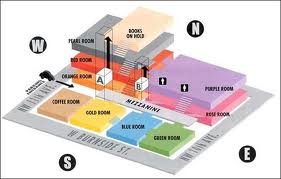
Could Powell’s City of Books – founded in the early 70s – propel Portland into the weirdness winner’s circle?  Maybe, considering that this is a bookstore where you’d be advised to Powells.2grab a store map at the information desk when you arrive.  You will need it in order to navigate three floors of book shelves occupying a whole city block, and upon leaving, like me, you will probably merit one of its free stickers, “I got lost in Powell’s City of Books,”  map or no map.  And if Mills’ End can be a park, Powell’s can surely be a city.  The true genius of this store, in my opinion, aside from powells.3ts size and the number of information desks, is that it shelves new and used books together – truly a two-for-one experience in book browsing/buying.  Believe me, worse things could happen than getting lost in Powell’s.  But does it contribute to Portland’s weirdness?  For something so rational and wonderful, it seems that points are deserved for “way cool” more than “weird.”

Since I railed at (pun intended) the Austin transit situation (not worthy of designation as a system), I’ll speak to Portland’s transportation system which consists of Max, the light Maxrail, buses, trams, etc.  It should also be noted that almost a quarter of their workforce bikes to work!  And what about the luxury of taking the light rail from downtown Portland all the way to the airport door (a 40-minute ride) for $2.50?  The reverse is also true – you can see the waiting train from the baggage claim area!  While it’s weird that Austin has nothing like this, I’m not sure that Portland can claim any weirdness points.  But again, very cool, Portland!

In the final analysis, dear readers, wouldn’t it make more sense for Portland to give up on the stolen weirdness motto and adopt the more accurate Keep Portland Cool?  After all, isn’t that coolness (literal) factor what draws us northwest during Austin summers?  Everything else Portland can offer is gravy, or should I say, herb vinaigrette?

Posted in Old/New Austin, Travel | Tagged , , , , , , , , , , , , , , , , | 3 Comments

Voting Rights: Deep Fried and Slathered with Butter

As you may have heard, one of the U.S. Supreme Court’s last acts this term was the axing of Section 4 of the 1965 Voting Rights Act that required pre-clearance by the Justice Department (or a federal court) of voting changes by certain states and local governments supreme-court-voting-rights-act-2014with a history of racial discrimination.  As Chief Justice John Roberts wrote, Section 4’s formula for determining which jurisdictions must seek pre-clearance, “is based on decades-old data and eradicated practices.” By eradicated practices, he means the literacy tests and poll taxes that suppressed voter registration and turnout in the 1960s and early 1970s.  Apparently, he and his Court majority gazed out upon the country (which presumably included the former Confederate states), and determined that the Act appeared to have worked its magic – despite a Congressional bipartisan majority’s reauthorization of the Act and the approval by a presidential son of the South (G.W. Bush) in 2006.

Seven years later, the Court exhorts Congress to go back and seek evidence on whether this system of “racial entitlement,” as Justice Scalia calls the Voting Rights Act, is still needed.  Makes me wonder.  Could they be thinking that racism has been eradicated because President Obama was elected?  If that’s your reasoning, Justice Roberts, please enlighten me:  how much of the Southern white vote did Barack Obama win in 2012?   As one conservative blogger said, “In what is being described as a resounding victory for conservatism, the overwhelming majority of native White Southerners voted against Barack Obama for the second time.”

Which brings me to Paula Deen, her brother, Bubba Hiers, and bad timing.  If only the Court could have heard about Ms. Deen’s admission of her use of the “n” word and her Bubba.2proposal that her brother have a plantation-themed wedding with black servers dressed up like plantation slaves.  And it might have been instructive to learn that at Bubba’s seafood restaurant, he restricted black employees to the back of the building, “out of sight of the white customers.”  May I suggest – if Congress follows the Court’s dictate to study racism in the South to see what jursidictions should be included in the pre-clearance coverage – that Ms. Deen and Bubba be called as witnesses?

If only Congress didn’t have to go through this exercise.  If the revelations concerning Deen and Hiers had happened a few months sooner, members of the Court might have gleaned  that a racist mindset persists in the Jim Crow south, particularly among a certain generation.  It was telling that Paula Deen was confused at first — mystified that anyone would have a problem with her use of the “n” word, particularly since they weren’t recent utterances or only used in jokes.  Frankly, as a born and bred daughter of the South, I don’t remember a time in my life when I could have FORCED the “n” word out of my mouth, unless it were during an intellectual discussion about the word, which I don’t think I’ve had yet.  Even here, my fingers refuse to type it.

But, some may wonder, are voting rights of blacks and minorities in the south at risk because of racial discrimination or simply because they happen to be partisans, generally, for a particular party?  Don’t the winners of elections get the spoils – including the right to voting.linesgerrymander and insulate themselves from all political opposition?  Normally, that would be true, but Congress long ago realized that white majorities in the South can’t be trusted to distinguish between political opposition in a way that doesn’t rely on race.  And no matter where you live in the country, arbitrarily depriving voters of convenient and historical places and hours to vote is undemocratic and not worthy of a country built on democratic ideals.

The bottom line is that I’m not sorry to see Paula Deen ostracized from the national stage because of her statements and fantasies about plantation days and the south of Jim Crow.  But there’s another reason not to feel bad for Paula Deen.  For too long, she has gotten away with running a food empire that is akin to pushing drugs on the local street corner – she just gets to do it on a larger scale and legally.

Yes, the local drug pusher doesn’t have a national platform like Paula’s from which she pushes her drugs of choice:  fried lasagne, chocolate-covered butter, and anything else paula-deen-parody dripping in salty, greasy, sugar-laden southern-ness.   To some, her national celebrity and financial success functions as permission to satisfy their addictions to that bliss point of fat, sugar, and salt.  After all, who would have said that Paula Deen peddled anything more than the good Southern fare that our mamas put on the table and we grew up eating? It’s tradition and what could be wrong with tradition?  Taking advantage of that emotional attachment, Paula Deen weaved a cocoon of blissful ignorance that anything with her imprimatur could be lethal to human health, contribute to the obesity epidemic, or play a role in this nation’s rising health care costs.

And yet, because we live in a free society, we couldn’t muzzle her.  We couldn’t even suggest that her cooking might be bad without risking a barrage of ravings from Sarah Palin about our freedom to eat whatever we wanted . . . I can hear Sarah now, alleging a conspiracy helmed by Michelle Obama who, we all know, had the galling audacity to promote healthy eating for children!  And Ann Coulter – before her love affair with Chris Christie ended (he’s dead to her now) – would have become Paula Deens’s new BFF because how dare anyone say that contributing to obesity is bad?  After all, according to the emaciated Ann (6 feet tall, 145 lbs), only girthful Chris can save the Republican party, so thou shalt not speak ill of obesity!!

Considering the alternatives, circumstances were kind to us this time.  Paula Deen exits stage left as a racist, which is so much easier for our media and talking heads to deal with PD.butterthan “food pornographer.”  Hopefully, she’ll take her butter and sugar-dipped fried cream cakes and crawl away.  I only wish the timing had been better – maybe about midway through the Supreme Court’s term, before they’d finalized their thoughts about voting rights.   Her sacrifice could have served this country in a way her foodie celebrity never did.

Posted in Politics | Tagged , , , , | Leave a comment

We’re Just Saying No: No Relaxing, No Enjoying It!

Among the many things that offended me about the events on the closing day of the Texas special session, one of the most offensive was Lieutenant Governor David Dewhurst blaming the Senate gallery for a breakdown of decorum and decency.

Thinking about decorum and decency, I have no quibble with Governor D that the gallery abandoned decorum after sitting quietly for more than 12 hours.  Yet, it was reported that until the last 15 minutes, they had been so quiet you could hear a pin drop on the Senate galleryfloor.  The gallery’s hold on decorum was lost at the same time the last remnant of parliamentary decorum was thrown under the bus, specifically when the presiding gavel-wielder of the Senate (Senator Robert Duncan) refused to recognize Senator Leticia Van De Putte.  The gallery – finally deciding that riding roughshod over women had its limits – reacted with chants of “Let her speak,” decorum be damned.  So in my humble opinion, an understandable breakdown of decorum.

What about the breakdown of decency Governor D mentioned?  I’m not sure what decency means to Governor D – he is an odd duck, after all – but Merriam Webster defines decency as “conformity to the recognized standards of decent or proper behavior.”  I’ll agree that it’s not customarily considered proper to yell out from the gallery of the Texas Senate.  But when did it become proper behavior to misinterpret the rules of an institution in order to get your way, something the Lt. Governor did repeatedly to stop the filibuster?   He didn’t just stretch the rules to stop Senator Davis from continuing to speak, he and his lieutenants made a mockery of them.  The 25-year old rule book was thrown away, as one long-time Capitol observer told me.  (Must read, by the way, Harold Cook.)

Before Tuesday, the Senate filibuster rules and past interpretations of those rules provided that a speaker couldn’t be disqualified from continuing her filibuster unless there were three sustained points of order holding that the speaker strayed from the topic of the bill.  A filibusterer in Texas cannot just hold the floor with reading the phone book as one in Washington can do.  Hence, her comments must be germane, in legislative lingo, to the bill under consideration.   In Senator Davis’s case, she was held to the three-strikes-you’re-out rule, but none of the sustained points of order were instances in which she had strayed off topic.  The specific points of orders to her filibuster on a bill about abortion restrictions and women’s health care were these:

Wendy1) It was not germane to speak of  Planned Parenthood’s budget;
2) It was impermissible for a colleague to help her fasten a back brace; and,
3) It was not germane to speak of the restrictions imposed last session regarding sonograms.

Clearly, there were not three non-germane points of order, as Senator Zaffarini noted in braceher late night point of order.  The second point was a violation, presumably, of the Senate rule that prohibits a senator from leaning on her desk, eating, or receiving any assistance from a colleague during a filibuster.  Accordingly, a fellow-senator’s assistance with the brace was an unfair strike against Senator Davis, because she had not requested the assistance — he instinctively helped her out as any southern gentleman would.  Shouldn’t that be a strike against him, not her?

But back to the first point, it’s hard to imagine anything more germane to evaluating the passage of a bill that would require the upgrading of facilities to surgical center standards (as SB 5 did) than a discussion of the financial capabilities of these facilities to perform the upgrade.  Does Governor D think that happens with fairy dust?  Money and budgets are at the core of the issue.  No facilities would need to be closed if money were a non-issue.

The third point of order was just as bogus as the first.  Senate Bill 5 imposed restrictions on a woman’s ability to obtain an abortion, closing the Roe v. Wade window of 24 weeks to 20 weeks, along with spelling the demise of most of the state’s clinics where abortions are currently performed.  Yet, it was ruled off topic for her to have mentioned the abortion requirement imposed upon women during the last session of the legislature, i.e., that a woman have a pre-abortion sonogram and wait 24 hours before having the actual abortion procedure.  Not only is that germane to the topic of restricting abortions, but considering the two laws in concert, S.B. 5 would create the situation of women having to travel long distances and spend at least a night in another city since the nearest center had to close.  This is absolutely germane and something that any lawmaker would presumably want to consider when imposing a new restriction on top of another one.

So, back to the subject of decency.  Is it decent to treat a woman differently than you would have treated a man?  Whether that was what Governor D did, I will not decide here, but Wendy Davis who has spent quite a bit of time in the Senate says that the leadership would not have ruled so dismissively had she been a man.

What is absolutely indecent, however, is why Governor D did what he did.  He first asked dewhurstGovernor Perry to add the subject to the call of the session solely for the purpose of furthering his political career.  His plan was to wave S.B. 5 around as a feather in his cap as evidence of his true conservatism to tea partiers who had supported Ted Cruz over Dewhurst in the U.S. Senate race.  And for this reason, he was bound and determined to get the bill passed by hook or by crook.  Women’s health care and their rights as full-fledged citizens — capable of making decisions about their own bodies — meant nothing to him other than a pathway to power.  And when you use women’s bodies as a means to an end, that is an act of violation not unlike rape.  So let me ask Governor D whether it is decent for a powerful man to stand up at a podium and gavel a woman down in order that he can have his way with her, and thereby, all the women of this state?

Because that’s the way it feels, Governor Dewhurst.  That’s why the women in the gallery started yelling.  They were tired, after more than 12 hours of witnessing the act you and your lieutenants so overtly perpetrated against Wendy Davis, Leticia Van de Putte, and women all over this state.  A woman can be scorned only so long before the furies of hell are unleashed.

I can’t help but recall Clayton Williams who ran for governor against Ann Richards in richards.21990.  His attitudes on women and their bodies were encapsulated in his offhand remark comparing bad weather to rape, ”If it’s inevitable, just relax and enjoy it.” Needless to say, Ann Richards won that election.

May Wendy Davis follow in Governor Richards’ footsteps (in whatever footwear she chooses) and let the Republican leadership know that they can expect a breakdown of decorum and decency whenever women are being burned at the stake, raped with impunity, or treated as second class citizens!  We will not relax and enjoy it, no matter how inevitable the circumstances!

Posted in Politics, Women | Tagged , , , , , , | 11 Comments

Circles and Cycles

As I hang up my two-decade litigation career at the Texas Attorney General’s Office, it seems fitting that I depart with some words of wisdom, acquired along the trail of courthouses across the state.  I’m sure my junior colleagues would have asked for some Yoda-style pronouncement, but in all the hoopla of my leaving, I’m sure they just forgot.  Not to worry, I will record some deep thoughts for them here.

Now, Grasshoppers, all of you are highly trained professionals, but this training has probably not prepared you for the issue of where to sit in the courtroom. traditional court  That’s not a problem, you might respond, because courtrooms are configured just like those we’ve seen on television and at the movies.  In other words, the judge sits in front at a raised desk, called the bench, with a witness seat to the side, and perpendicularly situated, there is usually an enclosed area for the jury, i.e., the jury box.  Finally, two rectangular tables, a few feet apart, are aligned in front of the judge where the opposing attorneys park themselves along with their notes, books, and files.  We’ve all seen My Cousin, Vinny, right?

And the fact is that most court rooms around Texas, thank goodness, conform to this plan.  Some date back to the 1800s and feature soaring ceilings and columns.  Others are modern with lowered ceilings, built-in projection screens, and teak paneling, but even then, rectangular counsel tables are placed, as tradition dictates, in front of the judge from where the attorneys address the court (standing) and question witnesses (sitting).  But, let me warn you, my friends, one day you will encounter CCC, the “Confounding Courtroom Circle.”

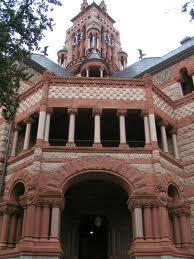
My first experience with CCC was in a courtroom in the Ellis County courthouse, Ellis countyoft-photographed and considered by many to be one of the grandest in the Southwest.  Pleasantly pre-disposed to historic buildings, I entered Judge Gene Knize’s courtroom expecting to take an appreciative, but brief, gander at the craftsmanship of yore before I sat down and began gathering my thoughts regarding my case.  Instead, I was confronted with the confusing sight of two round tables at least 6 to 7 feet in diameter placed in front of the judicial bench.  Where were the rectangular counsel tables that I had known and learned to love?  Had we driven to Waxahachie, Texas, only to be sent to a more distant past – King Arthur’s court?  If so, why two?  Maybe the courtroom doubled as a venue for dinner parties?  Forget cards — I couldn’t imagine poker-playing at tables so large.

So, instead of marshaling my thoughts in support of my excellent motion for judicial consideration, I had to figure out the seating.  If I wanted to face the judge in a normal fashion, I’d be at the back part of the table, a seemingly excessive distance from the bench and, depending on where the opposing attorney sat at the other table, I might be sitting 6 feet behind him.  I couldn’t sit on the front side of the table with my back to the judge for obvious reasons including whiplash.  So the only option was to sit on one side of the table with my chair and body skewed toward the front.  That left my legs exposed to the Judge’s gaze, which was very disconcerting since I wore skirts to court in those days.  I couldn’t help but wonder whether that was by design, i.e., was he a “leg man?”

And where would my co-counsel sit?  He would either be on the side with me, in a way that obstructed the view of the judge for one of us,  or sitting on the other side of the table making it difficult for us to consult during the proceeding.   Nothing in law school had prepared me for a courtroom like this.  Suffice it to say, Judge Knize got his leg shot.

In another variation of CCC, Cameron County has made entire courtrooms of the orbicular persuasion.  Other design features seem borrowed from a  science fiction/starship movie set – windowless with weird lighting effects, darker in the audience area and brighter in the “action” areas.  While the judge and witness box are situated at the top of the circle, attorneys sit at long semi-circular tables set up along the bottom third of the circle, so that opposing attorneys end up sitting on either sides of the room from one another.  If gladiatoryou like to see the whites of your opposing counsel’s eyes, forget about it.  You can’t even discern their tie patterns.  To consult or pass copies of documents, an attorney must trek over to the other side.  And instead of presenting your motion or case  from counsel table, a podium for addressing the judge is placed in the middle of the circle, reminiscent of a gladiator in front of the tiger — an apt metaphor for what happens to Austin attorneys in that neck of the woods. In terms of logistics, my young colleagues, think about what you’ll need in advance and carry it with you to the podium . . . take it from me, sprinting back and forth between counsel table and that podium is a bit awkward.

My most embarrassing CCC encounter, however, took place in Nueces County.  The courtroom was a beehive of activity upon my arrival with my land surveyor witness and client representative in tow.  I had little time to look around and orient myself  before our case was announced.  Proceeding through the gate, I went directly to an available table surface where I plopped down my briefcase, which I unloaded, observing — but not thinking too much about it — that it was rather narrow.  Nevertheless, it was nice and long so I could easily unfurl the large maps I had brought.  It seemed perfectly natural that I was seated almost directly in front of the judge and fairly close to the witness box where my witness would answer my questions and identify the maps and documents I was prepared to introduce into evidence.  If we were sitting on a clock face, the judge was at 12:00, I was at 6:00 and the witness box was at 3:00.  My opposing counsel was sitting about 10:00.

Upon completion of the hearing, I packed up my briefcase, noticing again the narrowness of the table I had been using.  As we departed the court room, the client rep (who had observed from the audience section) asked me, “Just out of curiosity, Jeffee, did you know you were sitting in the jury box?”  I looked back and it was only then that I realized that this was a newfangled courtroom that did not have a boxed structure to enclose the jury.  Instead, the jury sits in a semicircle of wheeled chairs that are placed around a curved divider – about a foot to 18 inches wide – which I had assumed was semi-circular table surface.  I had sat at the end of that structure where juror number 12 or 1 would sit.  The counsel table where I should have sat was a regular rectangular table, next to the table opposing counsel had been using . . . about 9:00 on the clock face.

I just looked at him and with as much aplomb as I could muster said, “Yes, of course.  It was more convenient than the counsel table.”  But during the entire four-hour drive back to Austin, all I could think about was that roomful of people wondering why the State’s attorney was sitting in the jury box!

So, as I look back on my career in litigation, I gladly bid adieu to the CCC, and leave that to you, Grasshoppers, to master.  I can only surmise that it will get worse if interior designers with this obvious aversion to lawyers get their way.  I would only point out that the legal world is about drawing lines . . . the line from prior cases to a current set of facts, the line between right and wrong, the line between your opponent’s version of the facts and the actual truth.  Lines, lines, lines.  If tall spires make people think in a more spiritual direction, how will these circles influence legal thinking?

It is my hope that this circular design will not imperil our legal system, but time will tell.  My last flagexercise in line-drawing occurred on May 31, 2013, when I drew the line between my employment as a state worker and my engagement as a state citizen.  As I end one stage and begin another in life’s cycle, I can assure you, it’s been an honor to represent the State of Texas . . . in rectangles, squares, and even those confounding circles!

Posted in Great Lessons | Tagged , , | 4 Comments

What I Want for Mother’s Day

This week brought the horrifying news of the three women enslaved by a man in a Cleveland house, the horror only diminished by the fact that the three were finally free.  After ten years.  The details — those revealed and those that I can imagine — make me physically sick.

But the reality is more sickening:  this could happen to any woman. Ariel Castro’s enslavement of the Cleveland women is a graphic metaphor for the neverending war on women conducted everyday in this country (not to mention atrocities around the world) by men who believe they have the right to control the lives of women, be it human trafficking or eliminating abortion facilities.

Such has been our history as women; unfortunately, it continues to this day, even in this country of so-called enlightenment and evolved beings.  In state after state, legislatures dominated by Republican majorities with Republican governors are curtailing as many options for women and their reproductive health as they think they can get away with.  Is this only because they can’t chain women up in houses and force them to remain in their places!?

I have been consumed with dismay during the last couple of weeks with the issue of guns, background checks, and every parent’s worst nightmare – of losing your child to a lethal weapon, be it in the hands of a maniac or another child with a “children’s rifle”.  Congress and legislatures across this country are clearly in the pockets of the NRA and there is little we can do to prevent that.

But ultimately, aren’t we talking about a question of money?  Votes?  Things that men and women can realistically do, and may do, in the next election cycle to close the background check loophole and maybe more gun control?

But the war on women is more daunting because it seems to be a remnant of primitive times that is locked in the male DNA.  Is there really any way to eradicate the gene that makes men believe they are on this planet to control women . . . to diminish them, keep them in their roles as subordinates, barefoot and pregnant, and TIED to the house?  No wonder so many men have a visceral (as opposed to rational) reaction when they contemplate a female president.

These days I see a Congress (primarily House of Representatives) and men in legislatures across the country attempting to keep women as second-class citizens by eliminating our ability to control our bodies.  As many quipsters have said, “If men could get pregnant, abortion would be a sacrament,” which is reasonably based on the reality that the biological effects of pregnancy and parenthood impact one’s ability to participate fully in the workplace and halls of power.   Thus, being able to control the timing of when we will start a family is a fundamental part of allowing women real economic and political equality with men.  The fight to put the reproductive genie back in the box has been escalated, I suspect, because they’ve seen what we are achieving in corporate boardrooms and electoral politics and they simply CAN’T STAND IT!!!

Caveat: I am not speaking here of the group among the male population who have evolved and seem to have the new DNA.  The ones I am indicting here wouldn’t waste their energy even reading this.

As today is Mother’s Day, I would also mention that – as the mother of two adult sons – I do not include them in my indictment of those who disrespect and diminish women.  I’m pleased to say that they are enlightened, evolved, and that I have every reason to be proud of them in regard to this, as well as many other issues.

So, maybe like the gun issue, things are not hopeless.  We can hope that my sons and the sons of other women like me will turn the tide against the Republican waves of misogyny. We can hope that they have learned that society is better off when all of its citizens are equal participants, be they mothers, homemakers, businesswomen, legislators, or judges.  We can hope that they know that the days of diminishing and enslaving women are as anachronistic as diminishing and enslaving our black citizens.

And while our sons are part of the equation to a future of female equality, our daughters are the other part.  May they continue to fight for the rights we thought we won 40 years victoryago.  As we’ve seen lately, these rights can slip away so easily.  What do I want for Mother’s Day?  The right of women to decide their own destinies and their having the opportunity and the means to do so.  After all this time, after fighting for the right to vote, to enter into contracts, to own property and have credit cards, to study at any educational facility, use birth control, and the right to choose, is it too much to allow us our victories?  Isn’t it time to let us frame our own futures?

Posted in Women | Tagged , , | Leave a comment

Resistance is (not) Futile

Much has been said about the failed attempt to pass the gun background check law through the Senate recently, but I’ll say some more things about it since it’s hardly an issue I can ignore — especially since I’m a fan of good government.  I find it hard to swallow that the biggest stumbling block in the way of generalized law, order, and a civilized society these days is our duly elected Congress, particularly the Senate 46 who voted against background checks.  This is definitely not good government.

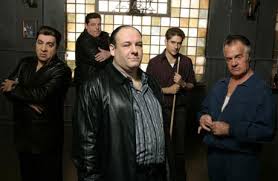
I guess I’m most troubled by the notion that law-abiding citizens need lethal weaponry in order to walk down the streets in 21st century America sopranos(and I’m not talking about you hunters and your shotguns . . . I know the deer herds must be thinned).   On the other hand, I understand why criminals need guns.  Heaven knows, I watched every episode of The Sopranos and it seemed quite sensible for Tony Soprano to carry a gun.  He had every reason to fear for his life.  Bank robbers, of course, need guns, too.  But how many among us are mob bosses and bank robbers? And why would the Senate 46 want to help out the Sopranos and the Dillingers of America with their criminal lifestyles?

And what law-abiding citizen fears a criminal background check, i.e., a computer search for criminal arrests, convictions, sojourns behind bars, etc.  To rent many apartments or buy a condo these days, one must agree to (and pay for) a criminal background check.  Various jobs and nearly all licensed professionals require such an investigation.  But we have 46 senators (and no telling how many House members) who think that this rather wimpy gun control measure is way too much control for individuals to suffer through in exchange for acquiring a killing machine.

Such a position, however, flies in the face of what polls tell us about the Americans the Senate 46 purportedly represent.  It’s been reported that 90% of Americans said they were in favor of closing the gun show background check loophole and requiring all sales to be subject to background checks.  In North Dakota, that number is 94%, which really makes me wonder who Heidi Heitkamp thinks she represents.  It’s hard to believe that the Senate 46 are expecting to get re-elected from that voting block of 6-10% who most likely couldn’t pass a background check and probably aren’t registered to vote.

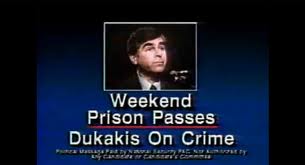
And what is really galling is that when election time rolls around, these 46 senators will be dukakisamong those who sound off loudest and most often about the need for more law and order.  And that’s because they know full well that big chunks of American voters are in favor of the law and order concept.  In other words, coddling criminals is not something that gets you elected to office . . . just ask Michael Dukakis who was wrongly smeared on the issue.

So, if it isn’t the criminal element that the Senate 46 wants to cuddle with, maybe it’s that special group of so-called Americans who say they need lethal weapons to “protect themselves from the government.”  That sounds so delusional, I assume these are the koreshfolks who are bogarting that medical marijuana!  That’s, like so 18-19th century, man.  If you missed high school history class during the Civil War chapter, here’s the Cliffs Note’s version:  the U.S. government won.  And surely you’ve read your Insurrectionist Monthly and feature on the more recent poster boy for insurrection, David Koresh, a.k.a. the Waco whacko.  But as someone recently pointed out, you could have a compound with millions of rounds to shoot at the government folks, but they have, let’s see, hmmm . . . everything else?  Yes, everything from bullets to tanks to nuclear weapons.   And drones, too.  So, the way I see it, any self-respecting insurrectionist needs at least a tank or two, but are we going to interpret the Second Amendment to allow tank ownership? And by the way, has anyone suggested that the Senate 46 could be accused of harboring traitors by empowering these insurrectionists?

Yes, maybe our country was founded by insurrectionists, but that was a one-time deal.  A government of the people, by the people, for the people doesn’t last long if those people are gunning for each other and/or trying to ditch the duly constituted representatives of government. Maybe we should try convincing insurrectionists to self-deport to a deserted island where they can run their own show, grow weed and shoot as many fellow-citizens as they like.

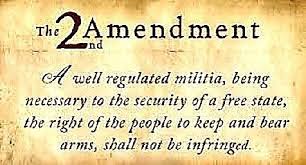
And what about the misread of the Second Amendment’s plain language in the name of strict construction?  I’m not sure whether it’s hysterical blindness or selective 2nd mendmentdyslexia, but there’s more to the second amendment than that single clause stating  “ . . . the right of the people to keep and bear arms shall not be infringed.”   In fact, that clause is prefaced with —  subordinate to — another clause, deliberately ignored by these so-called strict constructionists:  “A well-regulated militia, being necessary to the security of a free State . . . ”

Thus, if one adheres to the principal of legal interpretation – where every word in a statutory/constitutional provision must be considered to have been included for a reason and interpreted in harmony with every other word – the right of the people to bear arms assumes that those people bearing arms are part of a well-regulated militia.  And just because militias are no longer part of the American military landscape doesn’t mean that we get to ignore the prefatory language and adopt a new meaning by taking the second clause completely out of its context.  That is equivalent to re-writing or amending the amendment, which is impermissible without going through the amendment process in Article V.

Simply put, our founding fathers did not believe that guns were a good thing per se; the right to keep them in the wake of separation from Great Britain was inextricably linked with the need to have a well-regulated militia.  And while I haven’t researched it, I bet George Washington had a word or two to say on the subject of “well-regulated” in the second amendment, given that his biggest headache in fighting the American Revolution, according to historian David McCullough, was that the state militias he commanded were a rag-tag lot, undisciplined, and certainly not well-regulated.

So, the more I considered the Senate 46 and their willingness to thumb their collective nose at the prospect of more dead children, citizens, theater-goers, and congresspeople, I borg.2realized that I had to turn to fantasy to understand these people.  You Trekkies and occasional Star Trek watchers can guess where I’m going: Congress has been assimilated by the Borg, the alien race that periodically threatened the Enterprise.   The Borg, as I now understand it, is the National Rifle Association which spends big ($32 million in 2012) to elect guns-for-all-anytime candidates and defeat those who don’t support these goals, people’s lives be damned.  The Senate 46 have all bought into the notion that resistance is futile if they want to get re-elected, because having a career in Congress is more important than the lives of people and the NRA will get them re-elected.  That’s the only reasonable explanation for this vote.

Here’s the only reasonable response:  get the list and vote them out of office.  Since the Senate 46 cannot, it’s up to us to resist the Borg.

Posted in Politics | Tagged , , , , , , , , | 4 Comments

How about an International Women’s Decade?

I suspect that many of you are oblivious to the significance of March 8th and probably Mar 8didn’t see any reference to it anywhere last week. Except for the Google doodle referencing International Women’s Day (“IWD”), it didn’t get much media play. I didn’t see even one Hallmark card for IWD, although there were quite a few for St. Paddy’s Day, the important beer-drinking holiday.  That’s a real head-scratcher when you consider the market for the Irish or even beer drinkers.  Imagine selling cards to send to over 50% of the world’s population.  Huge! The sale of stamps to mail these cards might single-handedly save Saturday delivery for the USPS.

Since 2000, IWD has been an official holiday in Afghanistan, Armenia, Azerbaijan, Belarus, Burkina Faso, Cambodia, China , Cuba, Georgia, Guinea-Bissau, Eritrea, Kazakhstan, Kyrgyzstan, Laos, Madagascar, Moldova, Mongolia, Montenegro, Nepal, Russia, Tajikistan, Turkmenistan, Uganda, Ukraine, Uzbekistan, Vietnam and Zambia.  In many of these countries, they have traditions of men honoring their mothers, wives, girlfriends, colleagues, etc ., with flowers and small gifts. In some, IWD is akin to our Mother’s Day where children give small presents to their mothers and grandmothers.

One can speculate that the socialist roots of this movement might be one of the reasons why the US has not embraced the day full-heartedly. The International Women’s Movement began on the eve of World War I when Russian women, campaigning for peace, observed their first IWD on the last Sunday in February 1913.  Four years later, on that last Sunday, Russian women began a strike for “bread and peace” in response to the death of over 2 million Russian soldiers in war. Opposed by political leaders, the women continued to strike until four days later the Czar was forced to abdicate and the provisional government granted women the right to vote. The women’s strike commenced on Sunday 23 February on the Julian calendar then in use in Russia. This day on the Gregorian calendar in use elsewhere was March 8th and is the agreed upon date for IWD.

Since then, IWD has grown to become a global day of recognition and celebration across developed and developing countries alike.  Equally important, it is also a day for stressing the need for continued vigilance and action to ensure that women’s equality is gained and maintained in all aspects of life.  For many years the United Nations has held an annual IWD conference to coordinate international efforts for women’s rights and participation in social, political and economic processes. The UN even designated 1975 as International Women’s Year.   In case they are seeking opinions, I think we need another year or two…would it be too much to ask for a decade?


Although I’ve read that many global corporations have started supporting IWD moredoodle actively, I’ve seen no evidence of such support in my world, except, as I mentioned, the Google doodle of the day. Thanks, Google, I feel better.

But while women in this country may not have a specific day to mark their achievements (and take stock of what’s left to achieve or halt in its ugly misogynist tracks), March is a nationally dedicated month for celebrating Women’s History.

Honoring our history began as Women’s History Week in 1981 when Congress passed a resolution that authorized and requested the President to proclaim the week beginning historyMarch 7, 1982 as “Women’s History Week.” Throughout the next five years, Congress continued to pass joint resolutions so designating a week in March.  In 1987, after being petitioned by the National Women’s History Project, Congress designated the month of March 1987 as “Women’s History Month,” which it continued every year until 1994. Since 1995, Presidents Clinton, Bush and Obama have continued the designation for the month of March by issuing annual proclamations.

Celebrating women’s suffrage and full rights as citizens is a good thing, but we cannot rest easy. As we have seen in the last few election cycles, all that we have gained thus far can be wiped out at any time by misguided elected officials and groups seeking to impose their personal religious beliefs on all Americans. In these days of peril to our rights and freedoms, I’m glad we have the president we do, who appreciates women and is willing to champion our rights as equal citizens. The words of President Obama’s dedicating this month to women’s history are sweet music to the ears of all women and those who love women:

Year after year, visionary women met and marched and mobilized to prove what should have been self-evident. They grew a meeting at Seneca Falls into a movement that touched every community and took on our highest institutions. And after decades of slow, steady, extraordinary progress, women have written equal opportunity into the law again and again, giving generations of girls a future worthy of their potential.

That legacy of change is all around us. Women are nearly half of our Nation’s Rosie.riverterworkforce and more than half of our college graduates. But even now, too many women feel the weight of discrimination on their shoulders. They face a pay gap at work, or higher premiums for health insurance, or inadequate options for family leave. These issues affect all of us, and failing to address them holds our country back.

That is why my Administration has made the needs of women and girls a priority since day one — from signing the Lilly Ledbetter Fair Pay Act to helping ensure women are represented among tomorrow’s top scientists and engineers. It is why we secured stronger protections and more preventive services for women under the Affordable Care Act. It is why we have fought for greater workplace flexibility, access to capital and training for women-owned businesses, and equal pay for equal work. And it is why we have taken action to reduce violence against women at home and abroad, and to empower women around the world with full political and economic opportunity. . . .

And on the subject of empowering women, I would add a mere three words to the President’s proclamation: Run, Hillary, run!!!!Hillary

Posted in Uncategorized, Women | Tagged , , , , | 4 Comments

Choppy Waters for Fish Bowl Families

As the world knows by now, Kate Middleton, the future queen of Great Britain, Kate mis enceinte.   On both sides of the pond, we’ve been made privy to the details of her dreadful morning sickness and, of course, the tragic suicide of the poor nurse who allowed a telephonic Queen Elizabeth impersonator to talk with her.  Even without more such tragedy, Kate’s royal reproduction rites will be an ongoing soap opera as it titillates and reminds us that those who wear crowns are different from the rest of us.

Reproduction, for instance, is handled differently because different things are expected of them.  Unlike Americans and other commoners who have children so they can relive their youth vicariously through their kids or guarantee visitors at the nursing home, royals need to produce offspring to occupy a future vacant throne.  Brothers and sisters are needed just in case the oldest wants to marry an unacceptable American.  Raised for this eventuality, the royal progeny need care and guidance from carefully-selected nannies, tutors, and staff persons while their parents travel around the country performing at ribbon cuttings, charity events, and other royal adult activities.  Revealing herself as a novice royal, Kate Middleton has nixed the nanny idea in order to raise her own child, creating a slight stir among some royal watchers.

America’s closest thing to royalty, the President and his family, presents a distinctly Kantordifferent paradigm.  In general, our presidents and first ladies (one of the most nebulous roles on the American stage) must transition from a fairly pedestrian life to one with the trappings of wealth and power almost overnight.  One day in November every four or eight years, a new first family is catapulted from normalcy into a world where the quest for a new normal must begin.

In her book, The Obamas, Jodi Kantor pulls the curtain aside on how our current first family coped with this transition.  Consider that before the presidency, Michelle and Barack could attend their daughters’ sporting events, plays, recitals, back-to-school nights, and go to dinner together at their favorite Chicago pizzeria (Gino’s East?).  With his election, they became the most observed foursome in the country, unable to do anything that was done before, at least in any similar way.

Kantor’s book also reveals the various conflicts in the marital relationship of Barack and Michelle and their juggling between their roles as working professionals and involved parents.  A difficult task for any couple, it was exacerbated by Michelle’s long-held michellebelief that our  political system cannot forge lasting change of world problems, and Barack’s long-held belief to the contrary.  The whole time he has been a parent, Barack has been involved in politics, commuting between Chicago and Springfield as a state senator, and then to Washington D.C. as a U.S. Senator, and finally, all over the country as a candidate for president.   His absence at the family dinner table has been a hallmark of his life as a father, as well as a source of intense parental guilt and marital strain.

Even in the aftermath of the election in 2008, Michelle was hesitant to embrace the political life, toying with the idea of staying in Chicago so that the girls wouldn’t be uprooted and subjected to new schools and a whole new lifestyle, according to Kantor.  She was soon convinced that it was a ridiculous idea for a variety of reasons, but what really sold Michelle on White House living was the fact that Barack would be at home every day, available to have dinner every night for the first time ever in their daughters’  lives.  In fact, his scheduling and political staff have strict instructions not to schedule him to miss family dinner more than two evenings a week.

Of course, dinner with the family is easy compared to actually spending time with Sasha and Malia as a parent outside the confines of the White House.  Neither Michelle nor oldfamilyBarack can visit the girls’ schools, attend their performances, or yell encouragement from the sidelines of their soccer games as anonymous parents.  Early attempts to do so were quickly scrapped as it became evident that the President (or First Lady) at a school event took the attention away from the girls — their parents became the main event.

As much as both parents have wanted their daughters to be able to do normal kid things, it has generally been problematic as occupants of the White House:  trick or treating at Halloween, for example.   Neither Michelle nor Barack, with their required Secret Service entourage and the minute planning involved, can take the girls around the neighborhood, calling for candy.  One year, family friends were enlisted to take them around a nearby Washington neighborhood.  Even then, they were soon recognized, and the neighbors began to text each other, waiting at the doorstep for them to appear, thereby eliminating any surprise, one of the criteria which provides the level of safety the Secret Service requires.  The outing had to be truncated.

Sadly, we’ve recently witnessed attacks on President Obama by the crude and crass use of his daughters to advance the NRA agenda.  Despite the fact that national security requires NRAFirst Family protection, the NRA singled out the armed protection at Malia’s and Sasha’s schools as an example of the President’s hypocrisy in stating that more guns is not the answer to our national nightmare of never-ending violence.  Does this add to the President’s guilt about sacrificing his daughters’ normalcy and anonymity at the altar of his career choice?  Without a doubt.  And what a sad commentary on the America we’ve become.

The American president is often perceived as a national father figure, the one who will lead, shelter, and protect us as individuals and a nation.  But for those presidents whose children are still under their care, the parenting job is of no less significance, I’m sure, than preserving and protecting this country’s future.

I hope Kate Middleton continues in her quest to be a royal in the spirit of Diana Spencer, a fishbowlreal mother to her children.  But, unlike the American presidential family, she will not have to cope with children who suddenly lose their anonymity and the normalcy of everyday life.  From the beginning, even without nannies, her family will be raised in the fish bowl and under the microscope of the public and paparazzi.  Walls, fences, and protection will be normal in the life of her children; they will never have to experience the loss of a normal they will never know.

One other advantage Kate will have is this:  even while she will have to make adjustments in her parenting to satisfy certain security requirements, at least she can sleep better at night knowing she doesn’t have to put up with the NRA or a country full of gun nuts threatening her children.

Posted in Politics, Women | Tagged , , , , , | Leave a comment

Hangin’ High or Muddlin’ Through

[This post is borrowed from my friend Flaco’s blog: http://www.toofarfromtown.blogspot.com/%5D

According to the American Society of Composers, Authors and Publishers (ASCAP), Have treeYourself a Merry Little Christmas, written by Hugh Martin and Ralph Blane, is the ninth-most popular Christmas song so far this year. Recordings of the song by various artists were played on the radio 38,395 times between October 1 and November 28. Unfortunately, data are not available to show how many times each of the two versions of the song’s lyrics was played.

You may not have known there were two versions; you hardly ever hear but one of them nowadays.  The most popular version—the one you hear 99% of the time—goes like this:

Have yourself a merry little Christmas.
Let your heart be light.
From now on, our troubles will be out of sight.

Have yourself a merry little Christmas.
Make the yuletide gay.
From now on, our troubles will be miles away.

Here we are as in olden days,
Happy golden days of yore,
Faithful friends who are dear to us
Gather near to us once more.

Through the years we all will be together,
If the fates allow.
Hang a shining star upon the highest bough.

And have yourself a merry little Christmas now.

A few years ago, I was only vaguely aware that there might be two versions of the song.  I remembered hearing something about “muddling through” in the lyrics of the song, but I heard them only every once in awhile.  I didn’t give the matter much thought except to think that those were unusual words for a Christmas song.  Then I heard the song played one December night on the radio, and the announcer referred to it as the “original version recorded in the 1940’s.”  Everything then fell into place for me.  The 1940’s!  I’ll bet it was during the war, I thought.  A quick internet search confirmed my hunch.

The first recording of Have Yourself a Merry Little Christmas, sung by Judy Garland, was released by Decca records in 1944.   Think of what it must have been like for Americans judygarlandthat Christmas.  Gasoline, rubber, nylon, shoes and other essentials were being rationed because the war effort needed them.  People had planted “victory gardens” in their backyards to grow their own food.  They were conducting paper and scrap-metal drives and buying war bonds.  All across the country, families had husbands, fathers, sons, and brothers in combat theaters “somewhere in the Pacific” or “somewhere in Europe.” (That’s all the military censors would allow the servicemen to say about their locations in the letters they sent back home.)  From October through December of that year, for soldiersexample, General MacArthur’s army was fighting the Battle of Leyte in the Philippines, and in Leyte Gulf the navy fought what some say was the greatest battle in naval history.  Allied troops were fighting their way across Europe, and beginning in mid-December many were fighting desperately in the snow to repulse the German counteroffensive in the Battle of the Bulge. And whether servicemen’s families celebrating Christmas back home in 1944 said it out loud or not, they worried they might never see their loved ones again.  They dreaded the knock on the door from the Western Union boy, and of course, many had already received that life-changing telegram from the War Department.

Here are the words that Judy Garland sang that Christmas:

Have yourself a merry little Christmas.
Let your heart be light.
Next year all our troubles will be out of sight.

Have yourself a merry little Christmas.
Make the yuletide gay.
Next year all our troubles will be miles away.

Once again as in olden days,
Happy golden days of yore,
Faithful friends who were dear to us
Will be near to us once more.

Someday soon we all will be together,
If the fates allow.
Until then, we’ll have to muddle through somehow.

So have yourself a merry little Christmas now.

I understand (I’m getting much of this from Wikipedia by the way–credit where it’s due) that Judy Garland’s recording was a wartime favorite among American servicemen. And this original version of the lyrics was recorded by a few other singers as well. But things jolly sinatrachanged in 1957 when Frank Sinatra prevailed upon the composer to change the words of the song so that Sinatra could include a less bittersweet version in his album, A Jolly Christmas. Hugh Martin accommodated Sinatra by writing a jollier set of lyrics. He changed the song’s future-looking point of view — “next year” and “someday soon”– and replaced it with “from now on.”  And most tellingly, he deleted the muddling-through and, in its place, hung a shining star upon the highest bough.  But the title remained the same, which presents something of an anomaly.  If things in the Sinatra version are so hunky-dory now and will be from now on, why is it still just a  merry little Christmas?

The shining-star version has since been recorded many, many times by many, many singers (including Judy Garland, herself).  It’s pretty much all you hear nowadays (although James Taylor, bless his heart, did record the muddling-through version on his 2006 CD James Taylor at Christmas).

I much prefer the muddling-through version to the shining-star version, and it’s a shame we hardly ever hear it.  Its lyrics fit the scaled-down, subdued, merry little Christmas of the song’s title much better than the shining-star version does.

To my way of thinking, we still need the original version of the song, because there’s still plenty of muddling-through to be done at Christmas.  I guess there always will be. Take war, for example. By my rough count, there have been 22 Christmases since 1944 when Americans were serving in combat zones. (It’s a rough count, because it’s hard to keep up with the dates that some wars start and stop, as you know.) That’s twenty-two Christmases when there were American families uncertain that their loved ones would return home alive — and were muddling through the best they could in the meantime.

And there are plenty of other reasons besides having a family member deployed in a war stewartzone why a person or a family might find themselves muddling through a Christmas and hoping that things will be better next year: illness; unemployment; recent divorce; a recent death that has shaken a family’s very foundation. Under such circumstances, it will take quiet heroism for the folks involved to make Christmas merry, and if they achieve a merry Christmas at all it is likely to be a little one.

My family is doing just fine this Christmas, and I hope yours is, too.  But that could all change in a heartbeat.  Or with a telephone call.  Or with the delivery of a pink slip.  If we are not among the ranks of the muddling-through today, we could be tomorrow.  It seems to me that it isn’t asking too much to have at least one Christmas song for people who are just trying to muddle through.

Posted in Uncategorized | Tagged , , , | 5 Comments