The Violation of Viola

Right up front I’ll admit to having few credentials as a television or entertainment critic. On the other hand, I’ve read many reviews that make me question the credentials of others. I figure if you can articulate your opinion and a few significant whys and wherefores in support of it, anyone can be a critic . . . at least on their own blog!

Frankly, many television shows I’ve liked were not big hits. For example, Paul Haggis’s EZ Streets, starring Ken Olin and Joe Pantoliano, didn’t even air an entire season. While nine episodes were shot, the show was rudely axed from the schedule after the eighth one, as if it were a tub of rotting fish.  Not even a hint of closure.
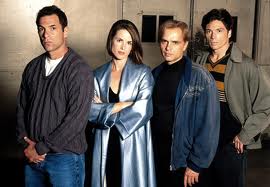
EZ streets

Also, Civil Wars with Mariel Hemingway, Debi Mazur, and Alan Rosenberg, produced by Steven Bochco, didn’t last long. The show featured a partnership of divorce attorneys in Manhattan in which one of the partners played by Rosenberg (Levi) has suffered a nervous breakdown. The budding relationship between Mariel and the new partner, Peter Onorati, along with Levi’s attempts to put back the pieces of his professional life were beautifully nuanced.

civil wars

Another favorite was Once and Again with Sela Ward and Billy Campbell, portraying a newly divorced single mom with two daughters who meets a single dad with his own children and problems. Interspersed throughout each episode were “interview” sequences filmed in black and white, in which the characters would reveal their innermost thoughts and memories to the camera. Alas, it only lasted a season or two.

once&again

And then, there was Jack and Bobby, a faux documentary on WB network about the lives of two brothers, one who would grow up to be president in 2041, starring the wonderful Christine Lahti as their mother and college professor. Unknown Bradley Cooper played one of her TAs and potential love interest.  Both the premise and the execution were television at its finest.  One season.

jackbobby

So, in case you haven’t already fired me as an entertainment critic, let me give you another reason:   Law & Order grates on my every last nerve. Even if you don’t mind that the police officers regularly arrest suspects by violating their constitutional protections, a viewer must put up with lawyers in the courtroom behaving badly, i.e., getting away with antics no judge would tolerate in a real court. Sam Waterston takes high dudgeon to new levels, badgering witnesses, pontificating, and grandstanding, which may be the way they practice law in New York court rooms, but I kind of doubt it. It’s just too irritating and implausible for me to watch.

Finally, if you are still with me, let me tell you about the new ABC show, How to Get Away with Murder, which was on the rave list of several (professional) television critics.  They apparently liked the show and gave Viola Davis high praise for her portrayal of a criminal law professor. As I think Viola Davis is a great actress and spent three years in law school, I thought it would be an interesting walk down memory lane, if nothing else.

Prof keating

Not only was it a far cry from the Paper Chase – it wasn’t even in the same universe.  Viola Davis as Annalise Keating, is more than a law school professor teaching first-year criminal law – outside the classroom she is also a criminal defense attorney! And, in this first episode, she’s on the eve of trial, defending a woman accused of murder. This also happens to be the first day of the fall semester.  Accordingly, she tells her class full of eager young men and women – who are still finding their way around the school, getting moved in, etc. – about the facts of her case and invites them to come up with ideas for defending this woman. Whichever five or six students think of the best ideas get to participate on the defense team.  Do I really need to point out, there are soooo many things wrong with this picture?

To begin with, first-year law students, with merely the first day of class under their belt, have no more knowledge about the law than the little they may have gleaned from Law & Order (not much). They are usually ignorant about both trial and pre-trial procedure, e.g., discovery, motions in limine, privileges, etc. Legal research is not yet in their skill set – Lexis and Westlaw passwords are probably still in the mail. To underscore this fact, one of the chosen students thinks he’s found a winning strategy after the first day of trial.  He excitedly suggests that she could go for a directed verdict (meaning that there is no legally sufficient evidence to allow a reasonable jury to reach a contrary conclusion) because she managed to discredit one of the prosecution’s witnesses on cross-examination. A directed verdict, of course, is nothing new to any trial lawyer, and Professor Keating appropriately rejects it out of hand. But one has to ask:  Why is she wasting time with these students?  Simply put, no trial attorney (even a part-time law school professor) would turn a murder trial into a learning exercise for newly-seated law students!!

In fact, these students, at the outset of their legal education, need to have their butts sitting in the rest of their first-year classes: Torts, Property, Constitutional Law, Contracts, and Civil Procedure classes. One gal (apparently the smartest among the trial team six) expresses some concern about her other classes, but Professor Keating cuts her down with rapier swiftness about being a real lawyer. Can’t she be a real law student first, Professor?

law books

Frankly, law professors fall all along the arrogance spectrum (which is good training for dealing with judges) but I can assure you, the rest of the faculty wouldn’t put up with Professor Keating very long. It’s clear that she is one who disdains traditional legal education and her colleagues, as well. And not to the benefit of her students.

If you need more implausibility, did I mention that the Professor goes to a cocktail party one night in the middle of the trial? If you are in the thick of any trial, much less a murder trial, I can guarantee you that the attorneys are not out partying and drinking. You barely have time to eat or sleep.

Perhaps the worst part of the show was watching what she did to a detective she had called as a witness. I’d hate to spoil it for you (in case this show is still on your DVR and I haven’t discouraged you from running it), but suffice it to say that she manipulated him into a compromising position a few days earlier and then, completely blindsided him on the stand, probably destroying him professionally and his department. It was pretty disgusting.

As for the subplot with the trial team students who become involved in a murder, I’m sure it is partly designed to distract viewers from the preposterousness of Professor Keating’s law practice and teaching methods. I’m not sure that their predicament will make the show watchable, but I will say that these kids would be better serving time in prison rather than serving a whole semester in Keating’s class and experiencing the soul murder that she would exact.

And speaking of the soul, I wonder if anyone else is offended by her character’s name: Professor Keating? The last Professor Keating in entertainment history was Robin Williams’s character in Dead Poet’s Society. If this is some cute attempt by the show’s creators to suggest that there is any commonality (beyond the employment of unorthodox teaching methods), I will hereby correct them.  There is no comparison. John Keating filled souls. Annalise Keating drains them.

robin.williams

In conclusion, it’s always sad to see talent wasted and in this case, to see the skills of a very good actress employed in furtherance of such ludicrous and outrageous nonsense.  With my track record, however, it will probably be a big hit.  Bets, anyone?

Posted in Television, Uncategorized | Tagged , , , , , , , | 3 Comments

Who are the Excuse Makers?

One of the disturbing truths about higher education seems to be that we, as a society, and colleges, as institutions, have yet to educate young men that it’s a bad idea to force yourself on young women. Protection from the seas of unrestrained testosterone that leave young women at risk of sexual assault, seems to have hardly improved since my college days. California, for example, just passed the “yes means yes” bill defining consensual sex as “an affirmative, conscious and voluntary agreement to engage in sexual activity” and requiring its adoption as policy by universities and colleges.

yes.means

Although we hear about the more notorious cases such as the recent ones involving two UT football players, the problem is surely not confined to athletes. Hard and fast statistics on the size of the problem, however, are not available. A survey by Senator Claire McCaskill, found that more than 40 percent of colleges and universities admitted that they have not conducted a single sexual assault investigation in the past five years.  President Obama recently launched a national effort to help colleges gauge the scope of the problem and institute certain protections for the victims.  The Campus Safety and Accountability Act, introduced by a bipartisan group of eight U.S. senators including Senator McCaskill, requires universities to address the issue of sexual assault seriously. Universities receiving federal funds (nearly all of them) would have to conduct “climate surveys” to better estimate numbers of incidents and measure student awareness of available help. Progress would be tracked with yearly updates, published online. Also, strict protocols are required for investigating allegations that would prevent athletic departments, for instance, from meddling with sexual assault investigations. Failure to comply with the law would subject campuses to stiff financial penalties — up to 1 percent of their operating budgets.

While I applaud these efforts unequivocally, I suspect that the size of the problem will remain undiscovered. Based on my experience, I think female coeds often resist reporting assaults to their best friends, much less the authorities, for a variety of reasons.

Part of the problem is shame and culpability in our victimization.  In our days, raised by mothers who grew up in the 40s, we worried about being branded a “bad girl,” or whether we had “asked for it” by making out, drinking alcohol, wearing too-enticing outfits, or even accepting a gift or an expensive dinner invite. Basically, we grew up with the notion that “boys are going to be boys” (if not worse), so we had to use good sense and keep our date in line with our own good behavior.

This type of thinking lives on.  Mary Sanchez, a columnist for the Kansas City Star, notes how it pervades our culture:

If we want to do something about sexual assault on college campuses, first we have to deal with the excuse-makers. These are the people who belittle sexual assault as youthful hanky-panky taken a little too far, who dismiss statistics of personal accounts as exaggerated or shrill. The worst are those who suggest the problem is victims who “ask” to be sexually violated by wearing certain clothes or drinking alcohol.

So, if the guy doesn’t behave, he has an excuse — the gal messed up!! Among the episodes I remember way too well from the dating battles of my college years is one that demonstrates how hard it is for the victim herself to square the circle of blame . . . even years later.

We were sophomores and my good friend was dating the captain of a UT athletic team, which came with the duty of trying to find dates, periodically, for team parties. The first time she approached, I thought it might be fun, so I accepted a party date with team member, Jim T.  At first, he seemed nice and a bit quiet, but once we got to the party he turned into an octopus with eight arms grabbing and groping me. I fended him off the whole evening, returning his physical offense with my physical defense and some creativity, mostly involving threats to scream. Fortunately, I was able to restrain his advances beyond a certain point, suffering no physical harm beyond some really sore arm muscles.

You’d think I’d avoid him after that. But a month or so later, I was asked to be Jim’s date, again. My friend was very persuasive, suggesting that her relationship with the captain hinged on my cooperation. Reluctantly, I agreed with the optimistic hope that he’d be less hands-on this time. Suffice it to say that it was an instant replay of the previous date.

And then – to show you how stupid young women can be – months later I went out with him a third time. Maybe I believed that, at least, he wouldn’t push any further than he had before and I could continue to put up the same resistance and get through it. Fortunately, I was right, but after that third time, no amount of persuasion could get me to agree to another wrestling match.

I should have reported him to his coach or complained to the captain, but I didn’t want to upset my friend. Also, since no actual intercourse was at issue, I could hear them telling me how these athletes need an outlet after hard practices,  release from competitive focus, blah, blah, blah.  Moreover, there was my assumption of the risk. I had agreed to additional dates with this guy, so I wasn’t caught unawares after the first date.   Glad it was just a close call, I accepted my partial blame, and walked away.

I was surprised, however, to revisit my experience with Jim T about 15 years later. A coworker at my office mentioned that her 4-year-old daughter had a pediatrician’s appointment that afternoon. A mother of two young children myself, I asked her the name of her pediatrician and was told that it was James T.  I was startled – could this be Jim T, the same grabber-groper of females? When I asked her whether he was a member of a certain UT athletic team in the 70s, she recalled seeing athletic trophies of some sort in his office, so it was likely. Had I known him, she asked?

My thoughts caromed against each other.  Should I say, “Yes, and, by the way, he subjected me to the most aggressive grope-over I ever experienced?” That he was a threat to young women everywhere? But this was before the internet and I couldn’t really be sure he was that Jim T . . . and surely, he couldn’t be practicing medicine if he were a danger to children. Plagued with doubts, I just said he might be a guy I went out with a few times in college.

Evidently, my poker face was good enough that she never suspected my consternation about him. Returning from the appointment, she reported that she had told him about me and then, “he said the most curious thing.” “What was that?” I asked. He simply said, she related, “to tell you he was sorry.”

Of course, she wondered what that was about, but I feigned memory loss on the subject.  And while I remembered the reason he was apologizing all too well, I admit that I was a bit astonished that he remembered, too.

pediatrician

So, why didn’t I just tell her of my experience with him and let her decide if she wanted him as her daughter’s doctor? After all, he opened the door to that disclosure by giving her the message, and certainly, he was not excusing his actions, otherwise he wouldn’t have apologized (even third-hand). Was the apology a plea for my silence?

I still wonder about that silence. Did I keep quiet because I was convinced that his regrets were sufficient punishment and I was vindicated by his admission of fault? Did I believe some kind of moral statute of limitations had run, preventing my complaints at this late date? Was his status as a doctor irrefutable evidence that he had reformed? Was I giving him a pass because he could have done much worse if he had wanted to – given his strength and size – and, I should be thankful that he refrained from that? Had it been reasonable at the time to interpret my acquiescence in the two additional dates as a form of consent to his advances?

Or, was I simply one of the excuse-makers??

Even though actual rape was not involved,  there is no question that he committed a battery, i.e., applying non-consensual force that resulted in either bodily injury or an offensive touching, that left a small scar in my psyche.  But, the reality is that part of me can’t forgive my own behavior:  going out with him three times.  Even though it was purely a favor for a friend, he didn’t know it.  On some level, he could have very well believed I enjoyed fighting him off.  But, sad to say, he was not the absolute worst. And they all remain unreported because I felt that the young man’s excuses had some validity, i.e., that I had at least some responsibility for what transpired and was ashamed of my own stupidity.

So, will colleges and universities ever obtain accurate numbers of the problem?  I have my doubts.  Somehow, we need to raise young women who are much smarter than I was . . . who know that there is no reason to put yourself in a situation where you aren’t respected. No date, party, or event is worth it.

But, thinking about raising young men, I think my history with Jim T should serve as a cautionary tale in this world of social media.  Imagine a college career of roughing up women, and then later, becoming a pediatrician, and just one of those women, still pissed off about what he did, decides that now is the time for her revenge.  And “now” could be at any time, just as your career is beginning . . . or ending.  Fortunately for Jim T — who is still practicing medicine — I have almost accepted his apology.

Posted in Women | Tagged , , , , | 12 Comments

The Children, the President, and the Lady

Recently, the right-wing media and their favorite politicians lambasted President Obama for not taking a quick field trip to the Texas/Mexico border. They were suggesting that as long as he was in Austin, he was already “in the neighborhood,” and therefore, it was some kind of dereliction of duty unless he personally reviewed the situation of the Central American children — so he could truly comprehend it, I suppose.  With righteous indignation, they compared his refusal to Bush opting for a birds-eye pass over the scene of Katrina damage.  Sadly, it took the senseless downing of a civilian plane and child killings in Gaza to quell this endless loop of rants about a border trip.

It doesn’t take a rocket scientist to identify these ravings as nothing more than political theater that would have certainly morphed into cries for impeachment if the other tragedies had not interceded.  Of course, Congressional Republicans are now experts on what they think the President’s job duties are; they’ve shown themselves clueless about their own jobs, of course.  The reality is (if anyone wants to go there) that the louder they yell about Obama doing or not doing something, the more suspicious we need to be about their motives.  In this case, the trip would be so unwarranted and unwise, the plot to trap the President couldn’t be more obvious.  Why wouldn’t this trip be an appropriate one for the President to make?  I thought of about four reasons.

1.) There is no particular necessity or justification for the presidential presence at the border now. The President doesn’t need more information.  He is fully informed and has no problem with numerical concepts. Since 2011, the administration has been aware of – and taking certain measures in conjunction with – the increasing numbers of unaccompanied minors coming to our border to escape gang violence (70,000 gang members in Honduras alone), corruption, and poverty in Central America. President Obama has already done what he can by asking Congress to appropriate funds to address this situation. The ball is now decidedly in Congress’s court.

Also, President Obama cannot say or promise much to these children, most of whom will probably be deported under our laws. Maybe a papal visit with blessings and fatherly love would be meaningful to the young people. Meanwhile, they’d probably be more excited to get some more good meals, a safe place to stay, and a good rest, no matter who comes to say howdy.

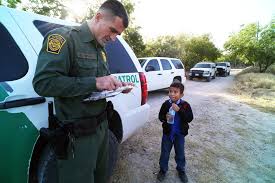
As for visiting the border patrol agents . . . I hardly think they deserve a presidential clap on the shoulder to keep up their morale and esprit d’ corps.  If they were dealing with armed insurgents, that might justify a trip (like the one to Afghanistan). But border agents are detaining children, many of whom are glad to surrender to someone who isn’t going to hurt them. No medals for bravery are going to be needed here.

border agent


2.) The Texas/Mexico border is NOT just down the road from Austin. This isn’t a situation where the President visited Manhattan and refused to go to Brooklyn.  If you google the square footage of Texas, you might also discover that within its borders, Texas could accommodate Rhode Island, Delaware, Connecticut, New Hampshire, New Jersey, Vermont, Massachusetts, Hawaii, Maryland, West Virginia, South Carolina, Maine, Indiana, and still have room for a good chunk of Kentucky.  The predominant Texas border crossing point is in Mission, a little over 300 miles from Austin – about the same distance between Philadelphia and Boston, two cities with New York City in between and not considered shouting distance from each other.

Texas

3.) A border trip at the time would have put the President’s safety at risk. I’m not equating the border region with a third-world country. . . only suggesting that any venue or detainment camp would be difficult to secure, particularly upon such short notice. Usually, advance teams begin work to secure a venue at least a week before a visit. For example, for the public address in Austin, the agreement to appear at the Paramount Theater was finalized about a week in advance.

But, I hear you ask, how can he just drop in at Franklin’s Barbeque unexpectedly? Your question contains the answer: “drop in…unexpectedly.” As explained in Jodi Kantor’s account of presidential life in her book, The Obamas, the Secret Service must sweep and secure any place the president visits unless he is making an unexpected, unscheduled visit. That exception is made because the element of surprise provides virtually the same level of security as an advance team can accomplish for a scheduled appearance. With the 3 Ps (Perry, pundits, and politicians) ranting about the need for him to visit the border, no trip to the Texas border would have been surprising.

4.) A surge of unaccompanied children from Central America is NOTHING like the Katrina disaster. In case you, too, are under any misapprehensions about Katrina (because you were in a coma that year), let me explain that the iconic city of New Orleans was virtually decimated. Katrina is the costliest natural disaster, as well as one of the five deadliest hurricanes in U.S. history, killing 1,833 people and damaging property to the tune of about $108 billion. Its residents, homeless in the aftermath of the storm, became refugees in their own country.

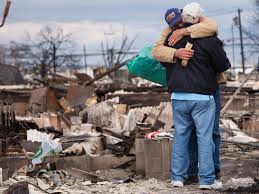
President Obama has not avoided personal visits when a large disaster involves American citizens and when he can reasonably help by consoling its victims and assuring them that they are not alone – that help is on the way. You saw President Obama visiting the Texas coast during the BP oil spill disaster and in New Jersey after Hurricane Sandy — where Americans lost their lives, homes, livelihoods, and sense of safety and security.  He brought the reassurance that only the presence of the President can provide.

sandy

Nothing even remotely like those disasters is occurring on the Texas border. Our citizens on the border are not threatened by an influx of children who need nothing more than food and lodging until they can receive the appropriate due process our laws require. No Americans will suffer loss of life, livelihood, or even a single night’s sleep because of this wave of border-crossers.  (Some of the picket-wielding, chanting/screaming protestors might keel over from heatstroke or apoplexy while they act like zombies were invading . . . zombies with the Ebola virus.)

So, what was it that the right wingers wanted from a presidential visit to the border?   They wanted photographs!  Photos of him with the children.  Photos to serve as “evidence” that President Obama “planned” this insurgency of minors and that, by such a visit, he was welcoming all who had heeded his Siren’s call to cross our borders illegally. The President, naturally, would have looked sympathetic and fatherly because it’s not his nature to be stern and forbidding with any children. much less those who have been through the travails that these children have. The right wingers would point to him smiling down on the multitudes as if admiring his handiwork.  Voila! Another Obama conspiracy revealed!

Frankly, we’ve seen the right-wing bait-and-switch so many times it would have been political malpractice for President Obama to fall for this trap.  Significantly, besides Rick Perry, no other Republicans are flying down to the border for fact-finding or even riding around in the border boat with Perry, looking simultaneously dorky and threatening (with machine guns at their ready.

RP.border

As for these children, one can only imagine the ordeals they’ve had to survive to arrive to this promised land. No doubt much innocence has been jettisoned along the journey north, resulting in young people older and wiser than when they started their trek. Unfortunately, the country they sought and eventually accessed – the one known for inviting the tired, poor, and huddled masses yearning to breathe free – is actually teaming with citizens, pundits, and politicians more childish than they. . . people who can’t see beyond their own selfishness, political agendas, ratings, and ignorance.  It seems that President Obama is the only adult in the room and, unfortunately, he can only do so much without the help of a functioning Congress — instead of this one that seems hell-bent to sabotage him (and don’t forget, sue and impeach him).

Undoubtedly for us all, while politicians play their political games in the midst of this humanitarian crisis that awaits their action, we’ve lost something more enduring than the childhood innocence of those huddled at our border.   Sadly, we’ve also lost the legacy of the Lady in the harbor who has beckoned so many to risk everything and find a way to America’s shining shores.

statute

Posted in Politics | Tagged , , , , , , , , | 2 Comments

Can a Dysfunctional Government Reinvent Itself?

Like most Americans, I have never found reason to question the notion that our founding fathers, endowed with genius, forged a virtually perfect foundation upon which to create a more perfect union of states and individuals within a republic. Until recently, I thought of the U.S. Constitution as sacrosanct, much like the Bible for Christians.  It never occurred to me to ask whether, as imperfect people, we’d be better off with a little less – or different kinds of – perfection in our union.

Constituion

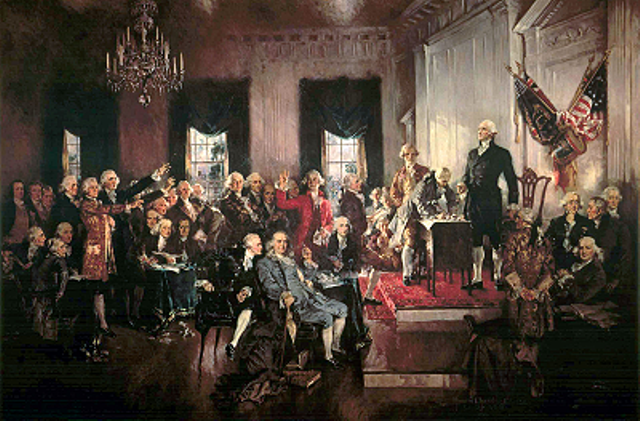
In the UT Law magazine, I ran across an interesting article on that subject, “Reframing the Constitution,” by Sanford Levinson, a UT Law constitutional law professor.  There, Professor Levinson reveals his concerns about whether the Constitution still fits our needs. He quickly points out that his questioning the Constitution is not a form of secular blasphemy, but rather, something the founding fathers had in mind all along. Knowing that the Constitution would need improvement in order to perpetuate its central values, he explains, that the drafters specifically included procedures for amending the Constitution in Article V, “including calling a brand-new constitutional convention.”

Professor Levinson then explains why we should now call for such a convention to “renew” the Constitution. He points to the predominant belief that Congress is dysfunctional and poll findings of a 63% majority in this country that believe it is going in the wrong direction. He allows for the fact that these perceptions could be the result of divided government (where the presidency and at least one of the two houses of Congress are controlled by different parties), but ultimately, Levinson concludes, the Constitution itself plays a detrimental role in our political system.  Here are some of the deficiencies he identifies in our current constitutional structure:

1) Passing legislation is too difficult, especially on the increasingly challenging and important national issues of our day. In a bicameral system, each house of Congress has the ability to block all legislation passed by the other body. The difficulty is increased when the houses are controlled by opposing parties because the opposition party has an incentive to block any legislation of a first term president to stymie his chances to be reelected, the public interest be damned.  (And as we’ve seen, it’s easy enough for Congressmen/women to “just say no,” and there’s not much we can do about it.)

2) The presidential veto isn’t just a check on congressional power, but actually creates a tricameral system (three lawmaking chambers). This might not be a system defect, Levinson allows, if the president truly represented the majority, but as we have witnessed, the electoral college sometimes results in a winner who isn’t supported by a majority of the voters, e.g., Al Gore’s loss to George W. Bush in 2000, and in 1968 and 1992 when Nixon and Clinton won with approximately 43 percent of the vote. Furthermore, the electoral college also guarantees that big predictable states (e.g. Texas and California) get very little of the candidates’ attention during the election process as the candidates fight it out in the appropriately named “battleground states.”  (I would say that encourages unequal or uneven political participation.)

3) Life tenure for federal judges, especially those on the Supreme Court, assures that we are governed by de facto “dead hands of the past,” which is especially problematic in regard to matters that the founding fathers could have never imagined, e.g., NSA surveillance, electronic voting, cell phones, drones. And as Levinson states, “Some . . . might even suggest the power and willingness of the Supreme Court to intervene in national political issues makes us a quadricameral system.”  Noting the 34-year term of Justice Stevens who retired at age 90, Professor Levinson suggests that single, non-renewable 18 year-terms might be preferable.  (And does anyone see a problem with 6 Catholics on the court?)

4) Amending the constitution as described in Article V must follow a stringent process and causes our Constitution to be the most difficult in the world to amend.  Professor Levinson finds it significant that the states have opted to make their constitutions significantly easier to amend.  (Flexibility can be a good thing when you have a 200+ year-old document.)

And before you dismiss the notion of tweaking the Constitution with a don’t-mess-with-success rationale, consider this question posed by Professor Levinson: Is it really possible that there are no lessons from our own experience that might enable us to improve our political system?”

I’ll go ahead and answer that: “No it’s not possible. There are many lessons!”

And besides, who wouldn’t love the opportunity for a redo on the Second Amendment? We don’t have militias anymore (at least legal ones), so why should they be well-armed? We now have a standing army, which is very well-armed – even better armed than the military thinks necessary .  And most importantly, how many more mass shootings of innocent people can this country stand while we continue to swallow the contention that the Second Amendment prevents any solution?

Equally important, we need the language from the Equal Rights Amendment: “Equality of rights under the law shall not be denied or abridged by the United States or by any State on account of sex.” This amendment, which failed to pass enough state legislatures by the 1982 deadline should be incorporated into any new document or its bill of rights. This would cover all LGBT individuals as well.

ERA

And just imagine a future in which abortion and contraception were no longer issues of national strife! I would propose an overarching section that recognizes that all people have unfettered rights over their own bodies. Ideally, it would be clear from the ERA language, but I suggest a belts-and-suspenders non-gender approach with language establishing that no law can be enacted to interfere with the doctor/patient relationship and any treatment decision derived therefrom.

Next, there would be constitutional provision prohibiting any law that would imbue corporations with personhood, recognizing them for the fictional entities they are, i.e., vehicles for financing business enterprises and shielding principals and officers from personal (partnership) liability. The new provision would expressly provide that corporations would not have the power to exercise religious beliefs, to engage in political activity, to marry, or possess any rights to free speech of any kind.

And what about religious liberty, i.e., freedom of religion?  Can we establish, once and for all, that we are a secular state and freedom FROM religion is just as important as a freedom to worship as you see fit.  In other words, can we all agree that a single religion (Christianity) does not respect the rights of others in this melting pot of citizens with their various and strongly-held religious beliefs?

jefferson

Finally, I believe our political system would be improved if the president were elected for a single term, say six, seven, or even eight years (since most presidents win reelection anyway). This would free the president to govern and prevent the stalemate that often occurs after year two of a president’s first term in office. There could still be some form of impeachment if he/she doesn’t work out.

But after compiling my wish list of changes, my constitutional reverie met up with the harsh reality of a question: who would write this “reframed” constitution. We know Congress could not do it . . . as captives to party politics, they can’t do much of anything, plus they’d have to take a long break from their so-called lawmaking to complete the task.

Maybe we could somehow appoint a body of individuals that included government and law professors, former officeholders (U.S. presidents congressmen/women, judges, legislative staffers, White House counsels), historians, etc?  They could hold televised public hearings to take testimony from knowledgeable individuals to assist in the task of writing a Constitution for our time. If nothing else, these hearings would be highly entertaining and a civics lesson like none other in modern American history. Remember the Watergate hearings? It might draw even bigger ratings than the Olympics!

framers

The other option for selecting drafters (or reframers), however, is quite scary: holding elections. I can just imagine who would be elected from Texas: Louie Gohmert- types, right wingers, and tea-partiers who want to do away with government (except for Medicare) or make it small enough to drown in a bathtub a la Grover Norquist. Along with those who would destroy public education and the anti-science crowd (those who insist on he teaching of creationism in science classes), Texas would elect an ample number of abortion foes who would attempt to make abortion a federal capital crime.  They’d want flat taxes and eliminate the IRS.  They would bring their uncompromising, just-say-no attitudes to the task and nothing would get done. (Could we make the Federalist Papers required reading?)

Alas, the more I consider it, dear readers, I realize that this idea of calling a convention is too enlightened to work in the country we now know. In fact, reading about the various battles and skirmishes among the drafters in Philadelphia in 1787, it’s a minor miracle we got the constitution we did. Those men ultimately found their way to compromise and cooperation, albeit with difficulty.

It’s sad to think that over 200 years later, we are stuck, muddling along, fighting political and legal battles that will never advance the cause of a free and prosperous America or fulfill the promise envisioned by the our founding fathers. But, at least we aren’t singing “God Bless the Queen” and governed by the English Parliament. Or a Fuhrer. On the other hand, give the Supreme Court, with its altar-boys-for life majority,  a few more cases like Burwell v. Hobby Lobby Stores, Inc. and we may find ourselves governed by Pope Francis.  A constitutional papacy, anyone?

Enough said.  Enjoy your fourth of July, anyway!

pope


Posted in Politics, Women | Tagged , , , , , , | 14 Comments

The Heartbreak of Tax Breaks

As many Austinites already know, our fair city – once known as a laid back haven for slackers, musicians, students, and escapees of the Dallas and Houston lifestyle – is becoming increasingly unlivable and unaffordable.  Unfortunately, the beauty and quality of life in Austin has attracted thousands of new residents who have driven up property values and pushed apartment occupancy to 95 or 96 percent, thereby raising rents. Supply and demand at work – high five to Adam Smith!

home prices

But, as the housing market has hit the boiling point, our property tax appraisals (based on market value) have risen accordingly. So, even if you want to stay in the same house you’ve cared for and loved for 30 years, many now question whether they can continue paying their property tax bills, particularly those on a fixed income. It’s not uncommon anymore to hear of lifelong Austin residents who significantly reduced their property taxes by moving no further than a town or two down the highway from Austin.

To make matters worse, we Austinites have done such a good job of conserving water lately, the City-owned electric and water utility is raising rates again to pay its bills for certain infrastructure that must be paid, water use or no water use. Plus, we may be hit with a “drought fee” to finance the search for more water because Lakes Travis and Buchanan that we have historically relied upon are drying up – currently they are only 36% full!

lake travis

And consider that the average homeowner’s tax bill includes about $200 a year so that the University of Texas can build a medical school. That homeowner also pays about $150 a year toward the Austin Community College District, and we’ll soon have the opportunity to vote on adding some extra dollars to all these assessments to finance a light rail system, which won’t provide transportation options where I live or anywhere near here.

With that backdrop, imagine how much I enjoyed Pete Winstead’s special contributor opinion piece in the Austin-American about giving tax breaks to big companies who want to relocate in Austin. In fact the headline, “Resting on our ‘cool’ laurels won’t keep Austin booming,” made me gag. He wrote that he wants to “build an even stronger and cooler Austin.” Still gagging over that.

winstead

Chairman of Opportunity Austin, Pete Winstead, you see, is a lawyer who honed his legal chops and civic involvement in Dallas. He did so well there, he moved here in 1987 to start an Austin branch of his law firm and work his “magic” on us. In the opinion of at least one former Dallasite I spoke with, Pete wants to Dallasify our city.

In his article, Pete makes compelling arguments for continuing the practice of giving tax breaks to companies that relocate to Austin. I say “compelling” if you believe in his trickle-down theory — that the opportunities these companies provide will enrich the rest of us in a variety of ways. He also argues that unless we offer these companies tax breaks, the City will be powerless to negotiate with them.

Negotiate? What Pete really means is the Winstead firm will be powerless to negotiate FOR the companies and AGAINST the City and Austin’s taxpayers. On his firm biography, for example, he states that the Winstead firm “guided Dell Computer Corporation through its initial public offering and its dealing with municipalities on the concessions related to the company’s relocation to Round Rock, Texas.”  And I love this sentence:  “His major involvement in civic, political and philanthropic matters in the Austin area has made him a ‘go to’ person to secure the award of various projects from political entities in the region or just to position a client to understand and succeed in the Central Texas area.”

Meanwhile, long-time Austin residents and business owners, must shoulder the price of government, watching our tax bills get bigger so we can pay for his wheeling and dealing to “position” his clients to get the biggest tax break possible.  Who wouldn’t have a few thoughts about where he could “go to.”

All of this is why I was glad to read Bill Aleshire’s piece in the Austin-American the next week, countering Pete’s thoughts on the subject. Bill moved to Austin in 1970, about the same time as Willie Nelson. Unlike Pete, Bill actually remembers when the town was “cool” (to use Pete’s word), i.e., when there was an Armadillo, Split Rail, Liberty Lunch, and a Threadgill’s Tavern featuring Janice Joplin. Bill has the perspective and, as former Tax Assessor/Collector and County Judge, the credibility to speak about what makes Austin livable – and it’s not incentives to entice big companies to move here and do business tax free!aleshire

In his own words, Bill says, “Recruiting tax dodgers to locate here has not made, and will not make, Austin more affordable for the rest of us. Stoking the red-hot fire of growth with tax giveaways is not the path to sustainable growth.” Moreover, he continues, the growth that Pete wants to see “is not the solution to traffic congestion, high rent and home prices or strains on education; wild growth is largely the cause of the current crisis in those areas.”

He effectively disputes the trickle-down delusion Pete lives under, i.e., that we all will be better off by allowing some privileged few to avoid a tax bill. Bill writes, “. . . no law of economics says that a lower cost of living will result when the wild growth inflates housing costs and drives up taxes and fees [in reaction to] the sudden strain on infrastructure, all while exempting new companies from paying taxes.”

And Pete’s ears had to burn when Bill explained about the few who benefit from this kind of growth: “. . . we now have a type of tax-incentive/political complex in Austin, where enormous political influence is wielded by those who benefit from the transactions that come along with recruiting big companies to Austin . . . [those who] make money off the relocation transaction, regardless of the net effect on the community at large.”

Does this make anyone else wonder how much did the Winstead firm earn from negotiating the Dell deal in Round Rock?

As a lifelong Austin resident, I understand that there is a price to pay for living here, but it’s a price that everyone within the City limits should have to shoulder proportionately. Companies need to pay their fair share as an act of corporate citizenship. Surely, if corporations can have free speech rights, they can have civic virtues.

City council

My hope is that, when elected, our new city council with members from single-member districts will be outsiders to the tax-incentive/political complex and be advocates for their constituents on the issue of affordability rather than growth at all costs. Maybe a majority of council members will take the approach that Austin’s leadership has been like a teenager with a new car and has negligently failed to do the appropriate maintenance, thereby  allowing the vehicle to deteriorate.   For the sake of current residents and taxpayers, I hope they will take back the keys until that teenager has matured and started showing evidence of responsible municipal stewardship.

To all of you who haven’t moved here yet, let me suggest that you don’t. Austin doesn’t deserve you. Until we can find a place for your car on the road, can assure you of tax fairness, and promise that you can find affordable rents and housing, we aren’t entitled to all of the special things you might bring to our world. It will be our loss, and your gain in the long run. Unless we get our act together, Austin will only break your heart along with your bank account.


Posted in Uncategorized | 5 Comments

Never Too Late to Crack those Books

Well, it’s that season again. For many of you, a reunion of your high school class is on the horizon and some of you are debating, as you always do, whether you should reveal to those you grew up with that you didn’t write the great American novel or find a cure for anything. And that aging body with all that gray, white, or simply, NO hair! After all, you looked so much better back then. But please believe me, everyone did and no one expects you to have found the fountain of youth.

Comeback

It’s no secret among my friends and readers that I love high school reunions. Unlike college, law school, med school, art school, etc., many of us have a longer and more complex history with the people who graduated from high school with us. Some relationships date back to elementary and middle school (formerly called “junior high”) or the local park where we took swimming lessons together, or the Little League teams on which we played and had our character molded. Of course, there were those god-awful braces, zits, bad hair styles, and other embarrassments. Like the time the teacher called upon you, you were half awake, and you uttered some inane answer that branded you as the biggest dunce ever for the rest of your high school career, as you remembered it. Or in biology class when you tested the fit of a bean in your ear, ending up in a doctor’s office to get it unstuck. Or when you were the only one who didn’t know to wear school colors on pep rally/football days in junior high.  I could go on and on (but won’t).

A middle school guidance counselor once explained to parents during an orientation session that the best way to understand your middle schooler was to keep in mind two letters: M & E, which happen to spell the word ME.  Typical middle schoolers, she shared, are only concerned about themselves and how they appear to others. A minor incident or cutting remark can have a much larger impact on their self-esteem than you can imagine. I’d like to suggest that this focus on ME lasts longer than just middle school. Thinking about myself as an example, I’m pretty sure I wasn’t the open-minded, considerate-of-others person I am now (trust me on that). I just wanted to be liked and have some fun in the process (and make good grades, too, I must admit). None of us were the “best we could be.”

So, recently, I spent some time with a good friend who was contemplating her 40th (or so) reunion. She was very reluctant to attend, stating that she didn’t want to see these people. “We don’t have anything in common . . . I kept up with the classmates I liked and they are the ones who won’t come anyway!” She seemed to have the whole event gamed out in her head months before the event, which I assured her was not necessarily the way it would turn out. But such concerns are not atypical, as I’ve learned in my years of reunion planning.

reunion cartoon

I tried to meet her objections with truth, facts, and evidence (lawyer that I am), but I could tell I wasn’t making any headway in convincing her to go. Truth is, I’m rarely successful with the most obdurate anti-reunionists, but our conversation got me to thinking. Is there a better way to intrigue people enough so they might just give going back to high school a try?

As an avid book-lover, what occurred to me is this: How about imagining your classmates as a library full of novels? Chapter One is about birth, the particulars of the parents meeting each other and deciding to start a family. It would also cover the period of learning to talk, taking those first steps, potty-training, and generally, all those events that make parents question their decision to have children.

After the first chapter, subsequent ones would recount the elementary, junior high (or middle school), and high school years. Let’s say these children were busy with dance recitals, baseball championships, scouting, swimming competitions, sad relationship breakups, any of which might pad the book’s chapter count a bit, maybe pushing it up to 7 or 8 chapters.  Assuming you haven’t seen a classmate in the intervening years since graduation, as a fellow classmate, you have probably only “read” one or two of those chapters.  But remember, their novels, like yours, are going to consist of 40 or more chapters!!!

Maybe it’s just my innate curiosity, but I enjoy reading the missing chapters, e.g., Chapters 20, 25, or 30, and finding my expectations, solely based on Chapters 7 or 8, to be completely upended and totally unrealistic!! As if we were equipped in high school with highly developed sensitivity, prescience, and character judgment.  The reality is that once you gather with folks many years later you invariably discover various surprises and plot twists you could have never imagined 40 or so years ago. The reunion offers you the opportunity to sit down with that person and, if nothing else, get the Cliffs Notes version of past chapters. And did I mention that a lot of single people end up marrying a former classmate they reconnected with at a reunion? That’s called “buying the hardback!”

I know it’s the oldest cliche in the world: you can’t judge a book by its cover.  Similarly, you can’t judge a person by his/her first few chapters. If that were true, who would ever finish a book? The fun part is having your expectations turned upside down by the introduction of a new character or plot development you didn’t see coming.

I've change

Speaking from experience, I am constantly surprised by former classmates who come to the reunions. Who knew the shy girl who was a whiz in algebra class would end up being a big-firm litigator (inside joke:  lawyers are lousy in mathematics)? That the wise-cracking, short guy would be a nationally known playwright whose height is totally acceptable and whose wise cracks have turned to great wit? That the prim and proper straight A-student would end up leading a country western band when she wasn’t acting on television? I guess the only non-surprise I remember from high school was that Ben Crenshaw (a grade ahead of me) would have a golfing career, but I bet he may have an interesting chapter or two we haven’t heard about. All in all, the reunion is full of so many books with so much potential . . . isn’t it worth a trip to study hall again?

And if you are still not convinced, because you don’t like the ways your appearance has changed, I have just one question: do you really think that you grew up with individuals who all turned into beautiful people in the intervening 30 or more years? Let me promise you, if you show up clean and relatively well groomed, no one will give your looks a second thought!! (Caveat:  unless you went to the same plastic surgeon as Kim Novak and Goldie Hawn.) Take it from me, as long as you stay on this side of the grass, your classmates will be glad to see you just the way you are!!

keepcalm

Find more reunion tips (from me) at https://jeffeepalmer.com/2010/05/08/where-everyone-knows-your-name/


Posted in Reunions | Tagged | 3 Comments

My Longest Love Affair

Witnessing the trees that sway like dancers from the vantage of my window, I’m reminded anew of my origins as nature’s child.  As the trees awake from their winter slumber and the symphony of another spring reaches its crescendo, I am struck by their beauty and wild magnificence.  Unlike other flora around us, the trees are our partners in growing old and many will continue to thrive as we fade and weaken.

I think that I shall never see, a poem as lovely as a tree.  A tree whose hungry mouth is pressed against the earth’s sweet flowing breast.  (Joyce Kilmer)

Who doesn’t love trees? If you grew up in Central Texas during the days when children lived outside as much as in, the trees have always been a part of our world. Good climbing trees were special. They served as measurements of our growth – as our legs grew longer, we could climb higher. The higher we climbed, the more superior we felt to the grown-ups who were stuck to the ground. And what sanctuaries!! We could escape to the skies — alone or with friends — and share space with the squirrels as we plotted the capture of pirate ships or fantasized about tree houses we might build. Passing by a tree for the first time and noticing the trunk with small perpendicular boards serving as ladder-like steps, the desire to climb up and see what was nestled among the branches was irresistible.

I part the out-thrusting branches and come in beneath
the blessed and the blessing trees.
Though I am silent there is singing around me. 
Though I am dark there is vision around me.
Though I am heavy there is flight around me.     (Wendell Berry)

And on those hot summer days, back before most houses were air-conditioned and our mothers shooed us outside to have peace and quiet in their own personal stuffiness, our trees were a source of shade and relief. We could spread out towels and play dolls in their shade or simply loll against the trunk and pretend to shoot at the predators (a.k.a., squirrels and birds). Some trees were large enough to shield us when we played hide and seek or when avoiding the bully walking down the street.

Distinctive trees have always served as meeting places between friends and witnesses of young love as manifested by initials of a beloved carved into the bark — at least for a season or two. In days of yore, land surveyors used trees to mark corners of the tract, scarring the tree with big Xs or other marks. After all, who could tamper with boundaries marked by a firmly rooted tree, loyally guarding the line?

We grew up in a world where trees were so plentiful, we took them for granted.  Now, bulldozers and bobcats wreckclear cut their havoc shamelessly everyday, which we hardly notice as we whiz by construction sites. I suppose the operators rationalize their work as the price of progress and the greater good.

Tree, gather up my thoughts like the clouds in your branches.
Draw up my soul like the waters in your root.
In the arteries of your trunk bring me together.
Through your leaves breathe out the sky.
(J. Daniel Beaudry)

LionsHere in Austin, of course, the University of Texas’s interpretation of the greater good is a localized “manifest destiny,” as the entity spreads its reach across the city. Few have survived the University’s push, as those organized to preserve Lions Municipal Golf Course and its lovely canopy of old oaks from UT’s development plans are well aware.

Many of us vividly remember the infamous Chairman of the UT Board of Regents, Frank Erwin, who spearheaded the expansion around Waller Creek and Royal Memorial Stadium in the early 70s. Notorious for getting his way, the Chairman would not be stopped by a bunch of “tree huggers” protesting the removal of the trees along the creek.

As the bulldozer approached to do its damage, the so-called tree huggers took perches in the trees. At the first occupied tree, the bulldozer driver stopped. Someone, called the Chairman, who shortly appeared on the scene and told the bulldozer driver to go ahead, push down the tree. The driver refused to bulldoze a tree with a human attached, so Frank climbed up in the driver’s seat and as soon as the driver had explained how the machine operated, the Chairman gave it the gas and moved toward the trees. The protesters vacated their tree posts quickly and the trees were destroyed. The ghost of Chairman Frank must be thrilled with UT’s new medical school – out with a park, up with a building.

Give me a land of boughs in leaf, A land of trees that stand;
Where trees are fallen there is grief; I love no leafless land.  (A.E. Housman)

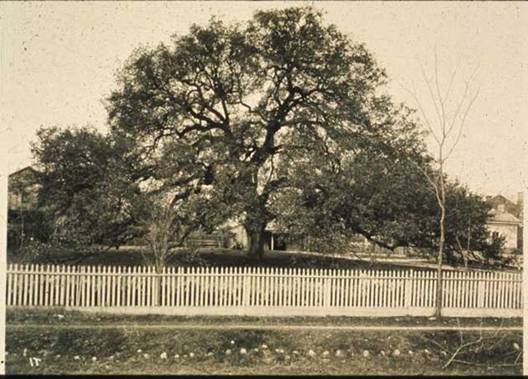
But in Austin’s history, there is no more horrific example of tree destruction than the deliberate poisoning of Treaty Oak, the last of treaty-oak-1930sjpg-5a5fea98798c0c38the Council Oaks, a grove of 14 trees that served as a sacred meeting place for Comanche and Tonkawa Tribes. It’s also said that the tree witnessed the meeting of Stephen F. Austin, the leader of the Austin Colony, with local Native Americans in the 1830s to negotiate and sign Texas’s first boundary treaty after two children and a local judge had been killed in raids. In 1927, Treaty Oak was admitted to the American Forestry Association Hall of Fame for Trees and declared the most perfect specimen of a North American tree. Foresters estimate the Treaty Oak to be about 500 years old with branches that had spread 127 feet.

Yet, in 1989, a deranged individual attempted to poison the tree with enough of the hardwood-herbicide, Velpar, to kill 100 trees, according to lab reports. The community outrage was an impassioned display of love for a tree. Featured in national news stories, the plight of the tree inspired assistance from various sources. Texas industrialist and former presidential candidate, Ross Perot, wrote a “blank check” to fund efforts to save the tree. Children made get-well cards that were displayed on the fence around the park where the tree struggled. Visitors and school children visited the site as if attending a wake, speaking softly and looking mournful. DuPont, the herbicide manufacturer, established a $10,000 reward to capture the perpetrator.

Meanwhile, arborists frantically labored to save Treaty Oak with applications of sugar to the root zone, replacement of soil around its roots and the installation of a system to mist the tree with spring water. Although these experts expected the tree to die, Treaty Oak survived, albeit lopsided, as almost two-thirds of the tree succumbed to the poison and more than half of its crown had to be pruned.

todaytreatyoak

Treaty Oak Today

The vandal was apprehended after reportedly bragging about the tree poisoning as a means of casting a spell. Convicted of felony criminal mischief, the man was sentenced to serve nine years in prison.  This may be a first for attempted tree murder.

I frequently tramped eight or ten miles through the deepest snow to keep an appointment with a beech-tree, or a yellow birch, or an old acquaintance among the pines. (Henry David Thoreau)

What makes anyone commit a violent act against a tree — maybe they’ve never climbed a tree, hugged it with both arms, or imagined themselves as Indians smoking peace pipes under the tree boughs as their children played and collected acorns.  And maybe they’ve never heard the wind whispering of peace and kindness as it whisks through the trees, cooling and caressing the leaves and branches, the gentlest of lovers.

 And when a moon floats on the sky;
They hum a drowsy lullaby
Of sleepy children long ago…
Trees are the kindest things I know. (Harry Behn)

Posted in Nature, Old/New Austin | Tagged , , , , , , , , | 2 Comments

Mothers, Daughters, and Sisters United!!

One of the sad truths about our democracy is that smear jobs now constitute the bread and butter of our political discourse, particularly by the right-wing hate media and their feeders. Swift-boating a candidate has become an R trademark, thanks to Karl Rove, the Koch Brothers, Harold Simmons, and their ilk.

Wendy.2Democratic nominee for Texas governor, Wendy Davis, is the latest object of such besmirching. Specifically, it is alleged, she misrepresented her biography with the goal of making herself look more sympathetic than she deserved.

Her detractors, for example, are very concerned that she was less than forthcoming about her divorce that she initiated as a teenager. How dare she say she was divorced at age 19 when, according to court records, the divorce didn’t become final until age 21.  She only filed for divorce when she 19.  For the Rs this is a HUGE failing!

And to make matters worse, she claimed to have moved into a trailer park after her divorce, BUT, she didn’t reveal she had ONLY stayed three months until she got her own apartment. So she didn’t chop wood long enough?

Equally disturbing for this crowd is how her Harvard law school tuition was paid.  Her husband took out a loan to pay for her tuition!!! Can you believe that wasn’t mentioned on her resume?!!  To the right-wing, it would have been only slightly more scandalous if she had turned tricks for tuition money.

And what about representing herself as a good, caring mother when her husband did the majority of the caring for their two daughters while she was in law school!!?? How galling of her to keep that information from the public!! (As if folks don’t know that Harvard is locate quite a ways from Fort Worth where her daughters attended school.)

So, the story of Abraham Wendy splitting logs to make money to raise her children and finance her education has been revealed as a deception along with her poor mothering skills!!! Does that mean she intends to fight for education, equal rights, and a strong economy any less?

Is Wendy Davis’s real failing the fact that she didn’t anticipate that her biography would become red meat to be picked over by the opposition?  The Dallas Morning News, in a disingenuous editorial (since their reporter, not the opposition exposed these issues with her resume), expressed “disappointment” that she wasn’t “smart” enough to realize that she needed to be more forthcoming and specific about the facts of her life in order to campaign more effectively.

Instead of lacking campaign smarts, however, Wendy Davis could have considered (if she thought about it at all) that her age when she was finally divorced, how long she lived in a trailer park post-divorce, or the specifics of her law school tuition payments were nothing of substance concerning who she is or what she would do in office.  Simply, why would anyone care?

For me, the biography of Wendy Davis that really sheds light on who she is and her priorities pre-dates those (non-) issues. I’m referring to the chapter in which her parents divorced when Wendy was 13, and her father abandoned the family, paying no child support, and leaving her mother equipped with nothing more than a 9th grade education to work menial jobs to support herself and her daughter. That was also the chapter wherein Wendy begins to work at age 14, selling newspaper subscriptions and serving fast food at Orange Julius. And yet, in spite of these difficult circumstances, she graduated from high school as a member of the National Honor Society.

I know the significance in this part of the story because it’s a lot like mine. My parents also divorced when I was 13, old enough to witness and feel my mother struggling with business college (a.k.a. secretarial school) where she studied typing, shorthand, and filing, so she could get an office job. While we were lucky because my father paid child support and mother received other assistance in the divorce decree, it was still very hard for her and for us.

How many times did my mother tell me that, no matter what, I had to get a college degree? As many times as Wendy’s mother surely told her? But the words were unnecessary. My mother’s experience proved to me that life was uncertain and you must be ready to support yourself and your children, whether you want a career or not.

Also, like Wendy, marriage and two children altered my plans to finish my college degree in a neat four years, but I was determined, too.  I intended to get a degree no matter how long it took . . . because that’s what women who watch their mothers suffer the indignities of not having an education often do. It took me until age 34 to obtain my undergraduate degree and then four years later, my law degree, with both of my sons in the audience at my graduation ceremony.

And, just in case you never ask, did my husband help me get that degree, both monetarily and by helping with the care of our two sons? You betcha! Did I miss out on some of my children’s school events or other activities because I had to attend class or study? Oh, yes!! Do I regret going to school? Not at all. Does anyone outside the family truly care how I financed law school and how the children were cared for during that time? Hardly.

The pure irrelevancy of these facts may be why Wendy Davis might not have tightened up her personal narrative. Also, too much particularity divides rather than unites the many women who have similar stories, myself being an example. In a world where more female role models are needed, why shouldn’t she stand up and represent the many of us who recognize ourselves in her?

The hogwash that the right-wing media is trying to pour over her candidacy is nothing more than gender politics, pure and simple. As my friend, Michelle Bassett, wrote in a letter to the Austin American Statesman, “If Davis were a man, not a single eyebrow would rise over the news that the children were primarily cared by their mother, who also worked to subsidize his education.”  So true, my sister, so true!

Wendy Davis is a survivor – one who has worked diligently since age 14 to get an education and become a woman of accomplishment, dignity, and worthy of respect. And I have no doubt that she will fight on behalf of the women in this state who have been run over by the Republican agenda of controlling women’s bodies, dismantling public education, and letting our poor children go hungry.

Considering what is at stake, questions concerning Wendy Davis’s teenage divorce and whether her husband helped pay for her law school education contribute nothing to advance the causes and policies needed in Texas. But, I forget, when we are talking about good smear jobs, the criteria is simple: the more ridiculous, the better. After all, it’s easier for the hate media and their audience: no need to think about complicated policy issue or a candidate’s stand.  Just ask our Kenyan president.

Posted in Women | Tagged , , | 4 Comments

Austin Makes Me Sick!!!

Among the reasons for not moving to Austin, I bet you think our atrocious traffic problem and lack of mass transit is at the top of the list. Or the lack of affordable housing. Or the high property taxes.

cedar.pollenBut you’d be mistaken. The number one reason not to live in Austin is CEDAR, specifically the pollen that cedar trees produce resulting in the truly abominable cedar fever. “Cedar is juniperus ashei,” allergist Dr. Eric Schultz told a local television reporter recently.  “It’s one of the worst allergens, or most potent allergens on the planet. Here in central Texas it’s rampant, especially in Austin.”

You might think I’m talking about a runny nose or some sneezes here and there. Again, you’d be wrong. It’s far beyond that.  For weeks you can be plagued by sore throat, amazing phlegm production, a nose that won’t stop running, watery, itchy eyes, intermittent sneezing attacks, and ultimately a hacking cough. A guy who moved from LA to central Texas reported that he had to start allergy shots after encountering cedar. “The fact that I can hold a regular conversation and see you five feet in front of me means it’s made a world of difference so far,” he told the television reporter.

And cedar doesn’t wait to bring us down at a convenient time of the year. No way! Cedar pollen makes its appearance just in time for Christmas, spills over to New Year’s, and stays around until Valentine’s Day, more or less.

I started having cedar allergies as a child, and as a result of being sick every Christmas, I developed a bah humbug attitude toward the whole holiday. My childhood pictures show a young girl with a bright red nose, a la Rudolph, and squinting eyes because she’s struggling to stay awake, being drugged to the gills with antihistamines. Needless to say, the best Christmases were those when we went to Dallas to visit grandparents.

Because of cedar fever, I’ve continued to dread this time of year and have been reluctant to plan much, particularly any outings on New Year’s Eve.  I just never know if I’m going to be sick or not. Even if I slide by Christmas because of a late pollen release, I could be sneezing my head off by New Year’s. Just imagine being in a club with a band blaring or a ballroom with a million noisemakers going off while your head and sinus cavities are pounding in painful rhythm!

Like the LA guy, I get weekly (or so) allergy injections that consist of ever-increasing doses of the allergens which I am sensitive to with hopes of building up an immunity to them. For the last 5 years I’ve been going to the allergist’s office to get the weekly shot, and then I have to wait for 15 minutes to make sure I don’t go into systemic shock. If this were to happen, my understanding is that a shot of epinephrine would be quickly administered to me. (I always envision John Travolta giving Uma Thurman a shot in her heart in Pulp Fiction!) But I digress. How effective are these shots? Usually, they work to minimize my reactions, but this year, with record level highs pollen counts, any dent they are making seems pretty minimal.

So, just to fully inform potential Austinites what they may be in for, here’s a look at the medicine cabinet of a cedar fever sufferer: antihistamines (non-drowsy and drowsy in both pill form and nasal spray), throat lozenges, pseudoephedrine (a.k.a. Sudafed which you need a picture I.D. to purchase), cough medicine, analgesics, eye drops for allergies, and guaifenesin (Mucinex, Maximum Strength is best). And that’s just the first tier. Second tier drugs are those nasal irrigationneeded after your allergy attack has matured into a sinus infection or bronchitis. Then, you will probably need a steroid injection or prednisone pills, along with antibiotics and perhaps a respiratory anti-inflammatory (e.g. Singulair). Along the way, you may want a Netti pot/nasal irrigator or bottle of saline solution to wash out your nasal passages and a cold mist humidifier. Did I mention Kleenex? Lots of Kleenex.

Now, I hear some of you saying, “This is not going to happen to me – I’ve never had any allergies, so I’m probably immune.” Not necessarily so, I assure you. And if you think you can predict anything after a single cedar season, again, you are misinformed. It takes about seven years before new residents fall prey to Satan cedar. But, at least you can say you had seven good years.

But wait! It’s not all about you. If you have children, why would you subject them to this torture? They can get cedar fever, just like I did, and if they are miserable, you will be miserable. And if you are in cedar fever hell already, you will be doubly miserable when your kids are sick and you are washing out their nasal passages and sucking out nasal production (polite word) with those bulb things. There’s nothing more pitiful than a sick kid. And if you have a sick spouse? Quadruple agony!

In short, cedar is the most evil tree ever allowed to spread in Central Texas.  Moreover, I’ve seen recent studies showing that cedar trees suck more water from the ground than any other tree. Here we are in the midst of the worse drought ever and wouldn’t you think someone would stand up and say: death to cedar trees!!??

But, of course, you’d be mistaken. No Austinite is going to advocate the destruction of a single tree, even if it were the last source in the world of hardwood planking for a West Austin McMansion. In Austin, we protect all of our trees without discriminating on the basis of color, country of origin, ethnicity, or costs to society.

But why not make an exception in the case of cedar?  This indiscriminate tree love is bad for at least half of the city’s populace. Imagine the workplace productivity that is lost and the trees that must be killed to produce more Kleenex and replace the printed page I just sneezed all over. Does it make sense that we’ll all end up with three or four enormous rain barrels in our yards before a single cedar tree is slaughtered at the altar of good health and sufficient water supply?

But I guess I should try to find a silver lining to all the misery related to this tree. I’m thinking that if we really publicize it, fewer people will move to Austin, and cedar fever will have served a higher purpose. How about a new city moniker: “Cedar Fever Capital of the World?” And then, let’s have a Cedar Fever festival at Zilker Park, giving our city leaders another opportunity to authorize the trampling and destruction of park grass. To make our point, we would open it up only to musicians who are roused from their sickbed to perform while sneezing, sniffling, and tripping on antihistamines. Just like Woodstock!

austin trafficWhat do think? If more people around the world heard about our cedar tree problem, do you think they’d stay away, find other places to live? If so, I could start loving the tree (albeit from a distance). Just think, this might be the ultimate solution to our god-awful traffic!!

Posted in Uncategorized | Tagged , , , , , | 9 Comments

Beyond All the Flag Waving…

Mike, my friend and Vietnam vet, recently posted some of his thoughts about his Army service.   I was reminded of my high school years during that war era and the angst over Vets Daythe draft lottery that the boys I knew suffered — all they wanted was the war to end before they were called up to go fight.  To participate in the fighting in Southeast Asia was the absolute last thing in the world they wanted to do.  Nevertheless, under the duress of American draft law, many of those kids — because that’s what they were —  served in the military.  Most returned, but some didn’t.   Of those who returned, none came home happy about what they had done.  No one ever mentioned that they were glad to have killed commies, or fought to make the world safe for democracy and our freedoms. More than anything, there seemed to be a sense of relief to be home and reluctance to discuss the events they had witnessed.

To add insult to injury, our Vietnam vets had to experience war on two fronts.  One was their tour of duty in Southeast Asia.  The other was here in America where they were shamed for their service.  They were  scorned, insulted and even spat on by vociferous anti-war activists.  In other words, many in this country failed to make the distinction between the unpopular war and the troops who served in it.  It wasn’t until 2011, that the U.S. Senate unanimously passed a resolution to provide these veterans with the chance at a proper welcome.  May 30, 2011 was designated “Welcome Home Vietnam Veterans Day.”  About time.

No wonder that many Vietnam vets are ambivalent about their participation in this war on behalf of this country.  I have a feeling that Mike speaks for many of them in the following blog post:

I’m uneasy if someone thanks me for being a veteran.  I did not join the Army to serve my country, to keep my fellow citizens safe and free, or to bring democracy to foreign nations.  I joined because I didn’t have a girlfriend and ran out of money for college; my new draft card marked me as 1-A.  Joining voluntarily might let me avoid the infantry and become a pilot.  Surely, I thought, pilots had lots of girlfriends.

In October 1967, at the age of 18, I was shipped off to basic training at Fort Polk, Louisiana. By January I had started flight school at Fort Wolters, Texas, near Mineral Wells, and then finished at Fort Hunter-Stewart just outside Savannah, Georgia.  By October 1968 I had my wings and my bars and was headed to Vietnam . . . [continue reading at http://www.mtweg.com/2013/11/reflections-on-veterans-day.html ]

Welcome home, Mike!  And to all veterans, may you receive the respect you deserve for fulfilling your obligations to this country — something most of us will never be called upon to do.

Posted in Uncategorized | Tagged , , | 6 Comments