Of Burros, Barbarians, and Brain Snatchers

In sleepy Austin, Texas, I came to consciousness during the “wonder years” world of the 50s and 60s, and like everyone around me, I was proud of my nationality, believing in the superiority of all things American.   My 21-year old self was taken aback, therefore, when it was pointed out that the rest of the world didn’t quite see things my way.  Living in Lima, Peru, I learned that many upper class Peruvians ( (insulated in a caste system based on blood lines) were unimpressed with Americans, referring to them among themselves as “burros with money.”  It surprised me because I had been taught that the United States was a good neighbor and friend in our hemispheric neighborhood.  They should like us!

Gradually, I realized that these Peruvians had been seeded with large doses of European culture and its snobbish aversion to uncultured Americans.  In fact, Lima seemed more European than Latin American, eating Continental style with not a chicken fried steak on any menu.  Back then, you could find menu selections of Canard a l’Orange (Duck with Orange Sauce) or Lobster Thermidor that would make a Frenchman feel at home (or Julia Child trill in delight)! Subject to widespread immigration, the country had been populated with many Europeans who transplanted their cultural norms, languages, and foods in a welcoming soil.  A Swiss man sold cheeses and chocolates and other delicacies from Switzerland from his La Tiendicita Blanca (the Little White Store).  Italians opened restaurants serving food from their homeland, where invariably your dining partner would disparage the “Americanization” of true Italian cuisine in the U.S.  I enjoyed knowing Pierre, a delightful engineer from Belgium who spoke five languages, and another charming man, Eduardo, who came from Germany and spoke at least three.  He might have been a former Nazi, now that I think about it.  Italian brothers Valerio and Gianni had a textile company, speaking an Italian-laced Spanish that was so expressive!  Valerio taught me a betting system he used when gambling in Monte Carlo.

But meeting fascinating people and experiencing some cultural condescension did not cause any rips in the fabric of my American pride.  That didn’t happen until recently, beginning when I saw citizens at town hall meetings on health care reform, act like street fighters, screaming, threatening, and having hysterics at the idea of providing health care for all Americans.  These meetings were called to engage in civil and civic discourse about life, death, putting an end to unnecessary  suffering, and curing disease among our citizenry.  What is it about that subject that warrants uncivilized belligerence – violent displays of ignorance and selfishness?

And what about the disrespect that so many Americans shower on our president, from Speaker John Boehner to the entire stable of commentators on the most shameful network ever permitted to pollute American air waves?  After all, what is the birther issue if not undisguised racism, a move to discredit President Obama because he is black?  It doesn’t matter that a majority of Americans voted to elect him president, preferring him to his Caucasian opposition.  And while you may not support the policies of the man, what happened to showing respect for the office, the face of our nation in the rest of the world?

But even with all that, we didn’t reach the ultimate unraveling of my American pride until these last Republican presidential debates.  During the first one, the crowd actually cheered when the moderator noted that 234 people who have been executed during Perry’s tenure as governor.  And then, Governor Perry was asked whether he had any trouble sleeping at night in regard to this number, to which he responded in the negative because he trusted in the system and knew they all deserved it.  Or words to that effect.

Am I among a minority of Americans who believe that every time that a person is killed at the hands of the State, we should solemnly reflect and pray that this person was truly guilty, assuming we believe in the death penalty in the first place?   Hasn’t the Innocence Project reminded us (in case we forgot) that civilized beings should have at least a little concern that perhaps out of those 234 people—just perhaps—one may have been innocent.

At least Patti Davis, Ronald Reagan’s daughter, seems to agree.  As she told Lawrence O’Donnell a few days later about the debate, “The moment that would have broken my father’s heart was the moment when applause broke out at the mention of more than 200 executions ordered by Rick Perry in Texas. It was stunning and brought tears to my eyes. This is what we’ve come to? That we applaud at executions?”

Describing the first time her father had to order an execution as governor of California, Patti said, “He and a minister went into a room, got down on their knees and prayed.”  That, my fellow Americans, is what decency at the head of an execution machine looks like.   And even more revealing is the inscription on Reagan’s tombstone:  “There is purpose and worth to each and every life,” Now we can argue about when life begins and I admit that I rarely agreed with this man as president.  But I cannot fault his compassion and respect for human life.  Civilized men and women  are not supposed to rejoice in another human’s death.

But rejoice they do!  At the next debate, the faithful cheered at the notion of letting a 30-year old die because he had no health insurance.  Dr. Ron Paul didn’t blink an eye over that prospect.  Has there been an invasion of body or brain snatchers who, as we speak, are replacing the minds of Americans with a version completely lacking in compassion?

These brain snatchers must be targeting conservatives.  New York TimesPaul Krugman recently wrote, that conservative intellectuals used to support “‘a comprehensive system of social insurance’ to protect citizens against ‘the common hazards of life,’” singling out health, in particular.  . . Now, the conservatives no longer accept government intervention in the name of compassion.  “Compassion is out of fashion— indeed, lack of compassion has become a matter of principle, at least among the G.O.P.’s base.”

I hate to use the word “un-American” because conservatives flail it around almost as much as they do “socialism,” usually directed at our president, but who are these people with whom I share citizenship?
Whatever the answer, I sadly realize that the rest of the world are seeing these same people via satellites and computers.  These are the people who are representing us – all Americans – to the Europeans, Latin Americans, Asians, and everywhere else.  I can’t help but think the word “barbarian” must come to the mind of many . . . along with “burros with money.”


Posted in Uncategorized | Tagged , , , , , , , , , | 4 Comments

Pray Away the Altar of More Wealth for the Few

I’m sorry to say that I didn’t get to participate much in the Day of Debauchery and Gluttony, the so-called day created on Facebook (and elsewhere, maybe?) as a reaction to Rick Perry’s Day of Prayer and Fasting.  But, I have several good reasons.  First, it’s too damn hot for much debauchery, unless you count soaking in a cool tub of water or de-icing that old garage freezer that doesn’t self defrost.

As far as gluttony is concerned, I still pay a monthly fee to Weight Watchers for my online account that keeps me honest and losing a bit of weight.  That’s why I must report that on Saturday I ate a serving of mayonnaise-y cole slaw costing me a bunch of valuable points.  But that’s certainly not the essence of true gluttony.  Us gluttons-in-abeyance know better.

But, I did have some thoughts about a prayer fest called to urge the attendees to call on the Christian god to step in and help us solve the various ills of the country.  As one woman explained on NPR, “We deserve bad leaders, we deserve economic downturn . . . we turned away from Jesus.”  A punishing Jesus?  This strikes me a bit primitive, more like the response of ancient people beset by famine, drought, hard times.  I’m reminded of the scene in Mel Gibson’s movie, Apocalypto with the Mayan priest at the top of a pyramid surrounded by thousands of people cheering on as human beings were sacrificed, assembly-line fashion as the civilization in decline sacrificed to appease the gods and reverse its fortunes.

Although I’m no student of religions, primitive cultures have always been characterized by religious beliefs that included recipes for problem-solving involving the sacrifice of virgins, goats, crops, liquor, first-born sons, etc., to appease angry and/or resentful gods.  Reading Hamilton’s Mythology in 8th grade, it was impressed upon me how the Romans and Greeks had a veritable soap operatic system of gods who, depending on their humors, became resentful, jealous, needy, vengeful, etc.

But regarding the prayer event in Houston, I’m not saying that it’s a bad thing to pray for strength in the face of our daily problems, or to try to find more tolerance and love for others through prayer.  Like meditation, prayer can help you find those things within yourself, whether divinely inspired or not, depending on your beliefs.  But how did we get to a place where a governor (supposedly a leader with ideas about running this country) is urging folks across the country to come to a big prayer meeting to call on Jesus  to come up with solutions to our social and economic problems?  It would be better to pray for a vision of how to make all the players in our legislative bodies and other institutions get along like adults and act as if we were all in this together (which we are, by the way).  Learn to negotiate instead of demand and take home your toys if you don’t get your way.  I wouldn’t think, however, that you need Jesus to guide you to that path.  After all, it’s kind of the way we’ve been governing ourselves since dumping George III (i.e., all years B.T.P. [Before Tea Party]).

But, I’m probably the least qualified to critique this event and the goals of the Governor in joining forces with the Christian evangelicals to stage this happening.  Reverend Jim Rigby, the pastor of St. Andrew’s Presbyterian Church in Austin, however, is qualified and offers up his response to “The Response,” which makes a lot of sense to me.  In his local contribution to the Austin American’s op-ed page Friday, August 5th, he characterized the government endorsement of one religion in a country with such rich religious diversity as unhealthy politics.  Significantly, he made five points based on scripture, which the organizers of this event have ignored.  In his words, more or less:

1.  Don’t make a show of prayer.  Jesus, he said, spoke out against public displays of religion.  In other words, ‘Don’t rub it in other people’s faces.’

2.  God doesn’t withhold rain because we’ve done something wrong.  Jesus said that God sends rain on the just and unjust.   Our love, he taught, should be equally nonselective.

3.  God doesn’t have favorites.  When the Bible says that God is not a “respecter of persons,” it means that God doesn’t have a favorite country o religion.  The idea that God wants Christians to be in charge of other people violates Jesus’ teaching that we are to take the lowest place, changing the world by humble persuasion and good example, not be messianic coercion.

4.  Worship by those who neglect the poor is offensive to God.   The prophet Amos, he notes, chastised the religion of his day for praying to God while mistreating people.  Texas leads the nation in residents who are uninsured, who work for minimum wage and who die from unsafe working conditions on construction sites.  Our state has the widest gap between rich and poor of any other state.

5.  The heart of Christian ethics is being a good neighbor.  Jesus told the story of the Good Samaritan, scapegoats of the day, to teach humility to a rich young zealot who thought he was approaching moral perfection.  The merciful Samaritan, he explained, was an example of ethical perfection.  In contrast, the American Family Association, one of the sponsors of the event, is listed by the Southern Poverty Law Center as a hate group for their stand on homosexuality and Muslims.

As the Reverend concludes, “The ‘prayer’ that is most needed at this time is for each of us, believer or not, to go into our own heart and find the humility and empathy that is at the core of righteousness, political and spiritual.”

Amen, Reverend.  As I consider that we haven’t heard the last of Republican congressmen trying to slash more jobs from the government payroll, dismantle entitlements, and eliminate the programs that help the least advantaged, I wonder – not for the first time – how they ignore the intellectual disconnect and call themselves followers of Jesus, rather than the high priests sacrificing the least among us at the altar of More Wealth for the Few.   Maybe if I pray a little bit harder, I’ll find a way of understanding  these people.  I will never, however, be able to pray hard enough to find a way to forgive them.

Posted in Uncategorized | Tagged , , , , , | Leave a comment

Zelma for President!!!

The woman known as Bicycle Annie has found her way to my pages of Austin memories on several occasions.  During the 50s, 60s, and 70s, she was a frequent sight along the Drag (the part of Guadalupe on the western edge of the UT campus) and other downtown Austin streets.  As her nickname would suggest, she was often on her bicycle or walking along as she pushed it.  Most Austinites and UT students of those decades remember her, some referring to her as the Indian Princess, other referring to her as simply Bicycle Annie.  She seemed to eschew interaction with others (if not outright resent it) and, was, accordingly, left alone  with the mental issues we assumed upon her.

But, as I learned recently, her real name was Zelma O’Riley.  This information arrived at my doorstep from Diane in Wichita Falls, a relative of Bicycle Annie’s who has been researching her life.  Through an exchange of emails precipitated after she discovered my blog entries, Diane shared with me what she has learned about this well-known, yet unknown, woman who once roamed our streets and garnered a place among local legends.

So, thanks to Diane, I have the opportunity to tell you that Zelma was from Durant, Oklahoma, where her father, John O’Riley was a professor.  John and wife, Mary Catherine Harkins, had five other children including, Lester, Arlee, Zula, Lula, Ora, and Lela.  Mary Catherine was a full-blooded Choctaw Indian who actually came to Durant on the “Trail of Tears.”  The family was purportedly very wealthy, and raised their children quite traditionally.  Zelma, who was very intelligent, moved to Fort Worth for a few years, and then finally to Austin to go to college at UT.   Here she started the publication “Up and Down the Drag” in 1941.

In an edition of “Up and Down” from November, 1947, she wrote what I think are the most prescient words I’ve ever heard:  “It will take a woman to save America.”    She saw herself as this potential savior of the country, and explained that her principal campaign plank was:  preparedness.  The advertisement read, “Vote for Zelma O’Riley for First Woman President of the United States –  she is Irish, she is Indian and she will care for you.”   Also, it is known that as the daughter of a strong Indian woman, one of her main causes throughout her life was Native American rights.

To finance her publication, Zelma sold subscriptions and advertising along the Drag.  But even after she stopped publishing”Up and Down,” she would periodically continued to sell advertising once in a while to fund herself.  It’s possible to believe that she actually intended to publish it again.  Whether her intentions were real or part of a delusion fantasy, many businesses bought “ads” to make her leave them alone.

While stories circulated about her being married to the man of her dreams and his death causing her to go into a depression, Diane says these are not true. She was never married and never had any kids. Her having a house in Hyde Park was also a fiction, although the Blue Bonnet Courts where she appeared to have lived is at the northwestern corner of that neighborhood.

Diane reports that throughout her life, Zelma visited Durant, in addition to Dallas where she stayed with her niece (Diane’s grandmother). Strangely enough, Diane’s uncle went to college in Austin and had many encounters with Zelma although he did not know at the time that he was her great-nephew.  He only knew her as “Bicycle Annie” for years.  Additionally, there are rumors that she attended Law School at one point to understand the judicial system to better “fight the power.”   The law school attendance cannot be verified, but in characterizing Zelma as a pioneer activist, Diane finds it credible.

Apparently, the niece (Diane’s grandmother) knew Zelma suffered from some mental problems and tried to keep up with her without much success.  After her grandmother’s death, Diane found Zelma’s obituary and a few copies of “Up and Down the Drag” among her things, which sparked her interest in this unusual relative.

Zelma passed away April 30, 1991, and is buried in Durant in a Choctaw burial ground.

As troubled and  as unconventional as Leslie ( our once-celebrated local transvestite), Zelma is significant to me because she is a piece of the original weirdness of the Austin I knew and loved.   In sharing our memories of her, Zelma links me to other Austinites who cherish yesterday’s city.  While our Indian Princess could be a bit shocking and disagreeable, she made a unique mark in our psyches, tying us to this unique city.

May Zelma remind us — in these times of antipathy toward the homeless — that even the most unappealing person was once child and part of family that cared about them.  And even if we can’t comprehend their world, they are still human beings, deserving of our compassion and understanding.

I hope our Indian Princess is at home resting in a world of peace and love. Austin sends you prayers and remembrance, Zelma.   And on a personal note, I think you were right about a woman president.

Posted in Great Lessons, Old/New Austin, Women | Tagged , , , , , , , , | 19 Comments

The Trouble with Men is . . .

I am sure glad the  latest “politician acting badly” (PAB) scandal has gone by the wayside.  I don’t think I could handle any more revelations concerning what lives under Mr. Weiner’s underwear and in his mind.  If I hadn’t been busy with my real work the last few weeks, I would have written more about this situation and how I’ve begun to wonder whether these PABs – representing us in the halls of government – also represent a large cross-section of the American male.  Are my co-workers tweeting and emailing pictures of themselves in their off hours?  How would I ever know?  How does anyone know, other than the tweetor and the tweetee?

But, I’ve been toiling and tired of stringing words into legal arguments and coherent sentences, so it’s been hard to work up the head of steam I need to follow this trail of thought very far.  But before I break to reset my brain along the byways of New Mexico, I want to leave behind something to think about.  Quoting liberally from Doris Kearns Goodwin’s great book, Team of Rivals (pages 184-85) here’s a report of congressmen of yore acting badly.  There were some really bad actors among newspaper publishers, too.

The incident occurred in 1856 during the debates regarding the admission of Kansas as a slave state.  Charles Sumner was a Senator from Massachusetts and leader of the antislavery forces in that state.  He was a powerful orator and known to allow others to see copies of his speeches before he delivered them, second readers, as it were, who would often temper their tone.  A few days before debates were to begin on the subject of Kansas, Frances Seward, a confidant and wife of Thomas Seward, read Sumner’s draft and strongly advised her friend to remove personal attacks, including a reference to Senator of South Carolina’s slight paralysis that slurred his speech.  But Sumner did not listen to the thoughtful advice.

When it came time for him to give his speech on the  Senate floor during the Kansas debates, he argued vociferously against admitting Kansas as a slave state, advancing the familiar arguments laced with literary and historical references.  As Goodwin reports, “The mood of the Senate chamber instantly shifted, however, when Sumner launched into a vituperative attack directed particularly against two of his fellow senators, Stephen Douglas of Illinois and Andrew Butler of South Carolina.  He likened Butler to the aging, feeble Don Quixote , who imagined himself ‘a chivalrous knight,’ sentimentally devoted to his beloved ‘harlot, Slavery . . . who, though ugly to others, is always lovely to him.’  Riding forth by Butler’s side, Douglas was ‘the squire of Slavery, its very Sancho Panza, ready to do all its humiliating office.’”

When Sumner finished, “Senator Lewis Cass of Michigan characterized the speech as the ‘the most un-American and unpatriotic that ever grated on the ears of the members of this high body – as I hope never to hear again here or elsewhere.'”

But what happened next was even more remarkable.   As Goodwin describes: “Two days later, Butler’s young cousin, Congressman Preston Brooks entered the Senate chamber armed with a heavy cane.  Walking up to Sumner, who was writing at his desk, Brooks reportedly said, ‘You have libeled South Carolina and my relative, and I have come to punish you.’  Before Sumner could speak, Brooks brought the cane down upon his head, cudgeling him repeatedly as Sumner futilely tried to rise from his desk.  Covered with blood, Sumner fell unconscious and was carried from the floor.”

This was no minor beating.  Sumner suffered severe injuries to his brain and spinal cord, which kept him out of the Senate for three years.  But if his goal was to rile up the North with antislavery sentiment, he was successful.  As the New York Tribune observed, “…the knocking-down and beating to bloody blindness and unconsciousness of an American Senator while writing at his desk in the Senate Chamber is a novel illustration of the ferocious Southern spirit.”  The Boston Daily Evening Transcript reported “knots of men” on street corners describing it as “a gross outrage on an American Senator and on freedom of speech.”

In the South, the reaction to the beating was much different.  Congressman Brooks was lionized in the South, where the press almost universally applauded the assault.  The Richmond Enquirer spoke for many when it pronounced the act “good in conception, better in execution, and best of all in consequences.”

“More ominous still,” writes Goodwin, “was the reaction of the distinguished Richmond Whig, a professional opponent of extremism on sectional issues.  ‘We are rejoiced at this,’ the Whig proclaimed, ‘The only regret we feel is, that Mr. Brooks did not employ a horsewhip or a cowhide upon his slanderous back, instead of a cane. . . We trust the ball may be kept in motion.  Seward and others should catch it next.’”

It is hard to imagine such an event happening in the halls of Congress today.  I would like to think we are more civilized today but I suspect that American politicians have technology, rather than canes, and that the methods for beating a member within an inch of his life only appear more civilized.  And while members of Congress might not engage in scathing disparagement of fellow members directly any more, there are plenty of mouthpieces out there to do the dirty work, plenty of character assassins to find the dirty laundry among those who serve the public.  Given the way Fox News and the Andrew Breitbarts of the world destroy those who offend our sensibilities, I have to wonder whether a cudgeling might be more humane.

And, finally, I have to hand it to Leonard Pitts whose point seems obvious, but not oft expressed.  He says, “. . . as female leaders attempt to shatter the proverbial glass ceiling on bases of fairness and representative government, a case can be made that they are missing the most persuasive argument of all for why we need more women in public life:  Men.”


Posted in Uncategorized | Tagged , , , , , | 4 Comments

Too Many Choices for an Austin Gal

Younger readers will probably be horrified to learn that during my formative years in Austin, we had just one television station.   The sole source of television fare was provided by KTBC, which started broadcasting in 1952 and was owned by the Johnson family (as in Lyndon Baines Johnson).  It was said, by at least some folks, that LBJ made sure that no other competitors could get a station from the Federal Communications Commission (FCC).  I’ve also read that this wasn’t necessarily true – that there was a quirk in the system involving the allocation of stations, something to do with VHF and UHF station availability.

I’ll leave it up to you students of quantum wave theory (I made that up) to clarify whether there was some scientific reason for this station shortage, but I don’t think you have to be a conspiracy theorist to speculate that LBJ had quantum clout at the FCC that could have untangled any non-scientific quirkiness.  In fact, one of Barry Goldwater’s favorite opening lines in his presidential bid against LBJ was “I didn’t have any trouble finding Austin; I just looked for a great big city with only one TV antenna.”  (By the way, the funniest part of this line was calling Austin a great big city in 1964.)

KTBC was primarily a CBS affiliate with secondary affiliations with NBC, and ABC until 1965, when Channel 42 (eventually KXAN) came on air as an NBC affiliate, joined in 1971 by the ABC local affiliate (KVUE).  Accordingly, between 1952 and 1971 there were some television shows that Austin television viewers could never watch.  So one of the treats awaiting me when I visited my Dallas grandparents was the opportunity to view all three networks and programs on three different Dallas stations (expanding to 6 local stations during the 1960s).  For some reason, I loved watching Jack LaLanne  a more sedate Richard Simmons who would lead his viewers in morning exercises, calisthenics, and isometrics.  Don’t ask me why, but a guy on television doing sit-ups was quite intriguing.  During my younger years, I watched Romper Room in the mornings and the Mickey Mouse Club in the afternoons, and as I got a bit older, the afternoon episodes of  “Love That Bob” and “The Many Loves of Dobie Gillis,” none of which appeared on the Austin television lineup.  In contrast, daytime television in Austin was devoted to game shows, soap operas, and for kids, the locally produced Uncle Jay Show with his sidekick Packer Jack.

The advent of cable changed all that, and now, with satellite and/or cable and computer modems, virtually anything is available any time.  Every niche market has its station and no one needs to drive 200 miles north to see a television show.

However, it’s good that this change in media availability happened gradually, because the sheer volume can be overwhelming for those of us raised on so few choices.   Television was only one aspect of our optionless world.  We communicated via telephone landlines that were all provided by Southwestern Bell — they all looked alike and had rotary dials.  All car windows had to be opened and closed with manual roll-up handles and all kitchen appliances were white (until we got avocado green).  Typewriting involved pressing a key hard enough to make an impression and returning a “carriage” to the beginning point at the end of each line.  A teeny bell would alert you that your line’s end was near.  I can still recall the hubbub of bells in our eighth grade typing class.  (Yes, we had typing classes so that many of us women could be secretaries!)

Is it any wonder that many of us from this boomer generation are technologically challenged?  Our brains are not hardwired to be constantly learning new ways to view television, figure out our phones, and constantly be choosing, choosing, choosing.  It’s exhausting!

Back in the mid 70s, I met a fellow UT student from Spain who told me that the problem with America was too many choices.  I thought that was an amusing observation.  What could be wrong with choice?   In Spain, he explained, there were 2 or 3 choices for products such as toothpaste, shampoo, deodorant, etc.  Consequently, it was easy to go about your shopping.  But here, he explained, you could spend hours deciding between the relative efficacy of these products, i.e., whether you should try the next new thing, stay with “old faithful,” or whether some newly identified hair problem (e.g., limp) required a specialty product in lieu of the one you bought last time.  I long wondered whether my Spanish friend made it back to Spain before his head exploded.

I often think about commercials and the small fortunes spent to convince us that one brand of shampoo is better than another, when all will clean our hair.  And how many women are convinced that certain wrinkle creams are the answer to our aging faces?  Cable providers spend big bucks to show us that we need their special cable boxes or satellites to watch, record, and replay what they broadcast.  They even want us to have systems so we can pause and unpause as we move around a household of televisions.

As I contemplate all the money spent in helping us decide which brands of consumer goods, I can’t help but think about the real needs and problems that have no advertising budget?  Aside from endless war, we need to provide homes for the homeless and food for the hungry, bring about an end to racism and bigotry, and take steps to eliminate the discrepancy between the haves and have-nots of our society.   Instead, we accept progress  in terms of not missing even a few seconds of programming as we move through houses full of television screens.

The little Austin girl who got excited about a trip to Dallas to watch more television shows reminds me to be careful about what she wishes for.  Spain beckons.

Posted in Old/New Austin, Television | Tagged , , , , , , , , | 2 Comments

All Children Left Behind

Maybe I’m simplifying matters, but these days I see media overly preoccupied with stories about the guessing game of which Republican will run for president, a Frenchman who accosted an American maid, another philandering governor, and, to a lesser degree, Charlie Sheen’s replacement and the new television season (better called the Madison Avenue message delivery mechanism).

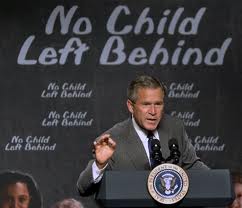
Meanwhile, despite some recent notable exceptions (Wisconsin), this country’s commitment to providing the means to cultivate an educated public and informed citizenry is being flushed down the toilet in relative quiet.  Wasn’t it just yesterday when the talking heads were nodding sagely at the wisdom of the “No Child Left Behind” initiative.  This unfunded mandate was willingly shouldered by such states as Texas, with Gov. Rick “States-Right-to be Ignorant” Perry at the helm, because, after all, education is our future.

But one day we awoke in a new world where it was “Torpedoes be damned!” against education, particularly teachers and school districts.  As a result, the teacher ranks will suffer layoffs, benefit reductions, and pension cuts.  That’s before they even walk into increasingly larger classes, fewer neighborhood campuses, and experience cuts in libraries, the arts and extracurricular activities.  Peggy Noonan, former Nixon speech writer, explained on Morning Joe one day recently that cutting the education budgets seemed reasonable to Republicans and tea partiers, because “they don’t see all that money going to children.”  I don’t get it, Peggy.  Do they believe that children should be teaching themselves?  Administering tests and developing curricula?  Or has there been an epidemic of administrators buying new cars and taking lavish trips with school funds?  What did I miss?

Or do they simply believe teachers should impoverish themselves in order to selflessly teach our children?  What kind of irrationality do they attribute to educators that would cause them to eschew their own self-interest and better paying jobs (and ones with less stress, surely) outside of the teaching profession?  The obvious reality is that education happens because  money is spent on  teachers, testing, buildings, bus drivers, and administrators.

Moreover, it is the insanity of this funding crisis that the school districts must comply with the laws that Legislature has imposed on them, funded or not.  As AISD Trustee Lori Moya wrote in a recent letter to the editor in the Austin-American, “School districts aren’t asking for more money.  We’re asking for enough money to meet state requirements and mandates.”

The only conclusion one can come to is that we’re in the midst of a right-wing campaign to dumb down the American public and consolidate their power over hearts and minds.   Accordingly, institutions and programs that exist to foster a more informed citizenry must be strangled to death.  Why else declare war on the Public Broadcasting System and National Public Radio, media outlets that inform Americans about the world in which we live and the politics, the science, and the literature that inform this world?

No, Americans should be fed a steady diet of network and cable television in order to get our marching orders from Madison Avenue.   The right wing wants to be sure that American heads get their fill of fare that make them good consumers and distract them from any critical thinking.  Just look at the television schedule and its distraction of murder, mayhem, and reality shows that have nothing to do with “reality” as we know it.  Like, what’s with The Bachelor?  How does it escape attacks from the right wing, when it totally trivializes marriage?  Isn’t that institution sacrosanct in their books – at least until they are discovered toe dancing in bathroom stalls, hiking in Argentina, or paying off the mistress and her family?

And if you consider the squelching our children’s potential as the right-wing objective, the battle over Planned Parenthood even begins to make sense.  The clients who use their services the most are the poor.  If fewer of the poor get abortions (which to the R-mind is all that PP does), they will have more children, preventing their ability to escape their impoverished condition.  Neither the parents or their offspring, mired in poverty and working their minimum wage jobs at best, will ever have the time or energy to acquire the education and skills it takes to make it to the middle class (assuming one still exists).  The children will never grow up to question Big Oil subsidies . . . or any other form of corporate welfare.

The situation is particularly dire in Texas.  Back in February, Paul Krugman wrote of the Texas budget cuts and pointed out that Texas is 43rd of 50 in state rankings in high school graduation rate.  Further, he wrote, the state ranks 5th in poverty nationally and leads in the percentage of children without health insurance.  Medicaid is being cut to such a degree that many fear  doctors will start refusing to see Medicaid patients.  Add to these grim statistics the prospect of as many as 100,000 layoffs in education sector.  Krugman poses the question that he heard asked by many business people in Texas:  how can the state prosper in the long run with a future work force blighted by childhood poverty, poor health and lack of education?

But obviously, Paul Krugman and Texas business leaders don’t get the same memos the Republican governors get.  Those memos explain that they can’t depend on the educated classes anymore.  They must hitch their wagons with the tea party whose loyalists could care a flying flip about education policy and the long-term health of a country and its economic system.

One Texas state representative (Democrat) said recently about the new crop of legislators from the right wing and tea party, in particular, “They are delighted that Texas is having this budget crises because that gives them the excuse to reduce government to where it  can be dragged into the bathroom and drowned in the bathtub a la Grover Norquist.” No matter that we’re flushing the future of our children and this country down the drain, too.  An educated electorate merely gets in the way of dismantling government as we know it.

As unbelievable as it is, I have to wonder, whether I will wake up to find that this was all just a bad dream?  If so, I’m just hopin’ George Bush is still gone.

Posted in Uncategorized | Tagged , , , | 6 Comments

The Amazing Man who Stopped the Can

Based on a friend’s high praise (from about 5 years ago), I finally knuckled down and immersed myself in the book, Team of Rivals, the Political Genius of Abraham Lincoln, by Doris Kearns Goodwin.  Within its 750 pages I discovered the amazing man who was our 16th president and the other three men who ran against him for the Republican nomination for president in 1860, only to find themselves as members of his cabinet and among the men who loved him most.  To say that I got teary-eyed at the assassination part should reveal to you how much my fondness and respect for this man grew.  Perhaps it’s a true testament to the author’s ability as a writer, but I suspect that it was more about the person she revealed in those pages, a man whose breadth and depth of character and intelligence is only hinted at in the history books that most of us have ever read.

It was merely coincidental that I happened to be reading Goodwin’s book during last month which marked the 150th anniversary of the beginning of the Civil War.   Consequently, I was well armed to weigh the comments of the several talking heads, opinion writers, and politicians who discussed the origins of this war as if it were still in contention.  You could hear the same post-hoc rationalizations that were heard after the Civil War from Southern apologists :  states’ rights, cultural differences, tariffs, or the industrializing North versus the agrarian South.  These, claim historian Orville Vernon Burton, would have you believe “that it was actually the collision of two noble civilizations from which black slaves had been airbrushed out.” Of course, it suits the Tea Party’s agenda to characterize it as a struggle over states’ rights.  They leave out the simple fact that the Southern states sought to protect states’ rights to permit human bondage.

Reading Team of Rivals, however, one cannot doubt this war’s origins.  As Goodwin depicted the politics of the time and the national disputes that alienated the country, the evidence is overwhelming that slavery was the root cause of this horrific war. Simply consider the Missouri Compromise (1820); the Fugitive Slave Law (1850s); the Kansas-Nebraska Act (1854); and the U.S. Supreme Court’s Dred Scott decision (protecting private property rights), to name a few.  In fact, the crisis had been brewing since the founding of this country.  As pointed out in the Ken Burn’s latest civil war documentary, a federal union consisting of the original 13 colonies would not have been possible if our founding fathers had not kicked the can (of slavery) down the road for future generations to deal with.

Of all the events depicted in the book, however, it was not the ground battles but the legislative battle — described in pages 686-690 and liberally quoted here — to pass the Thirteenth Amendment that most dramatized slavery as the motivating force behind that war —  at least, for this political junkie.

As author Goodwin explains, “. . . nothing on the home front in January 1865 engaged Lincoln with greater urgency than the passage of the Thirteenth Amendment, abolishing slavery.  He had long feared that his [1863] Emancipation Proclamation would be discarded once the war came to an end.  ‘A question might be raised whether the proclamation was legally valid,’ he said.  ‘It might be added that it only aided those who came into our lines . . . or that it would have no effect upon the children of the slaves born hereafter.’”

The amendment had passed in the Senate by the requisite two-thirds the previous spring, but failed to garner the two-third vote in the House, where Congress split along party lines (sound familiar?) with Republicans in favor and Democrats against.

Republican gains in the November elections ensured that the amendment would pass if he called a special session after March 4.  Questions about the Proclamation’s validity would be assured, however, if this Congress would complete the job.

Ohio Congressman James Ashley reintroduced the measure in the House on January 6, 1865.  To sway votes of moderate Democrats and border-state Unionists, Lincoln assigned two allies to deliver the votes of wavering members, leaving them no doubt that in exchange for the needed votes he had the power to offer plum assignments, pardons, campaign contributions, and/or government jobs.    Democrat Moses Odell, for example, changed his vote and received the lucrative position of Navy agent in New York when the session ended.

As the vote got nearer, the pressure intensified; Democrats were threatened with dire consequences if they failed to maintain the party line.

Rumors that Confederate Peace Commissioners were en route to Washington or had already arrived were being circulated.  Ashley feared the Democratic leadership might try to keep their members in line by arguing that the amendment’s passage would short-circuit peace talks.  He asked the President to confirm or deny the rumors and Lincoln promptly replied that there were no peace commissioners in the city, or likely to be. This was a cunning evasion, Ashley later learned, because the Commissioners were known by Lincoln to be on their way to Fort Monroe.

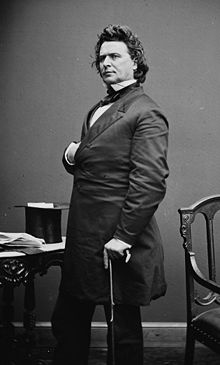
James Ashley

Describing the scene at the Capitol, Ashley wrote, “Every available foot of space, both in the galleries and on the floor of the House, was crowded at an early hour, and many hundred could not get within hearing.”  The  members of the Supreme Court were present, along with cabinet members Seward, Fessenden, and Dennison.  Dozens of senators and members of most foreign ministries had come to witness the historic debate.

Ashley yielded his time at the podium to the small band of Democrats who would support the amendment but needed to justify their vote shifts.   One Congressman explained that he had changed his mind when he saw that the only way to achieve peace was to destroy “the cornerstone of the Southern confederacy.”  Applause erupted from the galleries.

After every Democrat who wanted to speak had been heard, the voting began.  At first, it appeared that the amendment had fallen two or three votes short of the requisite two-thirds margin.  The floor was in a tumult when Speaker Colfax stood to announce the final tally.  His voice shaking, he said, “On the passage of the Joint Resolution to amend the Constitution of the United States the ayes have 119, the noes 56.  The constitutional majority of two-thirds having voted in the affirmative, the Joint Resolution has passed.”  Without five Democrats who had changed their votes, the amendment would have lost.

“For a moment there was a pause of utter silence,” Noah Brooks reported, “as if the voices of the dense mass of spectators were choked with strong emotion.  Then there was an explosion, a storm of cheers, the like of which probably no Congress of the United States ever heard before.”

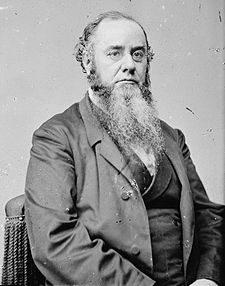
Edwin Stanton

“Before the members left their seats,” Congressman Arnold recalled, “the roar of artillery from Capitol Hill announced to the people of Washington that the amendment had passed.”  Ashley brought to the War Department a list of all those who had voted in favor.  War Secretary Edwin Stanton ordered three additional batteries to “fire one hundred guns with their heaviest charges” while he slowly read each name aloud, proclaiming, “History will embalm them in great honor.”

And that, we can safely say, is when that can, kicked down the road by our founding fathers, came to a stop.

Posted in Uncategorized | Tagged , , , , , | Leave a comment

Check that Authenticity at the Door, Ladies!

As Michelle Obama traveled around Brazil with her husband last month, I thought she looked particularly glamorous and represented our country well.  During her few public speaking engagements, she exhibited her warm personal demeanor along with the intelligence she wears as comfortably as the beautiful dresses unveiled during this trip.

I was reminded how difficult it is being the First Lady of this country and how you must be all things (personable, intelligent, fashionable), and yet, be nothing that calls too much attention or upsets current public opinion of what a First Lady should be.  Maybe Jacqueline Kennedy described it best when she told a friend sometime after the election, “I feel as though I had just turned into a piece of public property.”   Hillary Clinton characterized the position of First Lady as a “role,” not a job.

It seems that Americans demand that First Ladies check their authenticity at the door of the White House . . . or else.  No longer can one follow the dictates of Eleanor Roosevelt in explaining her work as First Lady, “Do what you feel in your heart to be right, for you’ll be criticized anyway. You’ll be damned if you do and damned if you don’t.”

These days, the damning is just so toxic, as Hillary Clinton can readily attest. Folks in Washington didn’t want her Wellesley and Yale-educated brain applying itself to work on health care reform, so she was accused of all sorts of crimes and misdemeanors —  including murder (Vince Foster) — to scare her back to her proper role of planning State dinner parties and decorating the White House Christmas tree.

Of course, to some degree, women are accustomed to backing down and donning masks to win approval. They must reinvent themselves multiple times during their lives, balancing on that tightrope which will make the difference between acceptance and rejection, trying to make the grade, appeal to others, and satisfy multiple roles, including wife, mother, worker, and chief laundress, to name a few.

First Ladies, at the top of the womanhood pyramid, are confronted with an audience of millions that must be satisfied.  Instead of receiving daily critiques of ideas or policies, like her husband, the presidential wife is often taken to task for issues relating to matters involving her self-image.  She is criticized for her wardrobe choices and hair styles, e.g., Hillary had too many hairstyle changes, and Michelle Obama has the audacity to wear sleeveless tops and dresses.  Laura Bush virtually erased herself, instructing her speech writers never to use the personal pronoun “I.”

One commentator suggests that Democrat women inspire more negativity than Republican women.  Why else, he asked, would worthy causes like nutrition and childhood obesity be suddenly suspect as something barely short of a communist plot?  The same commentator suggested that if Laura Bush had been a Democrat, the right wing would have decried reading and crucified her for promoting literacy.

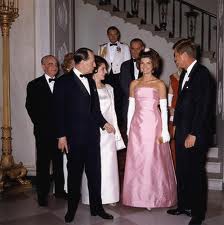
Too young to remember much about Jacqueline Kennedy during John F. Kennedy’s presidency, I was fascinated by an exhibit of her White House Years at the Met in 2001, highlighting her contributions to JFK’s presidency and her popularity with press and public, along with her fashion legacy.  I can’t help but wonder how she would be treated in today’s 24/7 news cycle and blogosphere.

Like the first ladies of today, Arthur Schlesinger writes, Jacqueline was keenly aware of the role she would be playing as first lady.   “She was all the more remarkable because, at the age of 31 she was 9 years younger than the youngest of any of the presidential wives before her or since.”  She was quoted as saying, “It’s really frightening to lose your anonymity at thirty-one.”

Her solution was to approach her role as any great actress, using her wardrobe, which she called “state clothing,” as a shield, and her style as an weapon.   One of her dress designers, Oleg Cassini explained her approach to trips of State, “every country was a campaign, with clothing an essential element in the battle plan.”  Apparently, she disarmed many.

Her impact on the word stage became clear with JFK’s first State trip to Canada in May, 1961.  The Canadians went wild, screaming “Jackie, Jackie” in the streets.  As Leticia Baldridge, her social secretary, remarked, “Canadians just don’t scream like that normally.”

A month later during the European tour, the public and press were no less enthralled with her.  After her reception upon arrival to France, President Kennedy famously quipped at the press luncheon in Paris: “I do not think it entirely inappropriate to introduce myself to this audience.  I am the man who accompanied Jacqueline Kennedy to Paris, and I have enjoyed it!”

Jackie had studied in France for a year and obtained a degree in French literature from George Washington University.  A former french ambassador noted that Jackie’s “influence was extremely efficient as far as Franco-American relations were concerned . . . Jacqueline helped [President Kennedy] very much to understand France.”  Author Pearl Buck wrote, “It was a source of pride to me that she appeared in France simply, but well dressed, and that she spoke to the French people in their own tongue.”

In Latin America, where JFK sought to improve his Alliance for Progress initiative, Jackie’s fluency in Spanish was a tremendous asset.  During a ceremony to present land titles to families in Venezuela, the president introduced his wife as “one of the Kennedys who does not need an interpreter.”  The first lady then delivered her own remarks in Spanish to resounding applause.

She even beguiled Khruschev who the AP reported “looked like a smitten schoolboy when the ice thaws along the Volga in springtime” upon meeting her.  And after a day of tense and unresolved negotiations between the premier and JFK, photographers asked Khruschev to shake the President’s hand.  He responded, “I’d like to shake her hand first.”

Many more incidents serve to illustrate how this woman adapted to her role of First Lady and created a character that beguiled the world while furthering this country’s foreign policy objectives.  Today, I expect that she would have been roundly criticized, beginning with her own penchant for sleeveless dresses.  And speaking fluent French AND Spanish!!??   She’d be bombarded by the proponents of Freedom Fries (remember them?) and the English ONLY movement. And that’s before you even consider that she might be accused of dipping her finger too deep into foreign policy!

I have to admit that I can hardly wait for the election of the first woman president so I can witness how the First Gentleman (what else?) will adapt to his role.  How will he cope with having his every move scrutinized and questioned in a public debate?  If he’s a golfer, will he be criticized for playing often, his handicap mocked, and his swing deconstructed?  Will his hairstyle be an issue, or the suits he wears?

On the other hand, all the issues that First Ladies have had to cope with may not even arise with the First Gentlemen.  And, just to warn you on this, that would really piss me off!!

Posted in Uncategorized | Tagged , , | Leave a comment

Symphonies in the Key of Life

As a friend fights on in the ICU at Seton Hospital, I’ve been thinking about our lives and how they get summed up in many ways when we were gone.  If you are a loyal reader, you might remember an entry from last June about my great interest in obituaries and how, not counting an inactive Facebook page, they may be the only retrievable source of information about our stay on Earth — at least for the non-famous among us.

Some find obituaries rather boring, as most follow a standard format including where and when a person was born, their marriages, offspring, professions, along with hobbies and pets and devotion to church. [Speaking of which, I’m convinced that religion is bad for your health.  Too many devotees have succumbed to all kinds of accidents and illnesses.]

But it is possible to find much richness — whether we knew the deceased or not — when a family member (or the person himself) tries to communicate the true essence of who the person in six column inches of newsprint.

Over the years, I’ve saved a few that have hit the mark in humanizing an individual in a way that a list of dates, places, and credentials will never do.  And there are some that simply put words together in beautiful ways.  I’ll pass on some that were simply too good to let them go the way of their subject.

Richard Ballard, who died in 2009, was described this way:  “Dick was a quietly honorable man who thoroughly embraced his passions: his family, the practice of medicine and the search for a great bottle of wine at a reasonable price.”

And how interesting it was to read of Wylma Louise “Cassie” Castelberry O’Connell Ruelke, of whom it was said, “Three things changed her life: the opening of a public library branch in the basement of her Houston elementary school that introduced her to a love of novels; her friendship with elementary school classmates Barbara Tierney and Shirley Jones who convinced her to join them in a pact to one day become nurses; and a high school job at the Piggly Wiggly deli counter that introduced her to such exotic fare as Camembert cheese and herring roll mops.”

While I’ll never rue my non-introduction to roll mops, I’m sorry I never met Mimi Segal after reading her obituary.  She was a pilot for the Women’s Airforce Service Pilots (WASP) program and after the war, she continued flying for North American Aviation.  Mimi met her future husband B. on a blind date, and if  “truth be known, she was smitten not so much by the dashing pilot from Louisiana, but by his co-pilot, a handsome cocker spaniel named ‘Tufy Tailspin.’  It only took B. seven years to turn on final approach and ground the lady ace long enough to say ‘I do’ on May 23, 1950.” [I must note that I am curious about B.’s real name, which was never revealed.  I’m now waiting for his obituary.]

In September, 1996, this was said about Robert Carnes who worked for the FBI:
“The harness required by his occupation was frequently at odds with his tender heart and elfin sense of humor.  He was intensely moral and honest, fair and kind.  Had he been otherwise, he may have accumulated more of what the world had to offer, but he fervently believed the real score was tallied on a different plane . . . He was a man, and that is the worst that can be said.  He was a man who lived a code of honor that required much, and that is how we recommend him to his God.  He will be sorely missed, but that is beside the real point of his life.  It is more accurate to say he will be well remembered.”

As for published poet Susan Fay Bush, she was reported as being “especially pissed off that her body would not allow her to stay around long enough to 1) see her grandchildren grow up, 2) attend her own memorial services, and 3) vote for Barack Obama.”  It was also wished that in lieu of flowers, we “eat a cheeseburger and drink some wine in Susan’s honor.  Or make a donation in her memory to Planned Parenthood or Hospice Austin.  Most importantly, vote early and often!”  (As you can see, a mention of wine goes a long way with me!)

And beyond the obituary, there are wonderful writings in funeral programs or memorial handouts.  I am reminded of the bookmark at Eileen [Mason] Orton’s memorial service.  On the bookmark was a poem, written by a family friend, Carl Gregory, that read, “To Eileen, dancing was life, and life was a glorious dance.  It was not her profession, nor her great talent, but was the heart of her spirit.  Her world was somehow always lighter, and her outlook brighter, than the one the rest of us lived in.  She lit a candle in everyone who knew her, and we are not darker for her passing but radiant for her having been with us.”  I still see that light in her daughters, Carl.

And finally, another poem recently appeared in a funeral program, written by Spencer Reid years before he was sick and found in one of his personal journals after he died.  “In my soul there are many songs; But not being a minstrel to sing them, I alone hear;  I dance to their melodies.  Unheard and unsung, they will go with me to my grave; And as the dirt smothers their music, people will say, ‘What a stranger!  He danced when there was no drummer and he cheered when there was no music.’  They will never know what a symphony my life really was.”

All of us, I know, have symphonies and dances inside of us.  What we don’t all have are family members with a talent for words, or friends to write poems about our luminous spirits.  Spencer, albeit unknowing, put his own life to music and words, to be remembered for years to come.

On this second morning of spring, outside my window, the birds wake up the day with their music, singing as if their lives depended on it.  And I wonder whether my sons will write a rap song for my memorial.

P.S.  Keep up the fight, Sherry!

Posted in Uncategorized | Tagged , , , , , | 11 Comments

Plates of Food for the Poor American Children

No doubt, many of you of my generation will remember parents instructing us to eat all the food on our plates, motivating us into this act of “cleaning our plates” with major guilt trips.  Specifically, they’d appeal to overseas guilt: “Just think about those poor children in India (or China) who would be glad to eat this food.”

As I look back on it, I don’t remember what concept I had about these children, although I would have gladly given the offending food to them.  Food we liked went down easy.  Food we didn’t want to eat, however, always brought up the specter of these starving children on the other side of the globe.

But that was then.  Nowadays hungry children live all around us, thanks to a political system that has systematically picked away at the middle class and has now climaxed in an economic collapse that pushed those who remained, albeit precariously on the edge, decidedly into poverty.   According to the 60 Minutes segment, Hard Times Generation: Homeless Kids, 25% of American children are now living in poverty. . . the largest generation since the Great Depression.

Since watching this, I am haunted by the vision and the words of a little boy describing how it feels to be hungry, to not being able to sleep at night because your stomach hurts so much.  Nor can I forget the girl who talked about getting food from churches or the one who told about asking classmates for their uneaten food.

The children in this story by Scott Pelley are living in Seminole County, Florida, within an hour’s drive of Disneyworld.  The irony, of course, is that Disneyworld is a children’s paradise of carnival rides while Seminole County school buses now make regular stops at the cheap motels to pick up students after losing their homes.

Those who still have houses describe having their electricity shut off for non-payment and having to study by candlelight, flashlights, or even the overhead lamps in a car.  It should come to no one’s surprise that these children are struggling in school.

And there are the psychological effects.  One young girl said she felt that it was her fault because her parents had to buy food and clothes for her.  No, it doesn’t make sense, but that’s common reasoning among vulnerable children trying to protect their parents from their shortcomings or failures.

But, be aware, these problems are not confined to Florida.  Last year, according to the group Green Doors, there were more than 5,000 homeless people on any given night in Austin and Travis County, 616 homeless families with children, and 3,000 to 5,000 homeless AISD students.  Furthermore, the average age of the Austin homeless person is 7 years old.  Surely, their faces are just as sad and troubled as those children in Seminole County.

I don’t know how any Wall Street executive or banker can sleep at night knowing that they have been bailed out with government funds – only to get richer than ever – while these children get more destitute and hungrier.

I also wonder how members of congress are sleeping at night, having just extended a tax cut to millionaires for another 2 years while the parents of these children lost jobs, their houses, and now, their dignity.   Why is it too much to ask for a little sacrifice from those who have gotten all the breaks in the last 10 years?  If only someone in Washington would worry about the starving children of America like they worry about millionaires who threaten to hijack the economy if they don’t get their tax breaks.

Must those children depend solely on the charity we “little people” can give?   How much can we feasibly accomplish when the forces in charge of this country have doomed the economic system that used to allow for most people – not just the very rich – to make a decent living? How can we keep our cash-strapped state governments from abandoning these children’s future, along with their present, by withdrawing support to public education?

Would giving more to the Capital Area Food Bank assure that no child goes to bed hungry?  I don’t even know where the food bank is….does it have branches?  Is it convenient for the homeless to visit?  I realize how little I know about it beyond being an regular contributor.  I should learn more.

There’s something so wrong about this situation.  I see the faces of these children and they aren’t living in India.  They are in the United States of America, Land of Plenty, Land of Opportunity, Land of the Free and the Brave.  And now Land of National Shame.

I wonder whether Mitch McConnell ever urges his grandchildren to clean their plates in the name of the poor starving children in America.

Posted in Uncategorized | Tagged , , , , , , , , | 3 Comments