The Summers of Our Discontent (or Why I Hate Daylight Savings Time)

As spring has sprung, I’ve heard many remarks about its beauty, folks proclaiming it their favorite season, and the sound of sneezing as blooming allergens make  their presence known.  The other day, a friend waxed on about how clean, fresh, green(!), and new everything appeared.  I could almost hear newborn lambs bleating as a soundtrack to our conversation.   After experiencing last summer’s drought, I have to admit that fresh, green, and alive is a welcome sight.

But, as I told my friend, I think I love the fall more. Whereas spring comes upon us gently, autumn makes its appearance, it seems, suddenly with a dramatic flair.  In spring, an exclusively light green palette predominates, but in fall, we are regaled with reds, oranges, yellows, and browns, backdropped by the deep green of evergreens.  The nicest part is the air that is infused with a smell that is so peculiarly autumnal.  Moreover, that smell long ago became associated with the excitement of starting a new school year, buying new spirals and school clothes, pep rallies, football games, and being back with our friends.  With school years far behind in my rear view mirror, I still feel that rush of possibilities.

While summer was a great time of year for a kid who enjoyed swim lessons, camp, and trips to visit grandparents, after those things were over and done, the long hot days of August in Texas, with nothing to do, seemed to wear on too long.  Our mothers, too, ran out of patience with us traipsing in the house after playing Barbies for 3 hours with girlfriends, proclaiming that we had “nothing to do!”  It was too hot to play hop scotch because the sidewalks burned our feet.  We asked for eggs to fry on the sidewalk to prove our point.

That never happened in the fall.  We folded book covers on our school books, wrote notes to friends to pass off in class the next day, practiced for sports, looked forward to parties.  If it could only last for a few more months with its crisp days of high-definition colors after the summer days with their haze of heated evaporation.  If only the leaves would dance a little longer on the branches and in the air.  If only the cold, death knell of winter could be put off a little longer.  As I write, I realize it sounds a bit like the season of my life right now.

Meanwhile, I accept the fact that folks can differ about the seasons, but what there seems little dispute about – at least here in the south – is Daylight Savings Time (“DST”).  As everyone knows, we recently went through the change. . . springing our clocks forward, losing a “mere” hour in clock time, but losing many more hours as our bodies and minds, wrested from the rhythm of Mother Nature, make their needed adjustments.

I suppose DST works well for countries that are far north and want to experience more daylight hours, except that they make the change in the summer when the globe is already tilting to give them more sunlight.  Sounds a bit greedy to me.  If you’ve been to St. Petersburg in June, you daylight lovers will have the delightful experience of 24 hours of daylight.  Winter, of course, presents the opposite phenomenon.  Wouldn’t it make more sense to tinker with the clock in the winter when folks are in endless dark?  Or even in those locales that experience darkness at 3:00 or 4:00?

But during our southern summers, all we get is endless heat.  It would be nice to go home after work and not have another 3 hours in the same heat we just endured while driving home in vehicles with air conditioning being generated to the max, thereby increasing our gas usage and overheating radiators stuck in traffic.

Of course, you often hear about sports aficionados that want to have more daylight time for sports, but our fields have lights.  I have long pitied those Little League parents who sit through the practices and games in 100 degree daylight, wearing hats, wetting bandanas with their water bottles to wipe off the sweat.   And is it really good for the kids?

And on the subject of energy savings, I fail to see how much is saved by this change in time – we still get up and get out of the house, heading for schools and offices  –  but at the end of the day the temperature is at its hottest and we have to find salvation with air conditioning, extra baths, showers, icemakers, and a whole panoply of electrical coping devices running at full tilt.  We develop strategies to wait in our cocoons – to take our evening stroll, walk across the street to get the mail, or walk the dog – until the sun is going down and the sidewalks have cooled down.

In this political atmosphere of Texas Republicans eschewing everything the federal government imposes upon the states, I’m surprised they don’t go for something easy like DST.  They don’t even have to file suit against the government or present a case before the Justice Department.  Just pass a law.  Declare your independence from this yoke of federalism, boys!!!

Whenever I think about opting out this time change, I’m reminded of Henry Sanchez, a state representative from Brownsville, Texas, who introduced a bill back in 1971 to exempt Texas from DST.  On the floor of the House, he stood at the front podium explicating  facts and figures that demonstrated the burden the time change imposed on Texas citizens.  He also explained that it was unpopular as shown by the amount of mail he had received from his constituents expressing their opposition to the time change.  To demonstrate his point, he enlisted a couple of young assistant sergeant-at-arms to pull some loaded postal bags to the podium.  Unfortunately, another representative asked to see the contents of the bags and since Rep. Sanchez could not really avoid their opening, it was revealed to all that the bags contained old newspapers, not constituent letters in opposition to anything.   In an attempt to save face, Rep. Sanchez explained that folks in the Valley weren’t prolific letter-writers, but they told him of their opposition all summer long.  Needless to say, the bill did not pass.  But thanks for trying, Henry!

Bottom line, I might consider DST a blessing in the winter, but if anything, we need to shorten daylight in the summer.  As global warming gets worse (no matter what your theory on its cause), an hour or two less of these long 100 degree summer days would be a big relief.

And, needless to say, another reason to love autumn.

Posted in Uncategorized | Tagged , , , , | 4 Comments

Seeing Each Other Through Blind Eyes

In the wake of the recent controversy surrounding Asian-American, Harvard grad Jeremy Lin of the New York Knicks, I found myself musing about the situation of minority groups who have such difficulty blending into the stereotypical American landscape.   One of the reasons, it seems, that Jeremy Lin burst into the news as some kind of phenomenon is because of racial stereotypes about his athletic ability.  It is not dissimilar from the experiences of individuals in other races or ethnic groups who are assumed to lack academic ability because of their bloodline.

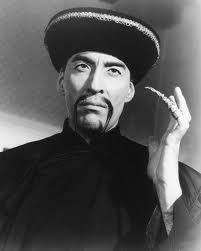
Unlike our long history with Blacks and Hispanics on the American continent, the Asian American as a prominent group in our society is a relatively new phenomenon.   In fact, I remember growing up in Austin, a city where Asians or their children – outside the University campus – appeared few and far between.   It’s probably safe to say that knowledge about Asians was gleaned from the movies of Charlie Chan, Fu Manchu, and World War II.

In my Dallas family, however, there was one Asian American who had played a prominent role for decades as the family physician.  Dr. William Tsukahara of Japanese ancestry even delivered me into this world.  But more significantly, he demonstrated to me and many that the kindly family doctor does not have to look like Marcus Welby, M.D.

Dr. Tsukahara, called “Suk” (pronounced “Suke”) was the doctor who cared for grandparents, mother, and aunt, and other members of the extended family.  He saw my mother through all of her childhood diseases, including diptheria, when she was quarantined and my grandmother had to boil everything she touched.  He was also the doctor who delivered my aunt, Jeri, and saw her through polio, recommending that she not be hospitalized like other children suffering from the disease.  He believed  that the spinal tap required by the hospital to confirm the diagnosis, made the condition worse, having seen it first-hand in his own daughter and other patients.  This, of course, required more work on his part, but Jeri attributes her complete recovery to his care and advice.  I’ll never forget the time or two I came from Austin to Dallas at Christmas time and I was taken to see Suk, who delivered me from severe cedar fever symptoms.

I asked Jeri if she ever thought it was strange that she would have a doctor of Japanese descent, and as you would suspect, she said she never thought twice about it.  That was her normal; he was just part of her family.  She remembered him as a roly-poly man with a beautiful speaking voice, and that she always felt better after going to see him – even if she was still sick.

Not too many years ago, something triggered my memories of him and I was struck with the idea that, unlike other Japanese Americans during World War II, he and his family were not forced into the internment camps.  And why, I wondered, was Dr. Tsukahara living in Dallas, Texas in the first place?  By the time my questions arose — since it was my previously unquestioned normal, too — I had only my aunt left as a source and she didn’t have many answers although she was confident he had been born in Texas.  Luckily, with the advent of the internet, I was able to satisfy my curiosity and learn the interesting history of his family.

From a google search, I easily retrieved a very informative article at the Baylor University Medical Center website about Dr. Tsukahara and other Asian-American doctors at the Center written by Dr. Masashi Kawasaki .  The story of Dr. Tsukahara and his family, I discovered, was quite an interesting thread in the tapestry of our history.

Dr. Tsukahara’s uncle, Kinta Tsukahara, was the first in the family to settle in Texas.  Kinta arrived in 1885 and settled in Honey Springs, Dallas County, Texas (annexed to Dallas in 1946).  Kinta was one of three Japanese Texans recorded in the 1890 census.  The other two resided in  Cameron and Tarrant counties.  Kinta worked at the Overton Farm in Honey Springs. The magnificent Overton homestead, built in 1844, is known as the oldest occupied home in Dallas County.
As Dr. Kawasaki writes, in those days, most people from Japan emigrated one at a time. If circumstances were favorable and the family could find the resources, the next chosen male family member would be sent to join his family member.  If location prospects in North America continued to be positive and the necessary funds were available, sometimes the entire family would come.  Kinta, a farmer, came a year after the Meiji Restoration sanctioned general emigration.  Emperor Meiji embraced the principles of the Industrial, American, and French Revolutions and dreamed of sending people abroad to learn and, subsequently return to westernize Japan.

Thus, in 1900, his brother, Kinya Tsukahara immigrated to Texas at the age of 26.  Rather than farm like his brother, Kinya wanted to follow the medical profession as previous generations in his family had done.  He had already graduated from Saisei Medical College in Tokyo in 1899, but for licensing reasons, Kinya entered Baylor University College of Medicine in 1904.  At that time, medical school was generally completed in 2 years; Kinya graduated on April 24, 1906 and joined the staff as an intern at the newly created Texas Baptist Memorial Sanitarium.  In 1908, he opened a private practice of medicine and surgery in Honey Springs.

At some point during these years, Kinya’s Japanese wife joined him in Dallas. From this arranged marriage, six children were born:   Henry Chuken, William Chono, Woodrow Chubin, Theodore Chusho, Mary Kura, and Berta Takako.  All the children were given western first names and Japanese middle names.  While many Japanese immigrants returned to Japan and aided in its planned westernization — Kinya and his older brother remained in Dallas and contributed to their chosen community.

Kinya Tsukahara’s son and our family doctor, William Chono, was born in 1912 in Honey Springs.  Enrolling in medical school in 1930 at age 18, William received his degree from Baylor University College of Medicine 4 years later (more requirements by then), and interned at Baylor Hospital.  In 1938, he served as health officer of the Texas Centennial Observance in Dallas and then established his medical practice on Forest Avenue in South Dallas (now MLK Boulevard).   Kawasaki notes that he was not forced into Japanese internment camps during the war because he did not live on the West Coast.  Government security officials, however, scrutinized his everyday activities during that time. [My aunt remembered my grandmother saying that he lost many patients as a result of the war and that his practice never thrived to the degree it had pre-war.]

Dr. Tsukahara was married twice and fathered six children, 5 daughters and one son.  Devoted to his patients, he maintained his practice throughout 6 years of dialysis treatment. He treated patients up until the day before his death in 1980, at age 68.

I would have loved the opportunity to have known Dr. Tsukahara better, but what I learned from him was enough to last a lifetime.  Through this modest man, one of a progressive America, but still possessing the sensibilities of his Japanese culture, I realized the value of looking beyond superficial appearances based on ancestry.  I’m sure he would be surprised to learn that 30 years after his death, that there are many people like me who still remember him fondly and, more importantly, attribute him with their exposure to a life-long, incurable affliction:  racial blindness.

Similarly, I hope that Jeremy Lin spreads the same affliction to a younger generation.  By ignoring the racist epitaphs and comments hurled his way, he has shown great class and courage, demonstrating once again that an individual can transcend their preconceived categories.

I just wonder when we, as a people, can transcend our tendency to conceive of such categories.

Posted in Uncategorized | Tagged , | 5 Comments

Wasted Days and Wasted Nights

I used to understand state government finance, or at least the basic principles.  Having served Mother Texas for some 38 years, I’ve lived through every kind of budget cycle, those during rainy days and those when the economic sun smiled brightly.  The nine years I spent in Comptroller Bullock’s budget, research, and revenue estimating divisions, educated me on the basic elements and factors in budget preparation, appropriations requests, and state revenue estimates . . . and the need for an occasional gloss of creative accounting.

But even with these insights, I am mystified as to how the Texas Facilities Commission (“TFC”) is saving money on the state’s new janitorial contract.  About a year ago, the agency ended its contract with a company whose crews, like the brownies of Scottish legend, came at night to empty our waste baskets, vacuum, and dust.   Office staff who departed by 5:30 rarely caught a glimpse of the cleaning crews.  Even among those of us who frequently work later hours,  the crews were hardly noticed because these unicorns of the night strived to be unobtrusive.

But then, the TFC found a cheaper alternative for these services.  One part involved a new and less costly contract crew.  The other part was the induction of office workers into a trash collection crew.  We were made responsible for emptying our own office waste baskets, for which purpose we were issued a spiffy blue container for recycling, and a tiny black one for regular trash.  We were instructed to empty these into their respective  larger collection bins situated in various places on the floor.  The contracted trash crew would come by periodically and empty the bins, but, as part of the new deal, they would no longer vacuum and dust every evening — just once every two weeks.   Hearing all this, we assumed that the janitorial efforts would be even more invisible than before.

Wrong!  Instead of the overnight trash collection, during the day, about once an hour or two, the trash crew detail circles the floor, guiding two large barrels on wheels.  He/she moves from collection bin to collection bin, emptying them into the barrels, often blocking foot traffic or requiring us to steer clear of the barrels in order to avoid collision because – in a startling reversal – we are invisible to the trash crew!

Moreover, they seem particularly adept at knowing the most inconvenient time to attend to these tasks.  For example, we have two big trash bins (one for each type of trash) in our break room which measures about 20 by 10  feet and houses a soda machine, large water cooler, refrigerator, sink, microwave, broiler, a large table, a sofa, etc.  Before and during the lunch hour, this is probably the most trafficked real estate on the floor.  But, invariably,  this is also the time that one of the janitors will unapologetically push her way in with the two big barrels and start emptying the trash (which we have only begun to fill).  It matters not that your soup is boiling over in the microwave . . . you will have to wait to get anywhere close to the appliance because large trash barrels will be planted between you and your lunch (or what’s left of it) until she is finished.

The bathroom crew is even more finely attuned to inconvenience.  Instead of a once-a-day visit, they come by, it seems, continually throughout the work day.  I’m not sure how many times a day the bathrooms get cleaning attention, but it seems that my bathroom needs coincide with that attention so I often encounter the bathroom squad about once an hour or so.  If I happen to miss them, I’ll be reminded of their recent departure by the upraised toilet seat, which used to give me a momentary start of “man alert!” until I got used to the midday toilet scrubs.

The intensity of care for our bathrooms is a bit mind-boggling.  Unlike users in the bathrooms of shopping malls or other public places where constant attention is necessary, we women, at least, are a pretty clean group (lawyers, paralegals and secretaries).  We manage to keep water in the sink, hit the target from our seated position, and properly dispose of our trash and “sanitary things.”  And speaking of those products, that’s not even much of an issue since I’d venture to say that the majority of us on our floor are post-menopausal.  The bathroom’s tampon machine, for instance, has been out of order for years and I’ve never heard anyone complain about it.

But the height of bathroom inconvenience occurs around the 5:00 hour, just as everyone is trekking to the bathroom for one last pit stop before getting on the road.  Apparently, this peak 4:30-5:30 time slot is when the crew believes a good mopping is required.  I have even been sitting on the toilet while the woman janitor thrusts her tentacled mop under the door directly toward my feet, barely missing them as I pull back in surprise.  If you suffer from even a slightly distractable bladder, wondering whether or not she’ll come in with further swipes does not encourage that organ to get on with its task.

Did I mention that none of the crew speak English . . . or Spanish. . . or any Western language?  All communication consists of pantomime or little shrieks expressing alarm.  And, speaking of alarm, I’ve been told by male office workers that when the male janitor is unavailable, the woman janitor walks blithely into the men’s bathroom while it’s in active use, apparently unconcerned about any male privacy issues.  I’m unaware of whether our menfolk actually shriek or whether an unannounced female presence has any affect on their bladder performance.

And the issue of the vacuuming and dusting function is impossible to ignore.  We have learned to tolerate these activities beginning at 5:00,  even while many of us work a staggered schedule with 5:30, 6:00, or 6:30 departure times.  But at times, this assiduous cleaning crew has attempted to move up the vacuuming/dusting hour to 4:00, which in addition to all the noise, involves the snaking of long extension cords along the length of the floor (at least half a city block) and the raising of powdered dust with their long-handled dusters.  It doesn’t seem to matter that lawyers and support staff are still trying to work, meet deadlines, and keep their allergies in check.  Although the crew members have been shooed off by head shaking, hand waving, and watch tapping at 4:00, they will invariably find their way back at 5:00 to bedevil us some more.  Fortunately, vacuuming only occurs once every two weeks or so.  Unfortunately, we will probably have to chip in for an office vacuum to meet any needs we have before they come back.

As you would expect from a group of lawyers, we’ve complained to the building manager about the 4:00 vacuuming and the wet bathroom floors at 5:00.  He believes that crew members just want to finish earlier and get home (or to their next job), but whatever the case, he has spoken with the company and they now wait to mop the bathroom between 6:00 and 6:30, although they still try to wet down the break room floor about 4:30.  But couldn’t they put up some “wet floor” caution signs?  At least one person reports her foot skating out from under her upon entering the break room, unaware of the mopping.

As strange as this all is, I can’t help but believe there may be some other goal – one other than cost-savings of janitorial services.  Could it be designed to reduce personnel by aggravating employees so much that they voluntarily choose to leave and find jobs without trash collection duties and offices where the dust has settled before the sun rises?

If so, I have news for the budget folks.  We are a sturdy lot, having long suffered the low pay, indignities, and lack of appreciation that government employees have to endure.  Interfering with our toilet activities and placing us in danger of tripping on extension cords, wiping out on wet floors, and risking collision with the rolling trash barrels is not enough.   We will survive all that —  even while we remember fondly the days when our waste baskets were magically emptied and floors made to sparkle as we slept.  In short, we can manage with the cleaning inconveniences in the office.  Just don’t get me started on the parking issues.

Posted in Uncategorized | Tagged , , , | 2 Comments

Let’s Be Mad as Hell!

Paging through the December 28th Austin American Statesman, I skimmed headlines until I was stopped on page A-7.  Catching my attention was “Israeli girl’s plight highlights religious extremism” headlining the story of an 8 year-old American immigrant, sporting a pony tail and eyeglasses, who was spat upon as she walked to school by Ultra orthodox Jewish extremists.  They would yell and call her a “whore” for dressing immodestly, even though she wore the standard dress for mainstream Jewish religious schools, a dress with long sleeves and skirt.  She sobbed on her way to school. “They were scary,” she said.  “They don’t want us to go to school.”

As I finished that horrific story, my eyes wandered upwards to the “World Digest” section where I read that an Egyptian court had banned ‘virginity testing’ of detainees.”   I discovered that the Egyptian military had put female detainees through virginity tests so that it could defend itself from accusations of rape.  The purpose of the tests was “to prove that they weren’t virgins in the first place.”  Obviously, once a woman is determined not to be a virgin, she could not prove that she was raped while in custody, in essence, separating those who could not be raped with impunity from those who could be.

After that discouraging report, the next digested world news was headlined “Somalia women face growing rape dangers.”   In Somalia, I read, the Islamic militant group al-Shabab is seizing women and girls as spoils of war, gang raping and abusing them. Other armed men are also preying on women and girls.  In the past two months, from Mogadishu alone, the UN has received more than 2,500 reports of gender-based violence.

If the newspaper layout editor was seeking to make the point that women are under siege by placing these articles all on the same page, he/she was preaching to the choir.  Yes, indeed, there is a war on women and we are not winning.  Even in this country we experience blips of progress, only to see them chipped away by legislators and judges who would steer us back into our “proper” female roles, living at the mercy of our biology and the male libido.

My hopes for women being treated as citizens with equal rights have been strapped in on a long roller coaster ride since those heady days in my 20s when I thought American women had achieved equality in the courts and congress with Roe v. Wade and decisions and legislation preventing gender discrimination.   But it didn’t take too many years before the backlash started and the ride began its downward trajectory.

It’s small consolation to consider that American women have it better than women in many other cultures.  Although we can freely wear Western clothes without being spit upon, drive cars, and aren’t subjected to virginity checks, those indignities might be better than losing our reproductive rights as Congress, state legislatures, and courts become the guardians of our wombs and force us to be baby makers.  Why did our society allow us to grow up believing in a destiny that included educations, careers, and equality in all ways to our male counterparts, in addition to being mothers when and if the time and partner was right?  Instead, in 2012 we are confronted with the daily display of  men-who-would-be-president (or some other elected office) who advocate that women should make babies no matter how the seed was planted, e.g., by knife to the throat or advantage-taking of a minor child.  If this isn’t an exercise in controlling women, it must be a strange womb fetish because these babies aren’t valued much once they depart the womb.

If this isn’t an exercise in controlling women, it must be a strange womb fetish because these babies aren’t valued much once they depart the womb.  And as a mechanism to control women, these officials and their pep squads seem to be aiming at the wrong demographic.  Maybe those conservative men just get all flustered thinking of vaginas and uteruses, because the women who are most threatening to their control agenda are those who can afford both birth control and abortions, as hard as they try to make them.  Instead, they wage war to cripple (or preferably, dismantle) Planned Parenthood, often the only refuge for low-income women.

But, maybe I judge too soon.  Maybe those Republicans running for the presidential nomination have figured that womb-control via abortion rights doesn’t hit the right target, so they’ve come out against a better tool:  outlaw contraception!!  Wow!  That would hit where it hurts!   But would the sexual revolution that was birthed by “the pill” go back into the box?  I have to wonder whether American men would be happy living in a country of chaste females, waiting to wear wedding rings before sex.

Perhaps this prospect could be the hook to entice our 20-something male population (50% of that undependable voting demographic) into guaranteed participation in the political process.  I’m willing to try anything to stop this onward march against women’s rights.  Wouldn’t it be the height of irony if our freedom from reproductive fascism were achieved by enlisting the forces of our youngest, most libidinous male citizens?

Fortunately, women can still vote, too, and for that I am eternally grateful to those women in the late 1800s and early 1900s who fought the fight to obtain that right.  In that regard, the movie Iron Jawed Angels starring Hilary Swank and Frances O’Connor, should be required viewing.   This movie tells the story of Alice Paul and Lucy Burns who put their lives on the line to fight for American women’s  right to vote.  While picketing for women’s suffrage, they are arrested on the trumped-up charge of “obstructing traffic,” even though their picket line is on the sidewalk.  Refusing to pay a fine for a crime they didn’t commit, the women were sentenced to sixty days in a Virginia women’s prison.  Insisting they were political prisoners, Burns demanded the warden respect their rights, only to be cuffed with her arms above her cell door.  In solidarity and defiance, the other suffragettes assumed the same painful posture.  Thrown into solitary confinement for breaking a window for fresh air, Paul went on a hunger strike, and returned to the prison’s general population the other detained suffragettes follow her example.  The warden began force-feeding them, but never broke them.

Every American should see this depiction of feeding by force.  I had often heard of the process, but I had never seen how it was accomplished and I will never think of it in the same way again.  More importantly, since seeing this movie, I have never cast a ballot without recalling what these brave and passionate women experienced so that I could vote for the people who govern my life.

And as we select our leaders in this election year, let’s not lay down and enjoy it.  Instead, reject any candidate who would continue to imprison us in our biology and restrict us from the scientific advances of the last century that prevent unwanted pregnancies.  It is not a far step from imprisoning women and sticking funnels down their throats to supporting a return to the old days of back alley abortions and requiring women to carry the children of their rapists.  Furthermore, we can’t pretend that forcing women to hear pre-abortion lectures and view sonograms is not a part of that goal.

Happy 39th anniversary of making a difference in women’s lives, Planned Parenthood!

Posted in Uncategorized | Tagged , , , , , , , , | 2 Comments

Foreign Encounters of the Friendly Kind

I anxiously reviewed incoming Christmas cards this year — as I do every year — hoping to see those from folks I’ve met along life’s way whose obituaries would not appear in the Austin paper, my main source of bad news.  I was glad to find one from General Jack Fisk, a supporting player in various legislative dramas in my early days.   While he’s not actually a general (an interesting story), everyone I know calls him “the General.”  His holiday cards from South Texas usually feature a picture of him with one of his dogs and always his War Veterans pin.

Rena Bartos

Another Christmas correspondent, New Yorker Rena Bartos, is one of my favorite “veterans” of life.  I forget her exact age, even though she wasn’t shy about revealing it.  Suffice it to say that she inspired me because she was not slowing down just because her mileage was high.  In fact, I met her as she enthusiastically added a few more miles to her odometer on a grueling three-week bus tour through Eastern Europe, Russia, and Scandinavia.

It was on that trip that I got to hear Rena’s life story. As I recall, she was in her mid to late 30s when her husband died, leaving her with a son to support.  In 1960, she joined the advertising workforce, and as you Mad Men viewers know, that was not a female-friendly environment.  But undaunted, Rena began as a marketing researcher and climbed to become Senior V-P at the J. Walter Thompson Company before forming her own marketing consulting firm, the Rena Bartos Company.   As I understand it, she was a pioneer in the field of marketing to women and an advocate for older adult consumers, until she retired in 1998.

While she had been very pleasant during the initial stages of the trip, I think our acquaintanceship took a real turn in a friendlier direction when I said something negative about President George W.  You could almost see her relief, as she expressed delight to learn that not all Texans were Bush aficionados.  As a liberal Democrat, she had reined herself in so she wouldn’t offend me with some crack about pre-emptive wars, for example.  I explained that Texas still harbored enclaves of liberal Democrats, particularly in Austin, who never believed GWB was ready for prime time.  Thus, Rena and I became political soulmates while traveling through Belarus and Russia, enjoying our freedom of speech in novel settings for that kind of thing.

Every year since, we have continued our political observations in short spurts written on the inside of Christmas cards.  This year I wrote about the other Texan swaggering around on the national stage while she countered with something about the specter of Callista Gingrich as first lady.

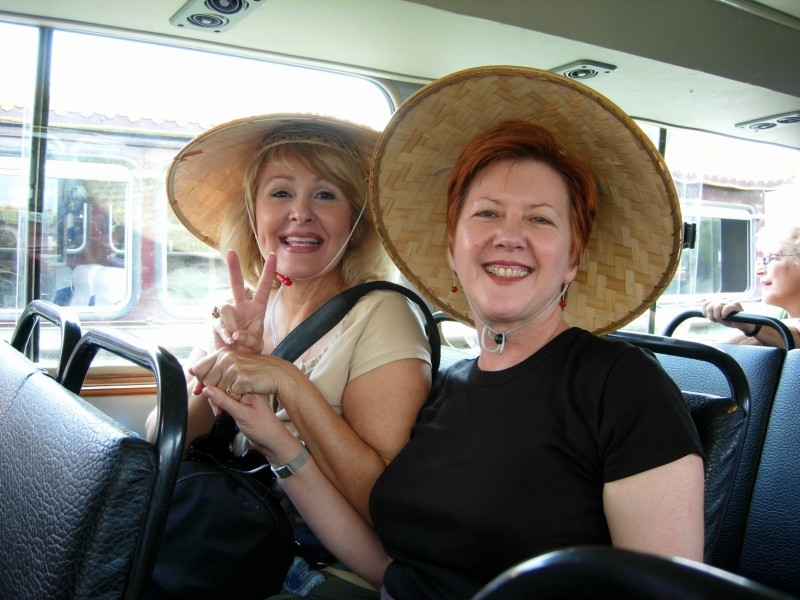
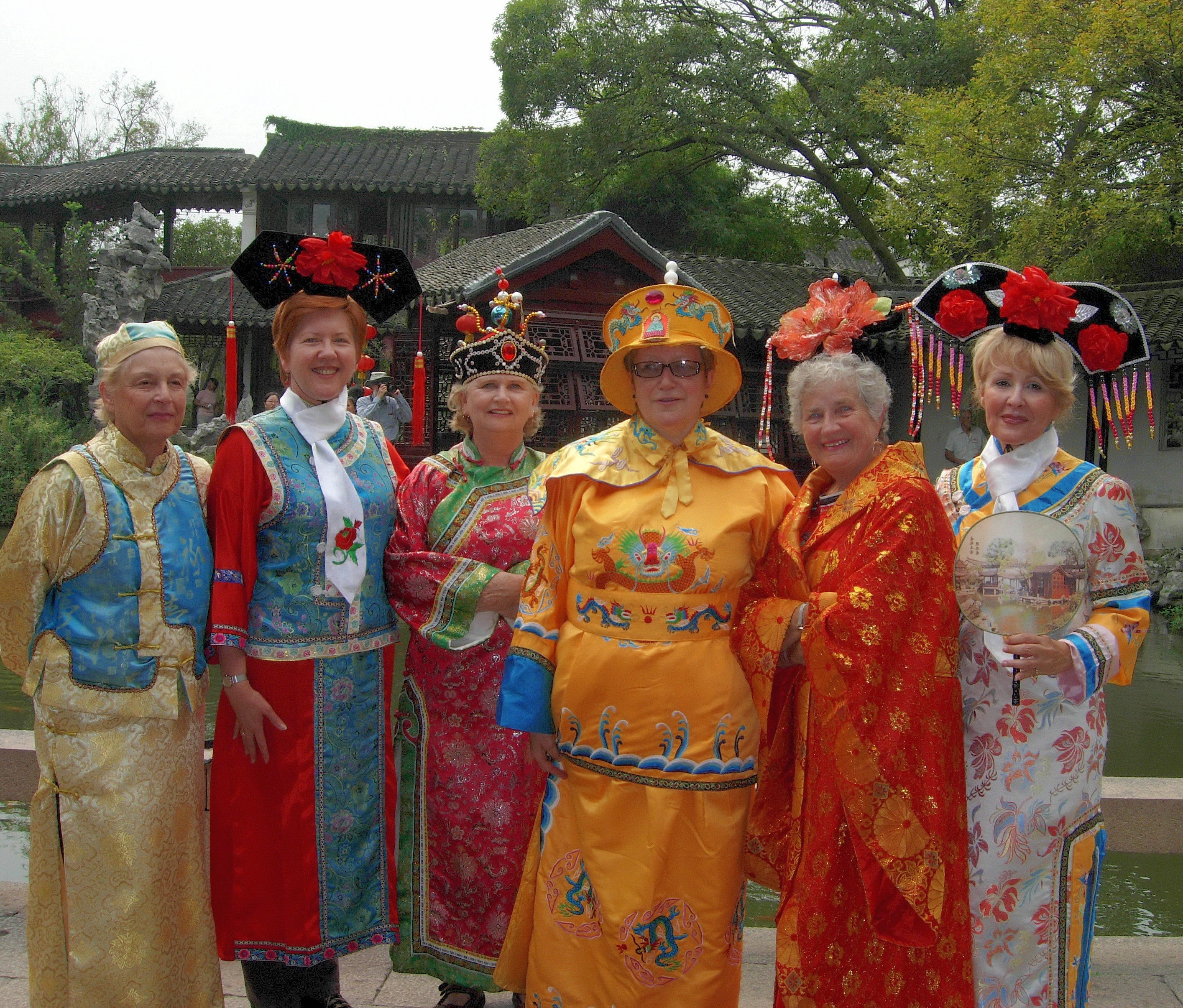
Her cards, along with other greetings in emails and on Facebook remind me of the  other great folks I’ve met on tours, particularly on my most recent to China.  For example, lawyer Howard Stern (yes, he’s been mistaken for the radio personality) provided me with many insights into practicing law in the northeast; while his wife Sandy told of her time working in the Justice Department under Robert F. Kennedy.  I felt an immediate kinship with Rosemary, a retired Michigan teacher, now living in Florida.  We bought bamboo hats in China and had such fun wearing them.  There are the Rapps from Des Moines, and Bunny and Fran from the state of Washington.  Meeting these lovely people from my own country is one of the delicious paradoxes and special benefits of my foreign travels.

My friend Mike and I have often discussed my preference for organized tours, which is 180 degrees opposite of his travel style.  Accompanied by his wife, Terri, they enjoy the Rick Steves-type of travel, managing their own trip, finding good deals on the internet, and enjoying the adventure of discovering good places to eat on their own.

But not all of us are so adept or have the time to plan.  And aside from meeting people you would never encounter on your own, there are other advantages:

1) More bang for the buck.  You can see and do more on a tour because they’ve worked out all the kinks, knowing the best travel routes, the closing times, not to mention, the language and the local customs.   They also provide you with better accommodations and other features because they are regular customers that can negotiate better deals than individuals.
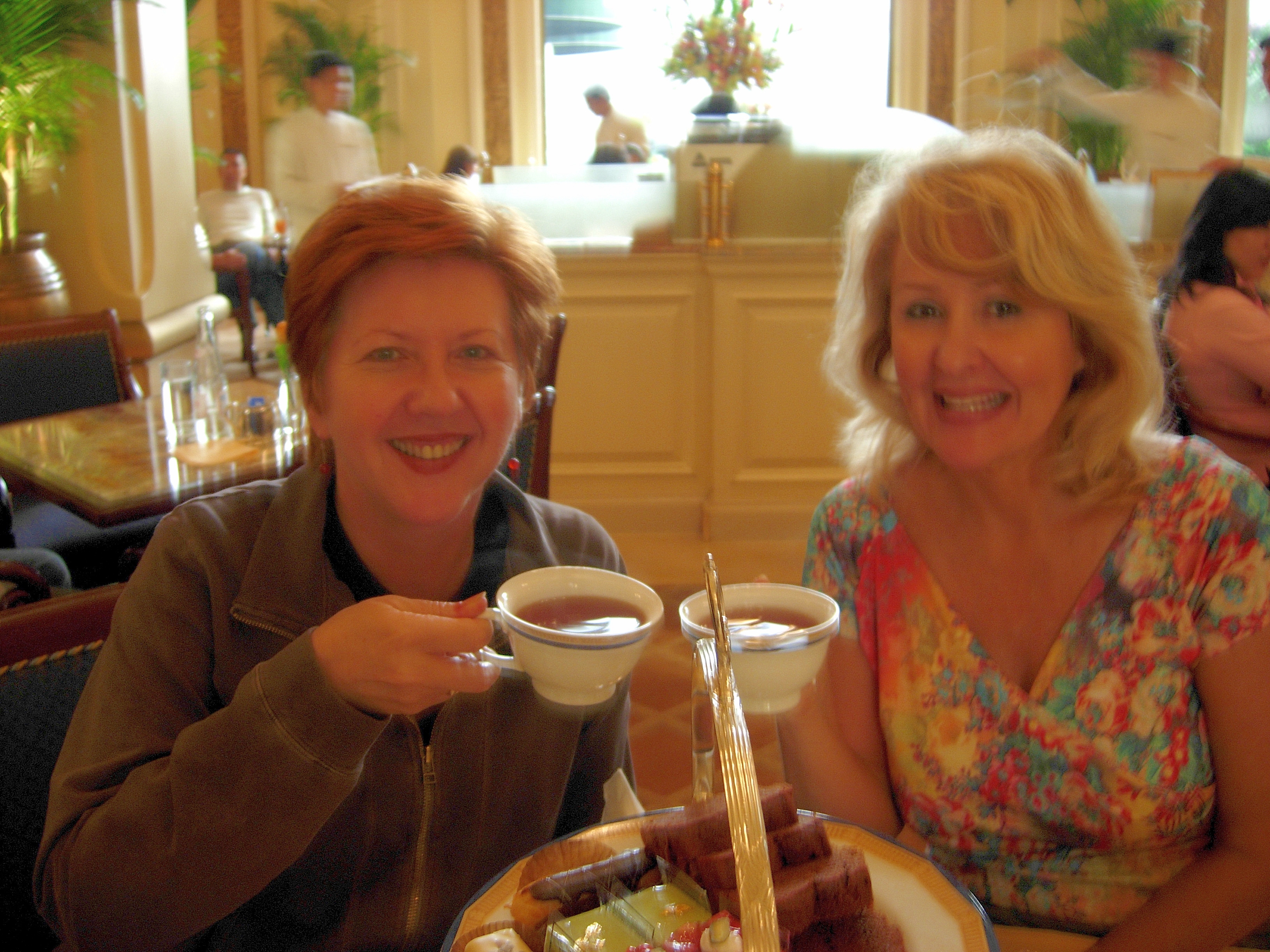
2) Team spirit.  Among other aspects of being in a group, it’s nice to have bathroom buddies from whom you can gather intel about the style of toilets, for example, (Western or squat) and the availability of toilet paper.  Someone always has Kleenex or handi-wipes when you’ve run out.  And I like having gals to shop with.  You may be looking all over for thimbles to bring back to Aunt Edna for her collection.  Another team member will be the one to find them for you.  And who would you dress up with, folks?  And what fun to have a friend go with you to have high tea at the Peninsula when your traveling companion isn’t interested.
3)  Less risk.   You don’t have to worry about whether the pictures of the hotel on the internet were  misleading.  Tour companies have reputations to maintain, so they don’t dare park you in a cockroach-infested dump.  Also, as noted above, you don’t waste time getting lost, asking for directions in broken Mandarin (if you aren’t Jon Huntsman).   While great discoveries can be made while lost in a strange city, it can also be frustrating, tiring, and dispiriting.
4) No need to study.  When I book a trip, I sincerely believe I’ll have time to do the trip research.  About the time I buy the guidebook and start googling, however, something at the office will blow up and I will have to work like a madwoman up until the day I depart, having barely enough time to grab the guidebook and pack my suitcase.  In the end, however, it doesn’t matter: the company has figured it all out for me.   I’ll just be a little less informed.
5) Tour directors.  As sources of information, these people are better than books because you get to ask questions.  Foreign tour directors are professionals:   highly educated and very knowledgeable about their material.  I’ll never forget motoring through the UK as Peter regaled us with stories of the English kings and queens, speaking as if he had known them (and their bedrooms) personally.

To be fair to Mike, I will admit to the big downside:  Days on a tour are fuller and more tiring than the go-alone travel.  While on tour, you’re out of bed, breakfasted (usually sumptuously), and seated on a bus by 8:00 or 8:30 a.m.  Often, I’ve wished to sleep late or dawdle over morning coffee, but I can do that in Austin.   I remind myself that I’m on a mission to see the world, not the sheets.

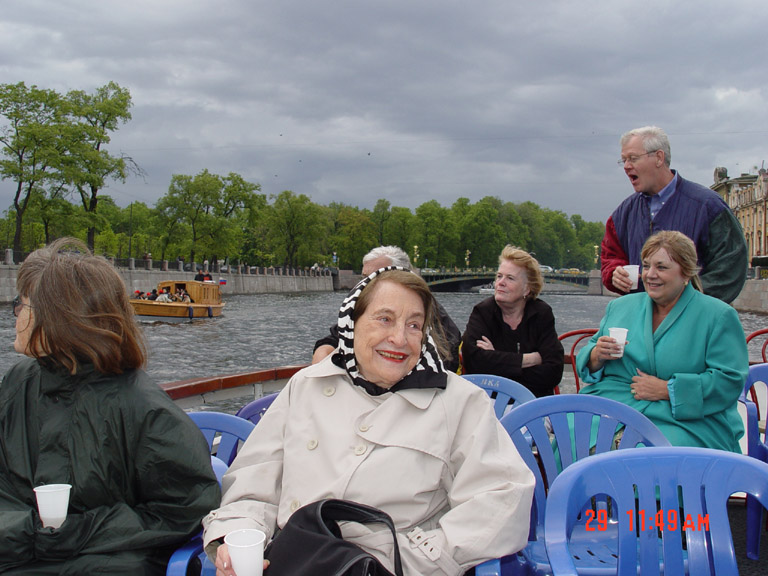
And there’s nothing sweeter than Rena’s annual holiday card.  I’ll remember drinking vodka on a St. Petersburg canal cruise, talking politics in the shadow of the  Kremlin, and making a new friend who generously gave me a peek into her interesting world as we explored another one, foreign to us both.  I always open her card and muse a bit how this single holiday greeting can make this big world with all its wonders seem a little bit smaller.

Posted in Uncategorized | Tagged , , , | 4 Comments

The Proof is in the Pudding

Food goes hand in hand, or hand to mouth, with the holidays.  In our family, we generally choose the traditional holiday fare, coming together for Thanksgiving at my Uncle Bob’s and Aunt Jerilyn’s house to eat turkey, her inimitable cornbread dressing, and real giblet gravy.  The rest of us bring all the other traditional meal components – a baked ham, sweet potatoes, mashed potatoes, green beans, broccoli/rice casserole, fruit salad, green salad, etc.

For Christmas, we’ve occasionally gone “alternative,” but invariably, we return to the traditional fare (a repeat of Thanksgiving) for the next Christmas.  It’s our comfort food, I believe, because Christmas can get so complicated, it’s a relief not to have to think much about at least one element of the holiday.

Also, it’s comforting how the traditional fare, with its tastes and smells of holidays past, summon the memory and spirit of the women cooks in our clan, long deceased, who used to cook these same dishes.  My grandmother, Madeline, in particular, is the one who taught my aunt to cook, and they both taught me (with minimal input from my mother who hated to cook).  My aunt has been my main resource for the last 20 years or so on culinary issues, as she owns a prodigious number of cook books and seems to have a personal relationship with Martha Stewart and Rachel Ray.

And now she is passing her expertise on to an even younger generation.  This Christmas was significant because my nieces took over preparation of the turkey and dressing with my aunt’s supervision.  In years to come, whenever they prepare these for us and/or their own families, they will no doubt think solely of her, having never met Grandmother, of course.

But they need to thank my grandmother (their great-grandmother) for my own year-end, year-out contribution to the Thanksgiving and Christmas dinners:  one of her desserts, which she called “Angel Delight.”  She didn’t start making it until after she relocated to Round Rock from Dallas after retirement.  When I asked her for the recipe, she wrote it out on a piece of paper, leading me to believe that she might have invented it.  After she died, I found it on page 185 of the 1978 edition of The Round Rock Official Good Eat’n and General Gourmet Cookbook, which was among her books.  Called “Four Layer Delight” in that book, the recipe calls for ½ cup more of flour than Grandmother called for in hers.  I assume she thought it was better with less.  She also tweaked the pudding layer.  Instead of 1 large package of chocolate pudding mix, she called for two small packages, one chocolate and the other vanilla, mixed together.

In the many years since her death, I took over the production of what many in the older generation informally call “Grandmother’s pudding dessert,” partly because it was so popular and partly to keep Grandmother with us during the festivities.  Its popularity has only grown among family newcomers and the kids that have grown up and passed on the pudding dessert craving in their DNA.   As the years go by, there’s little doubt that the dessert will be linked to me and referred to as (cousin, aunt) “Jeffee’s pudding dessert.”

Strangely enough, a few years ago, a colleague at the Attorney General’s office was raving about a dessert that was made for office parties by one of his division’s secretaries.  His description sounded eerily familiar, so I asked if he would ask her for the recipe.  He did and, sure enough, it was the Angel Delight, although she calls it “Chocolate Supreme Dessert.”  She makes it with the same amount of flour as my grandmother, but has innovated a bit by mixing some of the pudding from the pudding layer with the cool whip used for the top layer.  While Grandmother’s top layer was always white (hence, the angel name), her top is a muddy chocolate color.

So, after such ado about this pudding dessert, you will be glad to read that I’m providing it here for you, dear readers and family members.  I am calling it “Madeline’s Angel Delight,” but if you dare to make it and serve it at your own gathering, you are obviously free to call it by any of its other names or make up your own.  I say “dare” because you may be unwittingly starting a tradition and making the dessert for the rest of your cooking life.  You think I exaggerate, but I’ve often thought of the disappointed faces (or lynch mob) I’d face if I dared to make something different.  On the other hand, it’s nice to be appreciated.   So, without further ado:

Madeline’s Angel Delight

   1 cup flour
    1 stick margarine, softened
    1 cup chopped pecans
    1 8 oz. pkg. cream cheese, softened
    1 cup powdered sugar
    1 8 oz carton cool whip
    2 small pkgs of instant pudding (1 chocolate, 1 vanilla)
    3 cups milk

    Mix together first 3 ingredients and press into bottom of 9 x 13 inch pan. Bake at 300 degrees for 15 to 25 minutes til lightly brown around edges. Cool before spreading next layer.

    Mix cream cheese and sugar; fold in 1 cup of the cool whip. Spread carefully over crust (which will pull up if you over-manipulate it as you spread).

    Mix the vanilla and chocolate pudding mixes with 3 cups milk (instead of the 4 cups on box instructions).  Spread pudding over cream cheese layer.   

    Spread remaining cool whip over pudding layer.  Refrigerate well.

I will note for those of you who are not wed to a family chocolate tradition, that butterscotch, lemon, or vanilla pudding can be substituted for the chocolate, according to the office secretary.  She has also been known to sprinkle the top layer with chopped pecans or crushed peppermint, and recommends freezing the dessert overnight and removing it to the refrigerator several hours before serving.

Just remember, you have been forewarned.  Here’s wishing you a bon appetit and a happy and healthy 2012!

Posted in Uncategorized, Women | Tagged , , | 4 Comments

We Don’t Need No Stinkin’ Peter Pan

Unlike our more youthful co-travelers on the road of life, those of us of the mature persuasion tend to think more about our days being numbered.  We begin accumulating numbers that serve to focus our attention on this fact, such as blood pressure readings, cholesterol counts, years between colonoscopies, and other figures that can spell our doom.  Youth’s birthday glee and/or ambivalence gives way to aversion and unease.

For instance, I even admit to a twinge of angst earlier this month when I celebrated my younger son’s last year as a twenty-something.  Maybe part of that twinge was financial angst because the celebration involved my going to NYC and celebrating in appropriate NYC style (including a personal trip to my favorite number “21,” namely “Century 21,” the discount department store).   But there was the  growing acknowledgment that after this birthday, I would have to accept that Dax, my baby, is an adult.  (You might quibble with age 30 as the onset of adulthood, but I think I’m right.)   How can I have two thirty-something children?

And in October, there was our 40th High School Reunion, during which the big topic of conversation was a shared amazement of our impending 60th birthdays.  I kept hearing my classmates voice their surprise.   “Can you believe this is happening to us?”  As if growing up with a 1960s soundtrack of Beatles and Dylan gave us some kind of immunity against old age!?  Who knew we really believed in Peter Pan?

At some point, it occurs to me, we might enjoy life more if we quit thinking about chronology and concentrated on quality and the types of experiences we can have now, largely because we have this rich (and long) past to draw on.  In short, can we have both quality and quantity?

An example that came to mind was the reunion again.  Despite (or maybe as a result of) our dread about the number 60, there was something unique about this 40th Reunion, like a sense of liberation, perhaps.  At first, I thought it was just my own perception, but I began to get notes and comments  from fellow classmates, explaining that they had felt something similar.  One classmate summed it up like this: “At past reunions . . . it seemed that the barriers that kept many of us separated during school days, were still in place. At this reunion, the barriers have largely fallen away. I really enjoyed myself for the first time at a reunion and look forward to future ones.”  Did we have to wait 40 years in order to really appreciate our shared history and humanity free of the artificial barriers?  Maybe.  Was it worth it?  My vote: yes.

But my reveries in quality over chronology really found inspiration from my first cousin once-removed, Campbell Geeslin, a charming widower who still mows his grass in White Plains, NY.  I never met Campbell, now in his late 80s, but I had often heard of him from my mother and other relatives who were more his contemporaries.  His mother, Lee, was one of my grandfather’s six sisters.  She and her husband, Edward, raised Campbell and his four brothers in Brady, Texas.

But, after serving in WWII, Campbell had little appetite for more West Texas or small towns, locating in NYC, the biggest city he could find, to finish his college degree.  After graduating from Columbia, he pursued a career in journalism (writing and editing), beginning in Houston (Houston Post), then Florida (precursor of USA Today), and finally, returning to NYC where he worked on the editorial staff of This Week, People, and Life magazines.  He wrote the 1981 book, The Bonner Boys, a fictionalized version of five grown men who, reflecting on their shared childhood and the different directions taken, come to together for probably the last reunion with their mother.

But after retirement, Campbell didn’t just sit around or tend his garden.  He began writing   children’s books with settings in the Mexico he remembered from childhood vacations.  Capturing that child’s sense of fantasy, his stories are flavored with ingredients of magical realism and playfulness.  The book How Nanita Learned to Make Flan – about magic shoes – was made into a children’s opera, and Elena’s Serenade – about a young girl who wants to be a glass blower like her father – has been optioned for a children’s movie.

We had sporadically corresponded, but given the distance between Austin and White Plains, I never really thought I’d ever meet him in person.  But in planning my son’s birthday visit, I learned that White Plains is a mere 30 minutes by train from Grand Central station.  And, as fate would have it, he was happy to host a visit from me, my son and his girlfriend, Tacie, at which he would serve lunch.   Even better, he arranged a visit from another unmet cousin , Diane DeSanders, another writer, who lives in Brooklyn.  The granddaughter of my great Aunt Jeffee and namesake (one of the 6 sisters), she, too, was on my wish list of family to meet.

I will not bore you with the details of the table Campbell set, the excellent food he served, or all the family talk.  I will tell you, however, that the five of us – over 60 years between the oldest and youngest – gathered around that table for about 4 hours, drinking wine and eating, while we talked of books, movies, our careers, music, writing, working with and for the rich and famous, and life in general.  We eventually had to get up and leave, but only because it was getting late.  As Tacie wrote to me later:  I’ve reflected on that afternoon a number of times – thinking about how unique a situation it was to have us all at the table, with our different backgrounds and life experiences, and how easy and comfortable it was sharing our stories with each other while jumping seamlessly from topic to topic. I can honestly say I’ve never really been in a situation like that before but it was one I hope to be in again!

When Campbell drove us back to the train station, I, like Tacie,  knew something remarkable had taken place that afternoon.  No doubt a large part lies in being in the company of someone who has lived a long and interesting life.  But he has more than memories.  Campbell still writes a quarterly column for the Author’s Guild, reads the latest new books, has meetings with movie producers (and distant cousins), and in short, is actively involved with the world.   Even as I wrote this, he was cooking cornbread for his Texas-style dressing and readying the Thanksgiving turkey for his family’s gathering.  I have no doubt his family loves the tradition.

For this, my 50th blog entry I wanted to share something special and inspiring, never thinking I’d find it at the end of a half hour train ride from NYC’s Grand Central Station.  There, I found a living example that there doesn’t have to be a trade-off between quantity and quality, i.e., that one can survive to see a ripe old age even while experiencing the full ripeness of being.   And isn’t it nice to know that even while our own books get closer to the end, we can still count on some grand chapters?

Posted in Uncategorized | Tagged , , , | 4 Comments

The Annual Feast for Minds and Souls

The spoken words of authors who appeared at the recently concluded Texas Book Festival are still ringing in my ears, especially as I start reading their books.  My favorite of Austin’s perennial events, the festival — held at the State Capitol — is notable as one of the few events that doesn’t involve sacrificing your hearing to ear-splitting music or risking shin splints by running on concrete.  Not that the event is devoid of music – there’s a tent on the Capitol grounds where you can hear a steady stream of musicians, none of whom bother touting any literary endeavors.  (It must be an unwritten city rule that wherever two guitar pickers can find an audience, a stage must be provided.)   But the festival is an absolute feast for those with a literary bone or two in their bodies.  It’s where we get to hear the author’s speak about their books, their inspirations, and the spirit that motivates them to sit down and put that pen to paper.  On my plate at this feast of plenty, were the following authors whose insights are worth sharing:

Bob Edwards is the man with the mellifluous voice who woke me every weekday morning for about 20 years, until he was summarily fired from his Morning Edition hosting job on National Public Radio (NPR).  That voice now comes out of satellite’s SiriusXM Radio, in which I’ve failed to invest yet.  His book fair appearance, however, allowed me to reunite with that voice as he discussed his memoir, Voice in the Box.  Bob explained to the crowd in the Senate chamber that the title refers to the big Zenith radio in his childhood living room (which he still owns) and his fascination with the box from his time as toddler, longing soon thereafter to have his voice be one in the box.  He traced his career from the childhood dream to the dream job of hosting NPR’s Morning Edition for 20 years.  Asked about favorite folks to interview, he identified creative people.  His least favorite are politicians because they have an agenda and it doesn’t matter what question they are asked, they only want to further that agenda in their answer.  Most interesting to me was his rebuke of NPR for trying to run from the “liberal” label.   The result of this a misguided attempt to balance the factual truth with those who would dispute the truth.   Balance is not achieved, he explained, when you counter the truth as it is known to be with the untrue.  All you do is lose  your integrity and credentials as serious journalists.   On this riff he concluded, “Unless NPR starts broadcasting Rush Limbaugh or Glenn Beck, the network will be labeled liberal no matter what they do!”   They should give it up, he said.  The audience heartily applauded in agreement.

Another public radio personality, Lynne Rossetto Kasper was just as fun in person as she is on her show, The Splendid Table, discussing her new book, How to Eat Weekends.  While preparing a few of its recipes, she kept the audience engaged with countless tips about knives, ginger graters, her preference for Kikkoman soy sauce, cutting scallions and carrots diagonally to get more flavor, and real new one for me:  heating up spices for salad dressings with a little oil in the microwave to make the flavor explode.  She also recounted the inauspicious beginnings of her radio show, some 17 years ago.  It started largely as a call-in show and judging on the number of calls, it seemed like no one was listening.  Persevering, Lynne’s family and friends would call in under various pseudonyms,  altering their voices and home town.   She recalls when she got her first “real” caller, she was so excited that she kept the woman on the line for 10 minutes, peppering her with questions not necessarily related to the caller’s questions.   For instance, “Let me ask you, caller, what’s in your refrigerator now?”   Fortunately, Lynne now has plenty of callers and a growing audience of fans!

In talking about his new book, Lost Memory of Skin, Russell Banks raised some of the most important issues facing our lives in the 21st century.  The protagonist in the book is a young man, 23 years old, who has served time for some kind of sexual crime and is now designated as a sexual predator, monitored by  a GPS anklet and having his picture, name, and address plastered on the internet.  He lives under a bridge in a colony of other societal pariahs (which is based on an actual colony in Miami).  The title of the book is based on Banks’ observation that we are becoming increasingly digitized as our contacts with other human beings give way to another kind of contact via the internet, computer games, and on-line pornography.   He is also troubled by how we, as a culture, have allowed Madison Avenue to define women as sexual objects, in ways that those of us who grew up in the women’s liberation movement could never have imagined.   The advertising industry uses sexual images, including sexually suggestive images of children, to sell products.   Grown women are often dressed up as little girls, while little girls are vamped up to look like grown women.   Banks seemed to be asking, “Why are we surprised when the “sexually sick” lose track of the difference?”  And why are they punished while the real perpetrators are rewarded?  And why is it considered to punish an individual with a permanent branding after he has served his prison sentence?  All good questions.

Photographer Michael O’Brien spoke about his book, Hard Ground, which I  wrote about in my prior entry, and explained that this book of photographs of the homeless had its origins when the charity Mobile Loaves and Fishes asked him to take some pictures for a brochure.  He went to a church service in East Austin attended by many of the homeless to photograph them after the service.  O’Brien began attended these services regularly and taking even more pictures of those individuals who wanted to sit for him.  Cooperation was crucial, because the big-frame camera he used with its old-fashioned black hood, required the subject to remain perfectly still for about 15 seconds.  Unlike the multiple snaps photographers can capture  with digital cameras these days, he only took 1 or 2 pictures of each person because the Polaroid film was expensive, each shot costing $6 or $7.   As for the Tom Waits’ poetry serving as interludes between the photographs in the book,  O’Brien had actually asked him to write a single poem to introduce the book.  When Tom finally sent over his “poem,” O’Brien was surprised to find 23 poems.  When O’Brien told him that he had not expected such largesse, Waits quipped, “I wrote one, then another one . . . put them in a room and they had babies!”

Few people knew that Molly Ivins, one of Texas’ most vocal civil libertarians, was a great cook.  Ellen Sweets’ memoir of her friendship and kitchen time with Molly Ivins, Stirring it Up with Molly, reveals a side of the woman that many of us never knew.   Ellen, a news reporter and feature writer, explained that shortly after moving to Texas, she attended an ACLU meeting in Dallas.   The first person she saw was Molly standing outside the meeting room, and determined to meet people, Ellen extended her hand, saying “Hi, I’m Ellen Sweets.  I’m new to town and don’t know a soul.”  From that simple beginning, a fast friendship formed that lasted until the end of Molly’s life.   She recounts that Molly was a really good cook and while she loved chili and Southern food, she would add to her repertoire and hone her cooking skills on trips to France.  Food was also important to Molly because she believed in the fellowship and good conversation that sharing food with friends would generate.  Ellen described Molly’s beautiful big round table that would seat 8, “or 10 if you didn’t have intimacy issues,” a table large enough to engender many great discussions.   As for restaurants, Ellen told stories of Molly liking to eat at Magnolia Café because she thought the wait staff didn’t know who she was, only to learn that they secretly fought over who would wait on her.  Eschewing chain restaurants, she had her own table at Austin Land and Cattle and absolutely loved Jeffrey’s where her favorite waiter, Johnny, took great care of her.  At this, Ellen was surprised when the real Johnny waved at her from the audience.  It was especially poignant to hear Ellen talk about Molly’s final days when she could not eat much beyond chicken soup, but it is the years of laughter Ellen remembers best and memorializes in her book.   Along with stirring up many pots of gumbo!!

Thanks to all the authors who feed our souls and sustain our minds with their words and pictures.  What a shame I have to wait a whole year before this next celebration of books!

Posted in Uncategorized | Tagged , , , , , | Leave a comment

Testaments to Invisible Lives

As the unremitting heat of this past summer is about to remit, I’m seeing more and more of Austin’s street people out and about.  During this endless and hellacious summer, I had noted their absence downtown and hoped that they were staying cool at shelters or  the City of Austin’s cooling stations.

Even while I pondered their well-being, I realized that – with the exception of Leslie – we Austinites recognize very few of these denizens of our streets, referencing them as part of a collective category of “homeless” and/or “street people.”  The individual members remain largely faceless and certainly nameless.

In earlier days, particularly in the 1960s and -70s, many of us recognized Bicycle Annie, also called the Indian Princess, wearing braided hair and pieces of native American clothing.  Her trademark, the basketed bicycle she rode along the streets, was the reason for her other sobriquet, Bicycle Annie.

As I’ve noted in earlier postings, many of us didn’t know her real name was Zelma O’Riley and that she authored a publication called Up and Down the Drag in the 1940s while she was a University of Texas student.  We also didn’t know that she believed herself to be presidential material, writing in 1947, “It will take a woman to save America.”  Her principal campaign plank was “preparedness” and the slogan she published read “Vote for Zelma O’Riley for First Woman President of the United States –  she is Irish, she is Indian and she will care for you.”

While these are the barest outlines of a life, I’d like to think that knowing about Zelma and her history gives us some insight regarding our shared humanity with the others who roam our streets.  It was with great interest, therefore, that I read the article in September’s Texas Observer about the new book, “Hard Ground,” a collection of photographs of Austin’s homeless.  This is the work of photographer Michael O’Brien, who at an unsettled crossroads in his own professional life, started going to the Mission: Possible! Community Center in East Austin every Tuesday for three years to photograph and document the stories of individuals who live on Austin’s streets and various shelters.

What struck me the most was his notion of giving something to each person he photographed, specifically a copy of the photo.  In common parlance, of course, we say that a photo is “taken” and generally, nothing is exchanged for this taking.  But in this case, O’Brien used a type of Polaroid film that permitted him to give his subjects a print, while he maintained the negative.  This reminded me of the old Native American belief that a person’s soul was stolen in the photographic process.  Perhaps the gift of the print could symbolize the return of that soul.

But, more essentially, O’Brien describes the print as a testament to a life.  Consider how  we take photographic documentation of our own lives completely for granted.   While we can find our faces in countless photographs from phones, digital cameras, scrapbooks, and social media sites, it is surely a rarity for most of the wandering homeless to have visual evidence that testifies to their presence on this earth.

Pairing these photographs with poetry by musician Tom Waits, O’Brien has produced a very special book of diminished lives that he has accorded the respect and dignity that all of us, as human beings, deserve.  For O’Brien, personally, his achievement is equally meaningful.  He tells the story of how he had been floundering, often unemployed due to changes that had rocked the photojournalism industry, but over the three years he photographed the homeless, he regained his balance and place, rediscovering.   As you contemplate the images on the pages of this book, you become aware that O’Brien – in dignifying the lives of the pictured individuals – has also dignified his own.

Posted in Old/New Austin | Tagged , , , | Leave a comment

The Inescapable Shades of Gray

Human beings are purposeful animals.  We decide to do something, set a goal, put something in motion.  The funny thing about life, though, is that what we do doesn’t always work out as intended . . . we get blindsided by something we didn’t see coming.  Did we skip over the chapter with the foreshadowing?  Or forget that we rationalized it away like all boogie monsters?

Lately, I’ve been struck by these unintended consequences, primarily by our desires and actions to live a long life, the longer the better.  We take decided action not to step in front of moving vehicles or eat cheesecake in order disprove the actuarial tables.  But achieving longevity doesn’t always turn out that well for us.

Exemplifying this point, “Theories of the Sun” is a play I saw in Chicago last year about a woman who was seeking a cure for a disease that kept her from aging and ultimately dying.  In this twist on the Benjamin Button scenario, Elizabeth Sweeney quit aging in her early 20s and now her daughter is a middle-aged woman who, based on appearances, could be her own mother.  The play centers on her desire to be cured to avoid outliving her daughter.  It’s against the nature of things, she reasons, that a mother would have to bury her own aged daughter.

In an obituary last week, I read that Ruby Lee Duff Cook had blown past the life expectancy figures, staying firmly in this world until the age of 103.  I noticed with admiration that in her younger days she was “addicted to energetic activities.  If these activities involved sweating, so much the better.”  She and her husband were enthusiastic square dancers, while she also kept a pony and loved horseback riding.  Ruby took up golf in her 60s, danced ballroom at the Austin Rec Center until her early 90s, and was particularly happy to work in the yard raking leaves, picking up limbs, and collecting pecans.   All of this sounded like a woman happy in her activity and longevity, and then I read the disquieting parts:  “Ruby remained active in her Sunday School class until all the other members of her class died.”  The obit further reported that “Preceding her in death are (certainly not surprisingly) her parents, all her siblings . . . her husband of 51 years, Elmo V. Cook,  Elmo’s parents, Elmo’s siblings . . . and her older daughter.”

In short, there are real downsides to longevity, particularly when you are the long-lived one, the person left behind to mourn all your loved ones.

Another thing I wouldn’t have expected were some unsettled feelings in the aftermath of my 40th high school reunion early this month.  I was prepared to look back on the weekend and enjoy all the good feelings I normally experience after reunions  (which some of my readers will remember are near and dear to my heart).  But, curiously, I was uneasy.  What’s up with that? I wondered.    Being one of the organizers, maybe I was having a bit of postpartum planning depression now that the big push to beget the event was over.  And then I read what David, one of my classmates, wrote in a thank-you note that clarified that feeling for me.  He said:

“It always seems like unfinished business at the conclusion of these reunions.  The conversation that you didn’t get to finish, the person across the room that you never got to approach, the expectation to run into someone the next night and it doesn’t happen and in fact, at this stage of the game, may never happen.  For whatever reason, the lack of closure this year is a little more disquieting . . . ”

Yes, that’s the truth . . . the unfinished business that may never be addressed.  I once heard it said, that after the 40th high school reunion, the number of reunion attendees begins diminishing rather quickly.  I had managed to forget that niggling statistic until David’s words.

Steve Jobs’ death last week and the words he left behind were further reminders of the nature of things.  As his contributions to our world have been circling the planet via internet, I heard a commencement speech he had given at Stanford in 2005, which had a special resonance for me.    There he said: “Death is the destination we all share.  No one has ever escaped it.  And that is as it should be, because Death is very likely the single best invention of Life.  It is Life’s change agent.  It clears out the old to make way for the new.”

But before I could even think of resuming my post-partum reunion funk, he offered up some advice in that speech that inspired me with its ageless wisdom:  “Your time is limited, so don’t waste it living someone else’s life.  Don’t be trapped by dogma —which is living with the results of other people’s thinking.  Don’t let the noise of others’ opinions drown out your own inner voice.  And most important, have the courage to follow your heart and intuition.”  He makes a strong case for not wasting time worrying about longevity.  By his words and, more importantly, his example, Steve Jobs taught us a lot about carpe diem.

Yes, living a long life is a good thing, and getting old and being replaceable is not so good.  But there is little we can do to avoid the “not so good” part of life and a lot we can do to enjoy the good part.   The best approach may be to embrace the ambivalence and try to find some humor, whenever you can.  Which reminds me of something I heard Garrison Keilor say recently on Prairie Home Companion in the voice of American patriot Nathan Hale, “Give me ambivalence, or give me something else!”  

So, how about some cheesecake, friends?!

Posted in Uncategorized | Tagged , , , | 5 Comments